What is an AI agent, and what is not one?
An AI agent is software that gives a language model a goal, lets it choose its own next action, run tools, read the result and go again until the job is done. A chatbot answering the question you just typed is not an agent, and neither is a script that follows fixed steps.
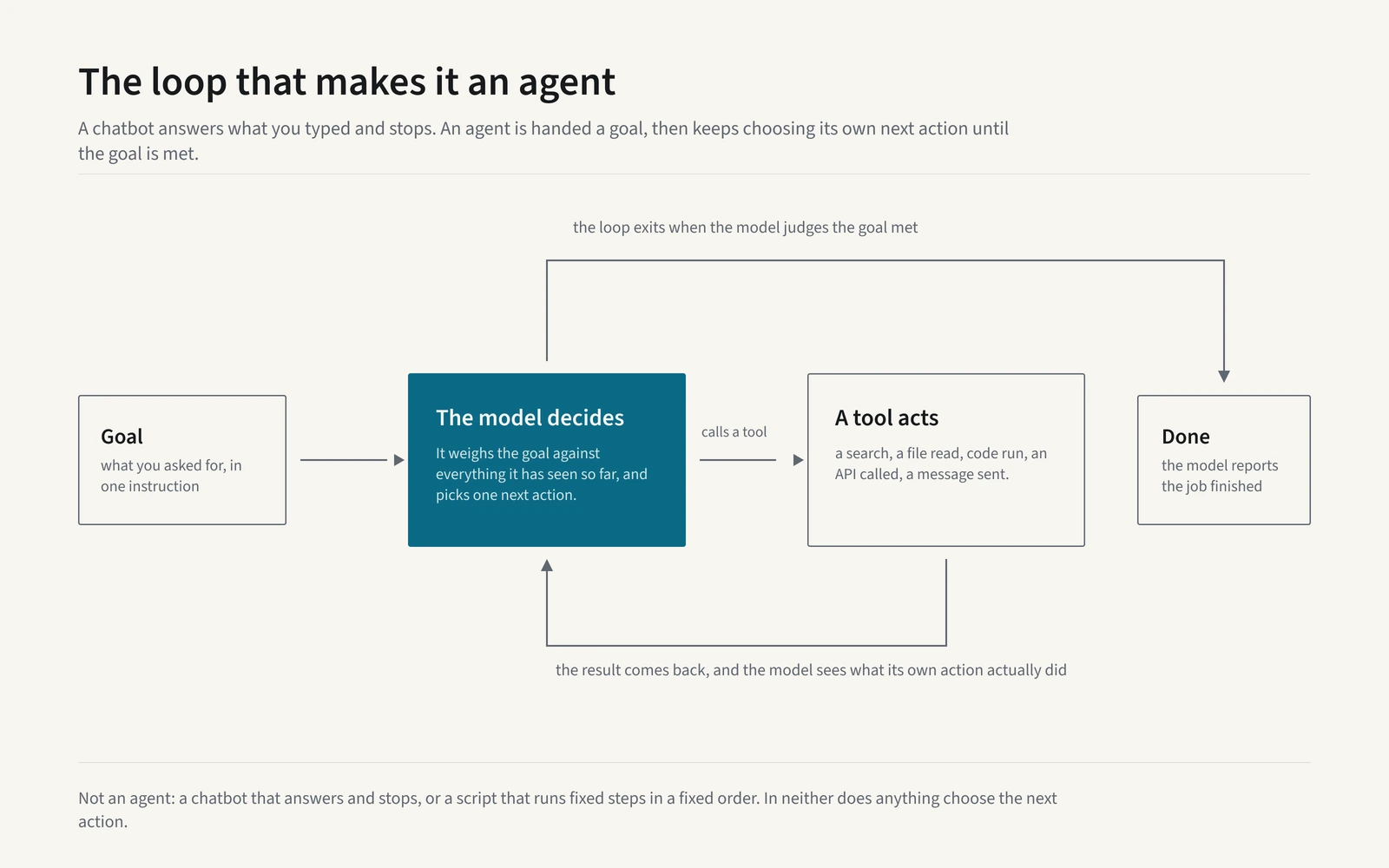
Read the full description of this diagram
Four labelled boxes in a row. A goal enters at the left and an arrow leads to the model, which decides what to do next. An arrow marked "calls a tool" leads on to a tool that acts, and a lower arrow carries the result back into the model. A separate arrow leaves the model for a box marked Done.
“Agent” is the word every AI company now attaches to its most expensive products, and it is doing a lot of work. The good news is that the vendors themselves publish precise definitions in their developer documentation, and those definitions mostly agree. This guide explains the term from those pages alone, so you can tell a real agent from a chat window with a new label.
Two terms first. A model is the engine that reads text and writes text back, the thing behind ChatGPT, Claude and Gemini. A tool is anything outside the model that software lets it use: a web search, a calculator, a file, a browser, your calendar.
The loop that makes it an agent
An agent is a model put inside a loop. You hand it a goal rather than a question. The model reads the goal and decides on an action. The software around it carries that action out, usually by running a tool. The result comes back to the model, which looks at it and decides the next action. The cycle repeats until the model judges the job finished, or gives up and tells you why.
That feedback step is the whole trick. A plain chatbot never sees the consequences of its own answer. An agent does, so it can notice that a search came back empty, try different wording, and carry on without you. OpenAI’s own agents guide defines them from the same angle: agents, it says, are applications that plan, call tools, collaborate across specialists, and keep enough state to complete multi step work. Every verb in that sentence belongs to the software rather than to you, and that is the load-bearing part: between your request and the finished job, the model is choosing the route.
The mechanics underneath are unglamorous. Google’s Gemini documentation calls the core mechanism function calling: the model does not run anything itself, it writes a short structured request naming the tool it wants and the inputs to give it, your software executes that request, and the output is pasted back into the conversation for the model to read. Every agent on the market is that exchange, repeated.
What is not an agent
A chatbot is not an agent. One question in, one answer out, then it waits. No goal survives between turns and nothing is acted on. This covers most everyday use of ChatGPT, Claude and Gemini.
A script is not an agent. Software that runs the same fixed procedure every time, however clever, contains no decision by a model. Anthropic’s engineering guide draws exactly this line: in its wording, workflows are systems where a model and its tools are orchestrated through predefined code paths, while agents are systems where the model dynamically directs its own processes and tool usage. Same ingredients, different chooser.
A single tool call is barely an agent. When a chatbot silently runs a web search before answering, the model did pick an action, but the loop ran once and stopped. Vendors themselves treat this as a feature of chat rather than an agent product. The label starts meaning something when the model plans across many actions and checks its own progress.
If you want a test to carry around: ask who decides what happens next. You, every turn: assistant. A programmer, in advance: script. The model, as it goes: agent.
What the vendors actually sell
The word appears at both counters. For developers, OpenAI sells agent building blocks in its API, Anthropic documents agent patterns for Claude, and Google exposes function calling in the Gemini API. These are kits: the vendor supplies the model and the loop, the buyer supplies the tools and the judgement.
For consumers the packaging is looser, and so is the evidence, so what follows is our reading rather than a definition of theirs. The pages quoted above are written for developers; how a subscription exposes the loop is a product decision the vendors describe in marketing rather than in documentation. What the dearer consumer tiers appear to sell is a longer licence to run that loop: an assistant that browses, fills in a form, runs code or works through a task list while you do something else. Part of what you pay for on those tiers, whose prices sit on our plans comparison, is that allowance, because every turn of the loop consumes tokens, the metered unit all of these companies bill by. It is also why a heavy user meets a limit sooner on an agent feature than in chat: one instruction becomes many model turns behind the scenes, and each of them is billed like any other.
What it means for you
First, read the permissions before the demo. An agent is exactly as consequential as the tools it holds. One that can only read the web can waste your time; one connected to your email, your files or a payment method can act wrongly at real cost. Vendors ship approval prompts for a reason, and switching them off is how a mistyped goal becomes a sent message.
Second, budget for the loop. Agent tasks burn through usage allowances far faster than chat, since one instruction can take many model turns. If an agent feature keeps stopping early on a cheap plan, the limit is usually the reason, and the honest fix is either shorter tasks or the tier above.
Third, treat the word itself as marketing until the loop is visible. If a product shows you the actions it took and the results it checked, it is an agent in the sense the vendors’ own documentation defines. If it just answers faster, it is a chatbot wearing this season’s label.
Questions people also ask
- Is ChatGPT an AI agent?
- The chat window is not: it waits for you, answers, and stops. OpenAI sells agent behaviour as separate features and developer tooling in which the model plans and uses tools across many steps; its own agents guide defines an agent as an application that plans, calls tools, collaborates across specialists, and keeps enough state to complete multi step work.
- What is the difference between an AI agent and an AI assistant?
- An assistant responds to you turn by turn and you steer every step. An agent is handed the goal and steers itself, deciding which tool to use and when the result is good enough. The dividing line is who chooses the next action.
- Are AI agents safe to use?
- They are as safe as the permissions you give them. An agent that can only read is low stakes. One that can send email, spend money or change files can do those things wrongly. Vendors ship confirmation prompts and scoped access for that reason; keep both switched on.
Where these numbers come from
Every figure on this page was read from the pages below on the dates shown, and nothing here is taken from another publisher's article. When a vendor changes a number on this page, the change is logged in what changed in AI and the page is corrected with a new date.
Published by Kawsar. How this site collects and checks data.