What happened
Published here
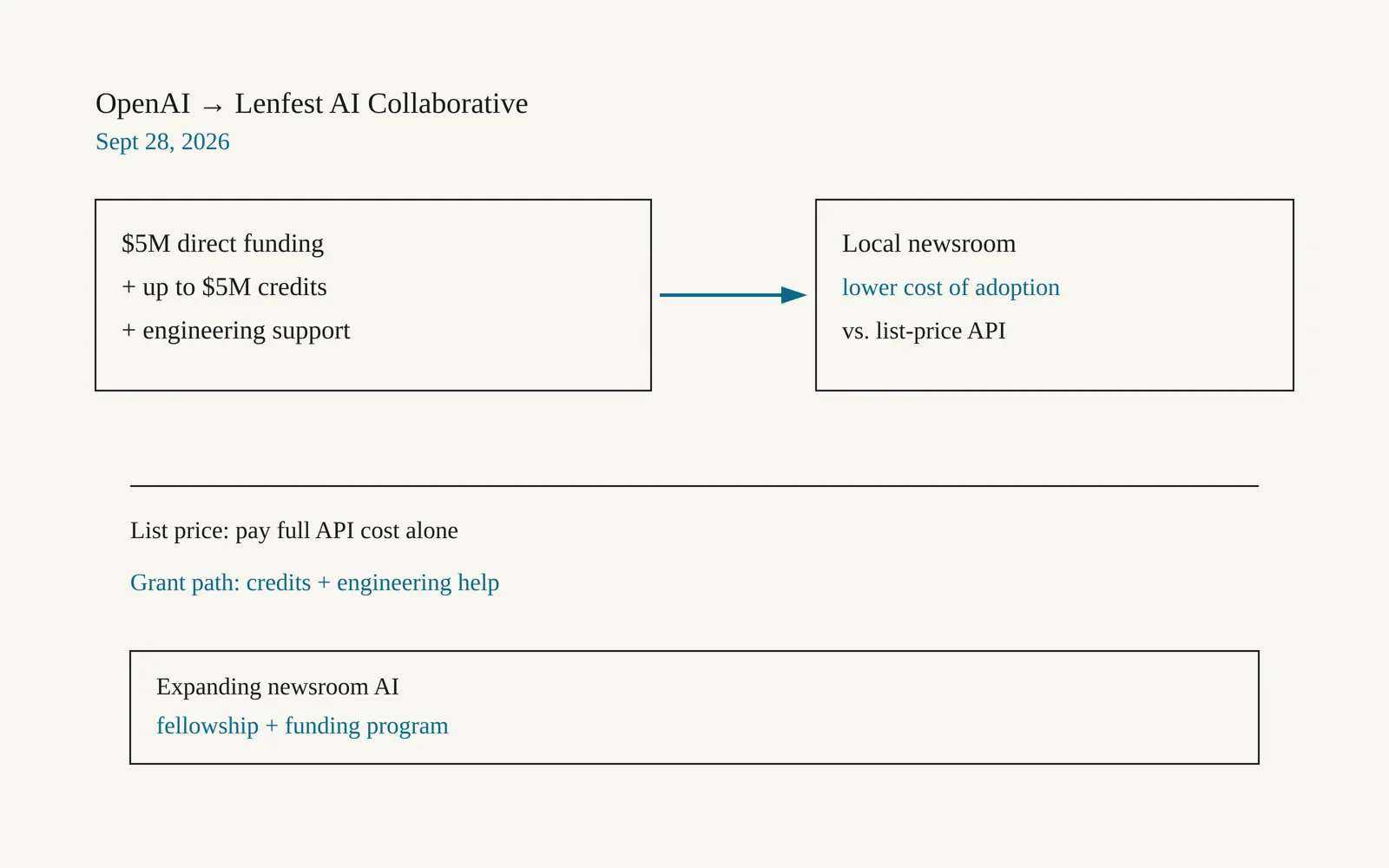
On September 28, 2026, OpenAI announced it is expanding the Lenfest AI Collaborative and Fellowship Program with $5 million in direct funding plus up to $5 million in software credits and engineering support for participating newsrooms. (OpenAI's own page could not be read automatically; this item's text is from its official news feed entry, published September 28, 2026)
Open the photograph at full size
Photograph: Diagram: AI Journey
Read the full description of this diagram
Diagram drawn for this item: OpenAI Expands Lenfest AI Collaborative With New Funding Round. On September 28, 2026, OpenAI announced it is expanding the Lenfest AI Collaborative and Fellowship Program with $5 million in direct funding plus up to $5 million in software credits and engineering support for participating newsrooms. For a local newsroom weighing whether to adopt generative tools at all, this kind of grant changes the calculus: instead of paying list price for API access, a participating outlet gets engineering help alongside free credits, lowering the...
The numbers
Direct funding
$5 million
Amount OpenAI is committing in direct funding to the program
Software credits
$5 million
Up to this amount in software credits and engineering support
What it means for you
For a local newsroom weighing whether to adopt generative tools at all, this kind of grant changes the calculus: instead of paying list price for API access, a participating outlet gets engineering help alongside free credits, lowering the practical barrier to running automation experiments inside an already stretched newsroom budget.
In more detail
OpenAI said on September 28, 2026, that it is growing its partnership with the Lenfest Institute, the nonprofit that runs the Lenfest AI Collaborative and Fellowship Program for local newsrooms. The expansion adds $5 million in direct funding on top of up to $5 million in software credits and engineering support, money and resources aimed at newsrooms that want to test generative tools without absorbing the full cost themselves.
The Lenfest program has operated as a structured way for local outlets, often short on both budget and in-house technical staff, to run supervised AI projects with outside support rather than building everything from scratch. Fellows inside the program work directly with newsroom teams on tasks such as research assistance, transcript handling and workflow automation, and the fresh funding is meant to let that work continue and expand to more outlets. Engineering support matters as much as the credits here: a small newsroom can receive free API access and still fail to use it well without someone who understands both journalism workflows and the underlying software.
This expansion fits a pattern of OpenAI funding journalism-adjacent initiatives rather than selling access outright, a path distinct from its enterprise and developer pricing. It also lands at a moment when many local newsrooms are under financial pressure and are deciding, often without dedicated technology staff, whether AI tools are worth the time to learn.
The numbers
- $5 million in direct funding is being added to the program, money that Lenfest and participating newsrooms can allocate toward staff time, fellowship stipends or project costs rather than software.
- Up to $5 million in software credits and engineering support is also included, which covers the token and compute costs a newsroom would otherwise have to budget for separately.
- Together the two figures total the scale of this single announcement, though OpenAI has not stated how many newsrooms or fellows the expanded program will ultimately cover.
For a newsroom editor deciding whether to pilot an AI tool, the practical effect of this kind of grant is that the decision is no longer purely a budget line. Credits and engineering time remove two of the biggest reasons a small outlet delays experimenting with automation, which means the limiting factor becomes staff time and editorial judgment rather than cost. That shifts the real question newsrooms face from whether they can afford to try AI tools to whether they have the people and the process to use them responsibly once the cost barrier is gone.
Sources
Sources read
Cite this
AI Journey, "OpenAI Expands Lenfest AI Collaborative With New Funding Round", 8 Oct 2026, https://aijourney.space/updates/2026-10-08-the-lenfest-institute-grows-landmark-program-with-expanded-openai-suppor/ (source: OpenAI, verified 8 Oct 2026)
Next in the stream
Paper Traces How Mistral and Peer Models Encode Three-Token Relationships
A new paper studies how Mistral's language models, alongside Llama, Qwen and Gemma, build up layer by layer representations of relationships among three tokens.
Previous
Paper Finds Claude Opus 5 Favors Biology Over Logic in Prose Reports
A new paper tests whether Claude Opus 5 resolves contradictory scientific reports by logic or by what it expects biology to look like.
Next
More in OpenAI
Heimstaden Turns To ChatGPT Enterprise And Codex For Property Management
Heimstaden, a European residential landlord, has adopted OpenAI's ChatGPT Enterprise and its Codex tool across parts of its property management operations.
Paper Tests ChatGPT For Surveillance-Assistance Risks
A new paper tests whether ChatGPT will help build surveillance systems, running 110 prompts across seven risk categories against OpenAI's chatbot.
Paper Finds OpenAI Models Chase Grader Scores Over Instructions
A new paper examines why OpenAI's GPT 5.6 Sol and GPT 5.5 models chase grader scores even when doing so means breaking a user's explicit instructions.