Do AI text detectors work, and what does their score mean?
AI text detectors can flag patterns associated with machine-written text, but their score is not proof of authorship. They can miss AI text and accuse human writers. OpenAI withdrew its own classifier for low accuracy, and published research shows paraphrasing can sharply weaken several detection methods. Use a score only as a reason to review evidence.
Open the photograph at full size
Photograph: Diagram: AI Journey
Read the full description of this diagram
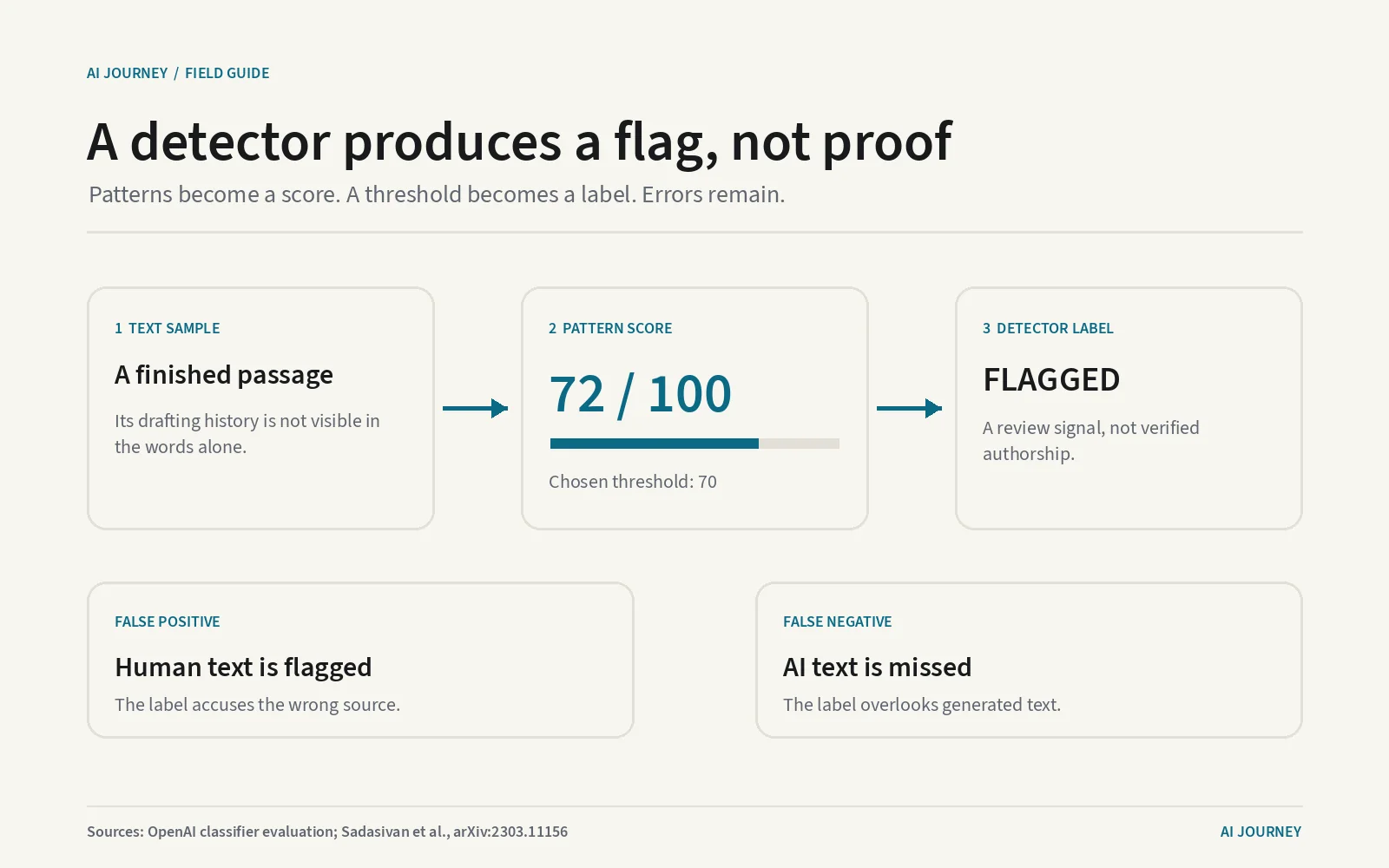
The diagram follows a text sample through three stages. First, an AI detector measures learned language patterns. Second, it produces a score and compares that score with a chosen threshold. Third, it labels the sample flagged or not flagged. A lower band shows the two errors that remain: a false positive labels human text as AI, while a false negative misses AI text. The final panel says that authorship needs evidence beyond the score.
An AI detector estimates whether patterns in text resemble examples it associates with AI. Its label is not proof of who wrote the text. Both errors are possible: human work can be flagged and AI work can pass. OpenAI retired its own classifier for low accuracy, and detector research shows ordinary editing can weaken results.
What an AI detector is actually measuring
An AI text detector is a classifier, a system that assigns an input to a category. It may examine how predictable the wording is, use a trained neural network, look for a hidden watermark or compare the text with stored generations. A watermark is a statistical pattern deliberately placed in generated text. Different methods can produce different results for the same paragraph.
The detector usually produces a score, a number representing its internal evidence, and compares it with a threshold, the cutoff selected for showing a label. Raising the threshold generally means fewer passages are accused, but more AI passages may be missed. Lowering it generally catches more candidates and also risks flagging more human work. The diagram shows this process. Nothing in the final label identifies the writer, the model or the drafting history by itself.
Read the product’s score definition before interpreting a percentage. One tool may display estimated confidence. Another may show the percentage of sentences it marked. A third may combine several signals into a proprietary number. A label that says “90 percent AI” is not automatically a scientifically validated 90 percent chance that the author used ChatGPT, Claude or Gemini.
Length and language matter. OpenAI’s retired classifier said it was very unreliable below 1,000 characters, worked less well outside English and was unreliable on code. Those limits belonged to that classifier, not every detector, but they demonstrate the questions any vendor should answer: what material was tested, how long was it, which languages were included and which models generated the comparison text?
False positives make the score unsafe as proof
A false positive occurs when a detector labels human writing as AI. A false negative occurs when it fails to flag AI writing. OpenAI reported both for its classifier’s English challenge set. It correctly identified 26 percent of AI-written texts as likely AI-written and incorrectly labeled 9 percent of human-written texts as AI-written. OpenAI withdrew the tool on 20 July 2023 because of its low rate of accuracy and said it should not be a primary decision-making tool.
The false-positive rate becomes especially important when most people in the tested group did not use AI. Imagine a school where only a small share of submitted essays actually contain AI text. Applying OpenAI’s published challenge-set rates to that hypothetical group would produce far more false accusations among the human essays than correct flags among the AI essays. This result illustrates base rates, the underlying frequency of the thing being detected. It is not a claim that the old OpenAI test applies to a current classroom or another product.
A detector vendor should therefore publish more than an overall accuracy headline. Useful evaluation includes separate false-positive and false-negative rates, the tested languages and text lengths, the source of human samples, the generating models and results on material collected after training. Without that detail, a score cannot be transferred safely to your population.
Editing and paraphrasing weaken detection
The primary paper by Vinu Sankar Sadasivan and colleagues stress-tested several kinds of AI text detectors. Their recursive paraphrasing attack, which repeatedly rewrites a passage, substantially reduced detection rates while often causing only a small drop in text quality. They also studied spoofing, where an attacker tries to make human text appear to carry an AI signature.
This creates a basic imbalance. A person who wants to evade a detector can edit generated prose, while an honest writer cannot easily prove that an unusual style is human. Models and writing tools also change after a detector is trained. Distribution shift is the mismatch between the examples used to build a classifier and the later material it receives. OpenAI warned that a neural classifier can be confidently wrong on input unlike its training data.
The result is not that every detector score is meaningless. A score can help select work for a closer, fair review when the tool has been validated on comparable material. It cannot carry the whole allegation.
A fair way to use a detector result
Begin with policy, not software. State whether brainstorming, grammar help, translation or generated drafting is allowed. Preserve version history, notes, cited sources and drafts when authorship matters. Those are process evidence, records showing how work developed. They answer a more useful question than whether the final prose resembles a statistical pattern.
If a detector flags work, have a person review it. Check quotations and references, compare the work with earlier samples, ask the author to explain choices, and allow a response before any consequence. Run no automatic penalty from a score. Record the detector version, threshold, text submitted and date, because the same service may change later.
For an institutional purchase, test the tool on a representative local set whose authorship is known. A representative set resembles the language, length and population the tool will face. Publish the error rates to the people affected. If the false-positive burden is unacceptable, the tool is not fit for that decision even if its marketing accuracy sounds high.
The model hubs for OpenAI, Anthropic and Google show how quickly the underlying products change. The ChatGPT versus Claude comparison and guide to reading benchmark tables help separate a measured result from a universal claim.
What it means for you
If your writing is flagged, ask what the displayed number means, which detector version was used and what appeal process exists. Offer drafts, notes, document history and source work. Do not try to prove human authorship by submitting the text to several more opaque scorers; disagreement among them does not reconstruct how the work was made.
If you are evaluating other people’s work, treat a detector as a noisy screening signal at most. Require corroborating evidence and a human conversation. A score can tell you that software noticed a pattern. It cannot tell you, on its own, who wrote the passage or what consequence is fair.
Questions people also ask
- What does a 90 percent AI detector score mean?
- It means only what that detector documents for its score, which may be a confidence, a share of flagged sentences or another proprietary measure. It does not mean there is a verified 90 percent probability that a particular person cheated.
- Can an AI detector identify ChatGPT writing?
- It may flag some unedited ChatGPT output, but no text-only result establishes which model wrote a passage. OpenAI said its own classifier could not reliably detect all AI text, and research shows editing can reduce detection.
- Can human writing be falsely flagged as AI?
- Yes. In OpenAI's published challenge-set evaluation, its retired classifier incorrectly labeled 9 percent of human-written text as AI-written. Results from another detector, language or population need their own validation and may differ.
Where these numbers come from
Every figure on this page was read from the pages below on the dates shown, and nothing here is taken from another publisher's article. When a vendor changes a number on this page, the change is logged in what changed in AI and the page is corrected with a new date.
Published by Kawsar. How this site collects and checks data.