Event Published Policy and lawOpenAI
The EU has put ChatGPT in its strictest tier, and it did so by calling it a search engine
The European Commission has designated OpenAI's ChatGPT a Very Large Online Search Engine at 159.1 million EU users, with the extra duties of that tier due in January 2027.
What happened
Published here
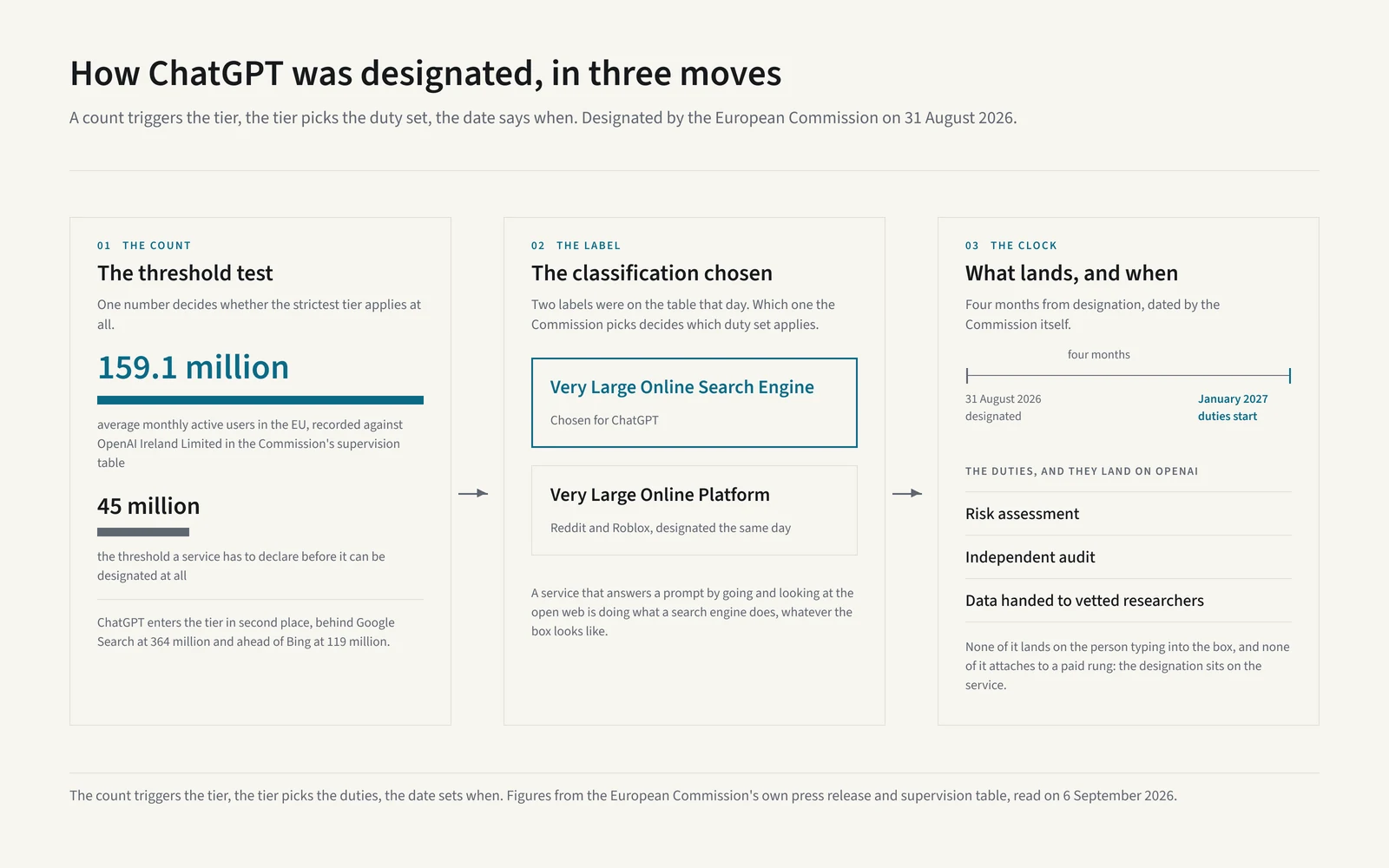
On 31 August 2026 the European Commission designated ChatGPT a Very Large Online Search Engine under the Digital Services Act, and designated Reddit and Roblox as Very Large Online Platforms. The Commission's own supervision table records the designation against OpenAI Ireland Limited and puts ChatGPT at 159.1 million average monthly active users in the EU, against a threshold of 45 million. The Commission says the designated services then have four months, which it dates as January 2027, to meet the extra duties the tier carries. (European Commission press release, 31 August 2026)
Read the full description of this diagram
Diagram of the designation in three panels. The count panel sets a bar for 159.1 million average monthly active users in the EU against a shorter bar for the 45 million threshold. The label panel shows two boxes, Very Large Online Search Engine outlined as the one chosen for ChatGPT and Very Large Online Platform for Reddit and Roblox on the same day. The clock panel runs a four-month line from designation on 31 August 2026 to duties starting in January 2027, and lists the three duties as risk assessment, independent audit and data handed to vetted researchers.
Tracked on this site: our ChatGPT plans table, and when each rung was last checked
What they are saying
Outlets read
Euronewsread as a safety regime, and the clock read wrong
Brussels has classified ChatGPT as a search engine under the Digital Services Act, a first for an AI chatbot, and designated Reddit and Roblox as Very Large Online Platforms.
read
Tech Policy Pressonly a slice of the product was designated
Impressive as those numbers are, they aren't how most people actually experience ChatGPT. The chat interface that lets users interact with the model does not necessarily search the web, which makes ChatGPT what the Commission calls a "hybrid service."
read
Forkastthe perimeter reaches whoever builds on the API
For developers building on ChatGPT APIs, this means their deployments are effectively pulled into the platform's regulatory perimeter, as the platform is now legally responsible for the systemic impacts of the agents it hosts.
read
Our verdict
They cannot even agree when the clock stops: Euronews puts the deadline at the end of November, while Tech Policy Press and the Commission's own page both say January 2027. Forkast is alone in asking what the designation does to somebody building on the API, and none of them looks up the figure sitting beside ChatGPT in the Commission's table, which now ranks it ahead of Bing and behind only Google Search among the search engines Europe supervises.
What it means for you
Nothing you pay moves on this date, and no duty in the designation lands on the person typing into the box. What lands in January 2027 lands on OpenAI: risk assessment, independent audit, and data handed to vetted researchers. That last one is the part worth waiting for, because it is the first arrangement under which somebody outside the company can test a claim about ChatGPT against something other than OpenAI's own reporting. None of it depends on your tier either: our ChatGPT plans table, checked against learn.chatgpt.com/docs/pricing on 5 September 2026, runs from a $0 rung to a $200 one, and the designation sits on the service across every rung of it.
In more detail
The numbers, and where each one comes from
- 159.1 million average monthly active users in the EU for ChatGPT, the figure recorded against OpenAI Ireland Limited in the Commission’s supervision table, read on 6 September 2026.
- 45 million average monthly users in the EU is the threshold a service has to declare to be designated at all, from the Commission’s press release of 31 August 2026.
- Four months, dated by the Commission as January 2027, is how long a newly designated service has to comply, from the same release.
- 364 million for Google Search and 119 million for Bing, the two search engines already in the tier, from the same supervision table. ChatGPT enters it in second place.
- $0 to $200 a month across the individual rungs of our ChatGPT plans table, checked against learn.chatgpt.com/docs/pricing on 5 September 2026. The designation attaches to none of them in particular.
Why the category matters more than the label
A platform and a search engine carry different duties under this law, and the Commission chose the search engine one. Its reasoning is that a service which answers a prompt by going and looking at the open web is doing what a search engine does, whatever the box looks like. That reading is what makes the designation portable: any assistant that searches the web and clears the user threshold is now describable in the same terms, and the Commission has said in its own words that it will keep watching for services that meet it.
The narrower point is that the figure which triggered this covers the search function. The chat that does not search is a different thing, and it has not been designated in its own right. Anyone reading 159.1 million as a count of European ChatGPT users is reading it as more than it is.
What actually changes, and when
Not the product, and not in September. The obligations start in January 2027, and the visible ones from a reader’s side are the annual risk assessment, the independent audit and the researcher data access. The first two produce documents. The third produces something this site has never been able to get: a route by which somebody who does not work for OpenAI can examine how the service behaves at scale and publish what they find.
Our own ledger will not move because of this. It records prices and allowances, and a designation changes neither. What we will record is the date the first assessment and the first audit appear, because those are the moments this stops being a legal category and starts being a document somebody can read.
Sources
Sources read
European Commission press release, 31 August 2026 (digital-strategy.ec.europa.eu)
Regulator read
The Commission's supervision table of designated platforms and search engines, where the user figure and the designation date are recorded (digital-strategy.ec.europa.eu)
Regulator read
Cite this
AI Journey, "The EU has put ChatGPT in its strictest tier, and it did so by calling it a search engine", 6 Sep 2026, https://aijourney.space/updates/2026-09-06-eu-designates-chatgpt-vlose/ (source: digital-strategy.ec.europa.eu, verified 6 Sep 2026)
Next in the stream
Anthropic opens a research preview of the Model Hardware Standard
Anthropic says the specification cuts integration work that takes a lab weeks or months down to hours or minutes, and will open source it after the preview.
Previous
Anthropic says its test cages leaked, and has published the rules it now wants its testers to follow
Anthropic has published what it changed after test models reached the open internet, including a rule telling its testers to phrase limits as instructions rather than as facts about the room.
Next
More in OpenAI
Heimstaden Turns To ChatGPT Enterprise And Codex For Property Management
Heimstaden, a European residential landlord, has adopted OpenAI's ChatGPT Enterprise and its Codex tool across parts of its property management operations.
Paper Tests ChatGPT For Surveillance-Assistance Risks
A new paper tests whether ChatGPT will help build surveillance systems, running 110 prompts across seven risk categories against OpenAI's chatbot.
Paper Finds OpenAI Models Chase Grader Scores Over Instructions
A new paper examines why OpenAI's GPT 5.6 Sol and GPT 5.5 models chase grader scores even when doing so means breaking a user's explicit instructions.