What happened
Published here
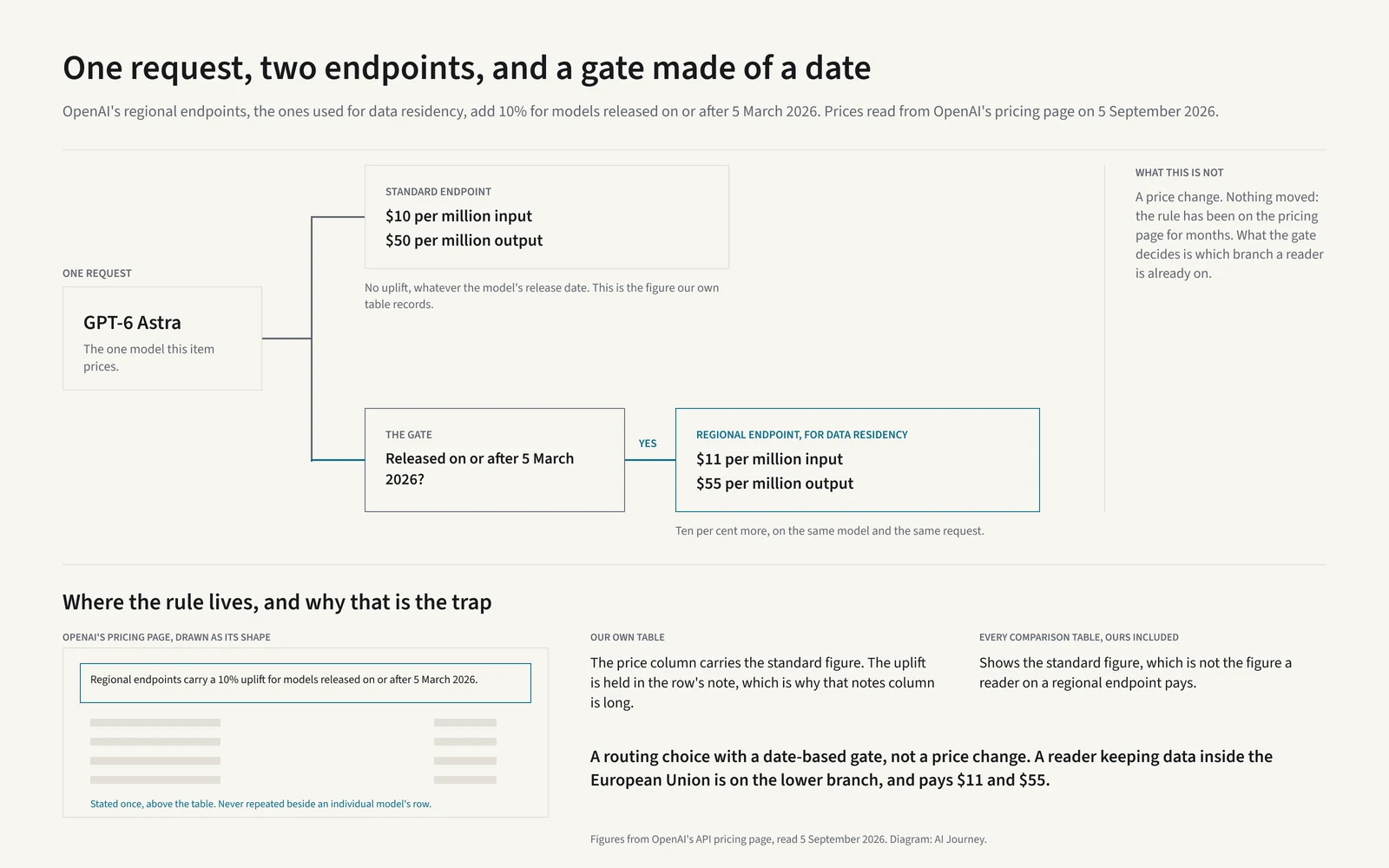
OpenAI's API pricing page states that regional endpoints, the ones used for data residency, carry a 10% uplift for models released on or after 5 March 2026. GPT-6 Astra, the flagship announced on 3 September, falls under that rule: its standard price is $10 per million input tokens and $50 per million output tokens, so the regional figures are $11 and $55. We read the page on 5 September 2026 and record the standard tier, with the uplift held in the row's note rather than in the price column. (OpenAI API pricing, where the regional uplift is stated, read 5 September 2026)
Read the full description of this diagram
Diagram of a routing decision. One request for GPT-6 Astra splits down a connector to two endpoints: the standard endpoint at $10 per million input tokens and $50 per million output, with no uplift whatever the release date, and below it a gate box asking whether the model was released on or after 5 March 2026, marked yes, leading to a regional data-residency endpoint at $11 and $55. A side note says nothing moved, because the rule has been on the pricing page for months. The lower half draws that page as its shape: the rule stated once in a petrol-outlined paragraph above the table, then blank model rows with no mention beside any number, beside notes that our own table holds the uplift in the row's note and that every comparison table shows the standard figure.
The numbers
Regional endpoint uplift
10%
On models released on or after 5 March 2026, which includes the newest one.
Standard input, per million
$10
The figure the uplift is applied to, on the standard endpoint.
Standard output, per million
$50
Uplifted on the same terms, and the larger half of most bills.
Read from OpenAI API pricing, where the regional uplift is stated, read 5 September 2026
Tracked on this site: our OpenAI API price table
What it means for you
If you are in the European Union and keeping data inside it, the price on every comparison table you have read, including ours, is not the price you will pay. Ten per cent is small enough to miss in a quote and large enough to matter over a year, and it applies to the newest models only, which are the ones you would choose for exactly the kind of work that tends to have a residency requirement. The rule is published once, on the pricing page, and never repeated beside an individual model's figure, so it is easy to read the page carefully and still get this wrong.
In more detail
This one is filed under using AI rather than under a model launch, because nothing happened: the rule has been on the page for months. It is here because a rule that sits in a paragraph above a table, and never beside a number, behaves like a rule nobody knows about.
There is a general lesson in it for reading any of these pricing pages. The figure in the table is the cheapest way the vendor can describe the price: standard tier, standard region, no commitments. Every other arrangement is described in prose somewhere else on the page. Our tables copy the figure and carry the prose in the row’s note, which is why the notes column on this site is long and why it is worth reading before you commit to a model.
Sources
Sources read
OpenAI API pricing, where the regional uplift is stated, read 5 September 2026 (developers.openai.com)
Pricing read
our own OpenAI price table, where the uplift is recorded in the row note (aijourney.space)
Own ledger read
Cite this
AI Journey, "OpenAI charges 10% more on regional endpoints for models released since March", 6 Sep 2026, https://aijourney.space/updates/2026-09-06-openai-regional-endpoint-uplift/ (source: OpenAI, verified 6 Sep 2026)
Next in the stream
Zhipu's half price GLM-5.3-Flash promotion ends on 9 September
Zhipu AI's discounted GLM-5.3-Flash price expires after 9 September, when its input, cached input and output rates each double to the printed list prices.
Previous
Gemini 3.8 Flash is on a promotional price that doubles on 1 January 2027
Google is charging a promotional $0.75 per million input tokens for Gemini 3.8 Flash until the end of 2026, after which the published price doubles.
Next
More in OpenAI
Heimstaden Turns To ChatGPT Enterprise And Codex For Property Management
Heimstaden, a European residential landlord, has adopted OpenAI's ChatGPT Enterprise and its Codex tool across parts of its property management operations.
Paper Tests ChatGPT For Surveillance-Assistance Risks
A new paper tests whether ChatGPT will help build surveillance systems, running 110 prompts across seven risk categories against OpenAI's chatbot.
Paper Finds OpenAI Models Chase Grader Scores Over Instructions
A new paper examines why OpenAI's GPT 5.6 Sol and GPT 5.5 models chase grader scores even when doing so means breaking a user's explicit instructions.