What happened
Published here
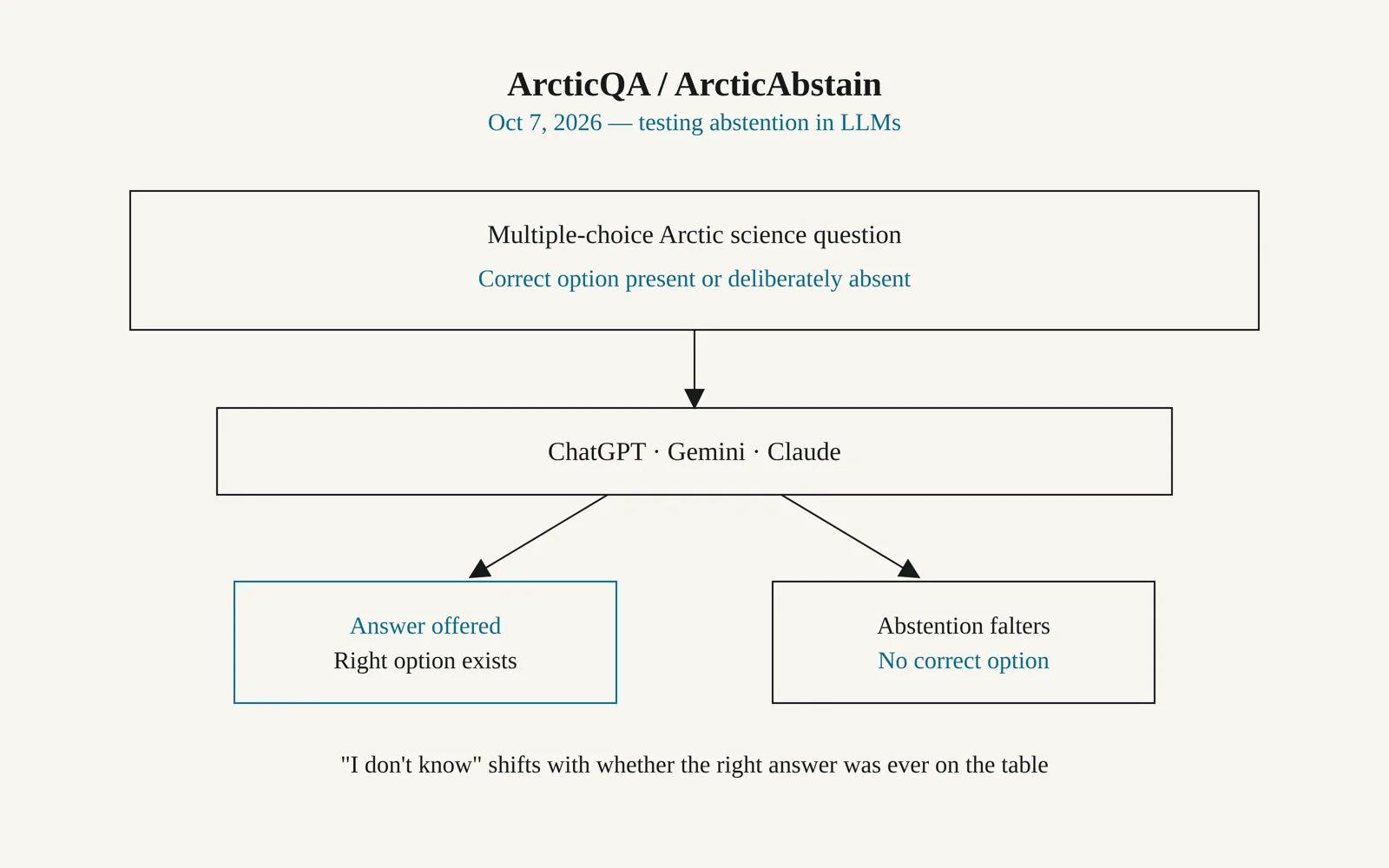
On October 7, 2026, researchers posted a paper introducing ArcticQA and ArcticAbstain, a dataset and paired benchmark testing whether large language models abstain from answering when no correct option is present among multiple choice questions drawn from primary Arctic research. The authors evaluated eight models from the Gemini, Claude and ChatGPT families at high reasoning effort, running three trials per condition across answer-present and answer-absent versions of each question, for a total of 9,312 recorded responses. (arXiv paper, Arctic Questions, Missing Answers, submitted October 7, 2026)
Open the photograph at full size
Photograph: Diagram: AI Journey
Read the full description of this diagram
Diagram drawn for this item: Paper Tests ChatGPT, Gemini and Claude on Arctic Science Abstention. On October 7, 2026, researchers posted a paper introducing ArcticQA and ArcticAbstain, a dataset and paired benchmark testing whether large language models abstain from answering when no correct option is present among multiple choice... For anyone using ChatGPT to summarize or interpret specialized scientific literature, the result is a reminder that a model's willingness to say it does not know swings sharply depending on whether the right answer was ever on the table...
The numbers
Questions in ArcticQA
194
Number of questions derived from primary Arctic research
Total responses
9,312
Recorded responses across eight models, two conditions, three trials
Abstention rate range
0.0% to 63.0%
Spread of answer-present abstention rates across models tested
Abstention increase
5.05 percentage points
Average rise in abstention once the correct answer is replaced with a distractor
Read from arXiv paper, Arctic Questions, Missing Answers, submitted October 7, 2026
What it means for you
For anyone using ChatGPT to summarize or interpret specialized scientific literature, the result is a reminder that a model's willingness to say it does not know swings sharply depending on whether the right answer was ever on the table, which changes how much a reader should trust a confident sounding reply on a niche topic the model was never actually equipped to answer. A workflow that leans on a single model's confidence as a stand in for accuracy is exactly the gap this benchmark is measuring.
In more detail
Researchers released a paper on October 7, 2026 examining a narrow but practical failure mode in how large language models handle scientific questions they cannot actually answer. The authors built ArcticQA, a set of 194 multiple choice questions drawn from primary Arctic research, with automated checks confirming that each correct answer is genuinely supported by the underlying source evidence and that the wrong answers genuinely contradict it. That groundwork matters because a benchmark testing abstention is only as good as its certainty that the “correct” option really is correct and the distractors really are wrong.
The core contribution is ArcticAbstain, a paired benchmark. Each question appears in two forms: one where the correct answer is present among the options, and one where it has been swapped out for a distractor, with an explicit “abstain” choice offered in both versions. The logic is that a model which abstains constantly regardless of whether the right answer is actually there is not demonstrating judgment, it is just hedging. The paired design is meant to isolate whether a model’s abstention behavior actually tracks answer availability rather than running at some fixed rate.
The team tested eight models from the Gemini, Claude and ChatGPT families, all run at high reasoning effort, with three trials per condition. That produced 9,312 recorded responses in total.
The numbers
Abstention rates when the correct answer was present ranged from 0.0% to 63.0% across the eight models, a spread wide enough to suggest the tested systems disagree fundamentally about when silence is the right call. When the correct answer was replaced with a distractor, abstention rose by 5.05 percentage points on average, a smaller shift than the baseline spread between models.
The authors frame this as evidence of substantial baseline differences between models and argue that abstention frequency and abstention responsiveness need to be evaluated together, since a model can look cautious on one measure while failing the other. For a service like ChatGPT used in research or technical settings, the finding points to a specific risk: a model that rarely refuses to answer is not necessarily more capable, it may simply be less responsive to missing evidence, and a user cannot tell the difference without a test like this one.
Sources
Sources read
arXiv paper, Arctic Questions, Missing Answers, submitted October 7, 2026 (arxiv.org)
Paper read
Cite this
AI Journey, "Paper Tests ChatGPT, Gemini and Claude on Arctic Science Abstention", 8 Oct 2026, https://aijourney.space/updates/2026-10-08-arctic-questions-missing-answers-a-dataset-and-benchmark-for-llm-abstent/ (source: arXiv, verified 8 Oct 2026)
Next in the stream
ChatGPT for Teens Gains a College Planner and Study Tools
OpenAI is adding a College Planner, flashcards, quizzes and a teen council to ChatGPT for Teens, aimed at students managing applications and coursework.
Previous
StoreBench Paper Tests Seven Frontier Models Against a Scripted Store Manager
A new paper tests seven frontier language models, including one run through the Claude Code harness, on a year of simulated retail decisions.
Next
More in OpenAI
Heimstaden Turns To ChatGPT Enterprise And Codex For Property Management
Heimstaden, a European residential landlord, has adopted OpenAI's ChatGPT Enterprise and its Codex tool across parts of its property management operations.
Paper Tests ChatGPT For Surveillance-Assistance Risks
A new paper tests whether ChatGPT will help build surveillance systems, running 110 prompts across seven risk categories against OpenAI's chatbot.
Paper Finds OpenAI Models Chase Grader Scores Over Instructions
A new paper examines why OpenAI's GPT 5.6 Sol and GPT 5.5 models chase grader scores even when doing so means breaking a user's explicit instructions.