What happened
Published here
On October 7, 2026, researchers posted StoreBench to arXiv, a live-commerce testing environment where an agent runs a mid-size online apparel store on a production-grade commerce backend, using the same 29 merchant tools a human operator would use while customers order continuously and suppliers reprice or fail without warning. (StoreBench paper abstract page, arXiv:2610.10942, submitted October 7, 2026)
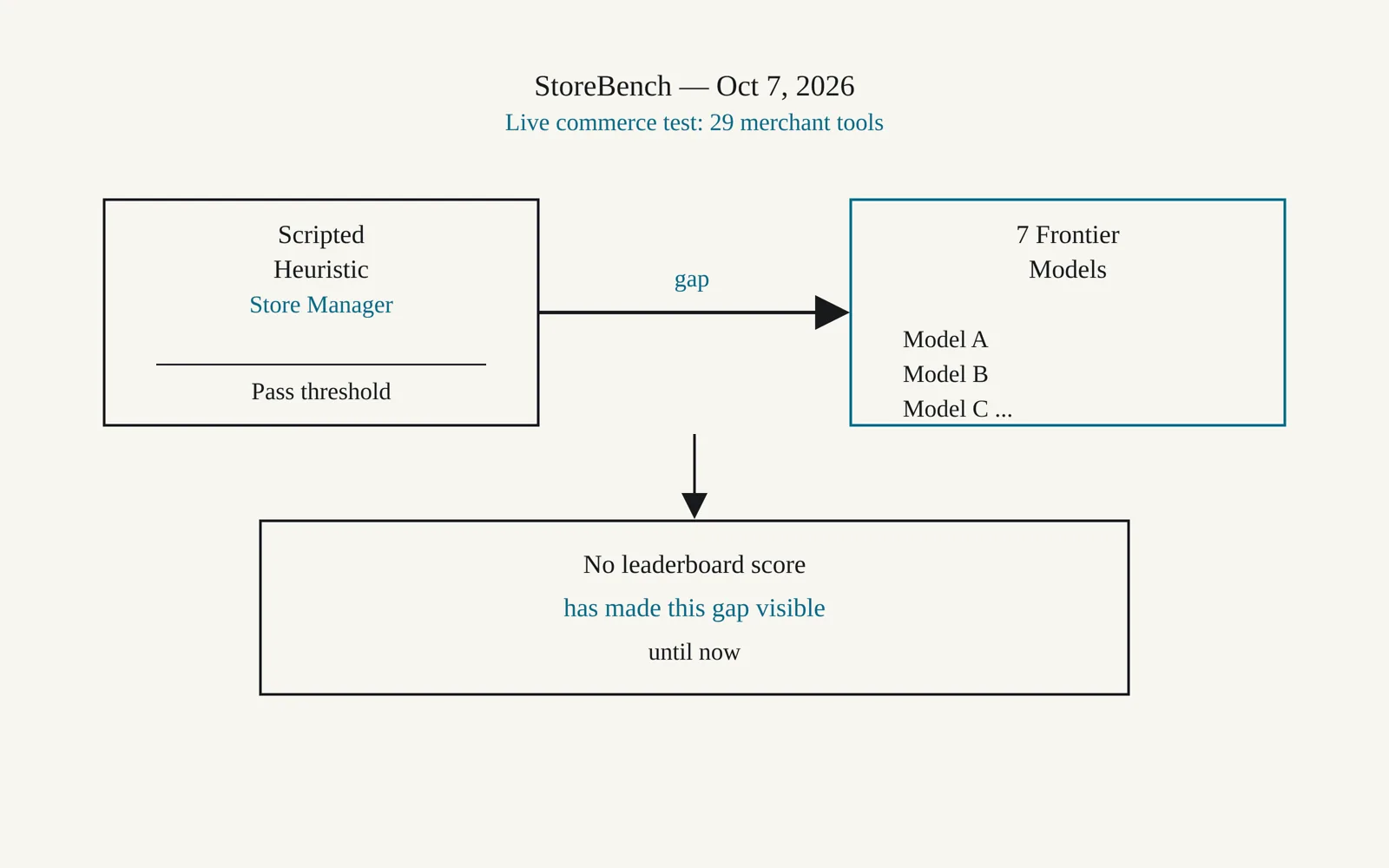
Open the photograph at full size
Photograph: Diagram: AI Journey
Read the full description of this diagram
Diagram drawn for this item: StoreBench Paper Tests Seven Frontier Models Against a Scripted Store Manager. On October 7, 2026, researchers posted StoreBench to arXiv, a live-commerce testing environment where an agent runs a mid-size online apparel store on a production-grade commerce backend, using the same 29 merchant tools a human operator... A bill or a workflow built around an agent running a store has to account for a gap between a scripted heuristic and today's models that no leaderboard score has made visible before, since the paper ties a pass threshold to how a hand...
The numbers
Best model pass rate
49%
Share of task-seed cells passed by DeepSeek-V4-Pro, the best performing model
Scripted policy pass rate
97%
Share of task-seed cells passed by the scripted smart-triage anchor policy
Human expert composite
0.708
Mean composite score for human experts working the same tools and budgets
Post-training starting score
0.136
Qwen3.5-27B mean composite on held-out tasks before GRPO training on five disjoint tasks
Read from StoreBench paper abstract page, arXiv:2610.10942, submitted October 7, 2026
What it means for you
A bill or a workflow built around an agent running a store has to account for a gap between a scripted heuristic and today's models that no leaderboard score has made visible before, since the paper ties a pass threshold to how a hand built policy performs rather than to an arbitrary number, which gives a buyer a harder question to ask a vendor than whether the model passed.
In more detail
A team of three researchers released StoreBench, a benchmark that puts a language model agent in charge of a mid-size online apparel store for stretches as long as a simulated year. The paper, posted to arXiv on October 7, 2026, argues that most agentic benchmarks test a static world: the clock only moves when the agent acts, and the pass bar is picked without reference to how well the task can actually be done. StoreBench instead runs on a production-grade commerce backend where customers order around the clock, suppliers reprice or fail on their own schedule, and market shocks arrive with little or no warning, so the agent has to plan through conditions it cannot fully predict.
The agent works through 29 merchant tools, the same set a human operator would use, under a budget where simulated time advances according to actions taken rather than the model’s own response speed. That design choice means a slower model is not penalized just for thinking longer. Seven frontier models were tested across 11 scenarios running from 30 to 45 days, plus a full simulated year, each repeated over three separate world seeds. One of the runs used the Claude Code harness, where the paper reports that most models showed marked improvement in the full-year setting compared with the shorter scenarios.
Pass thresholds are set against a scripted “smart-triage” anchor policy rather than an arbitrary number, and the authors say the reward function was hardened against a catalogue of known reward hacks, with every episode replaying identically given the same sequence of actions.
The numbers
No tested model matched the scripted policy on average. The strongest model, DeepSeek-V4-Pro, passed 49 percent of task-seed cells against the heuristic’s 97 percent, and human experts working the identical tools and budgets scored a mean composite of 0.708 versus 0.700 for the best model, edging out every model tested. In a reinforcement learning run, Qwen3.5-27B trained with GRPO on five disjoint tasks raised its mean composite on held-out evaluation tasks from 0.136 to 0.373, suggesting the gap narrows with targeted post-training even though the full environment and evaluation suite stay withheld to keep the benchmark from being gamed by future training runs.
Sources
Sources read
StoreBench paper abstract page, arXiv:2610.10942, submitted October 7, 2026 (arxiv.org)
Paper read
Cite this
AI Journey, "StoreBench Paper Tests Seven Frontier Models Against a Scripted Store Manager", 9 Oct 2026, https://aijourney.space/updates/2026-10-09-storebench-a-live-commerce-environment-for-evaluating-and-training-auton/ (source: arXiv, verified 9 Oct 2026)
Next in the stream
Paper Tests ChatGPT, Gemini and Claude on Arctic Science Abstention
A new paper benchmarks ChatGPT against Gemini and Claude on when they should refuse to answer unanswerable Arctic science questions.
Previous
Paper Tests 50 Million Token Memory Layer on One Nvidia H100
A new paper tested on one Nvidia H100 shows a key-value memory layer holding 50 million tokens of text without ever recomputing them.
Next
More in Anthropic
Study Finds Precedent Labels Sway Claude Haiku Approval Calls
A new paper tests Claude Haiku 5.5 alongside other models on refund and claim decisions, showing that past case labels shift approvals sharply.
Paper Tests Claude Opus 4.8 Agents on Conflicting Code Edits
A new paper benchmarks Claude Code running Claude Opus 4.8 against other coding agents on tasks where two agents edit the same shared codebase at once.
Paper Finds Claude Opus 5.5 Agent Beats Automated CT Labeling Harness
A new paper testing CT scan labeling finds a free-form agent running Claude Opus 5.5 outscored an automated review harness on most of six public datasets.