What happened
Published here
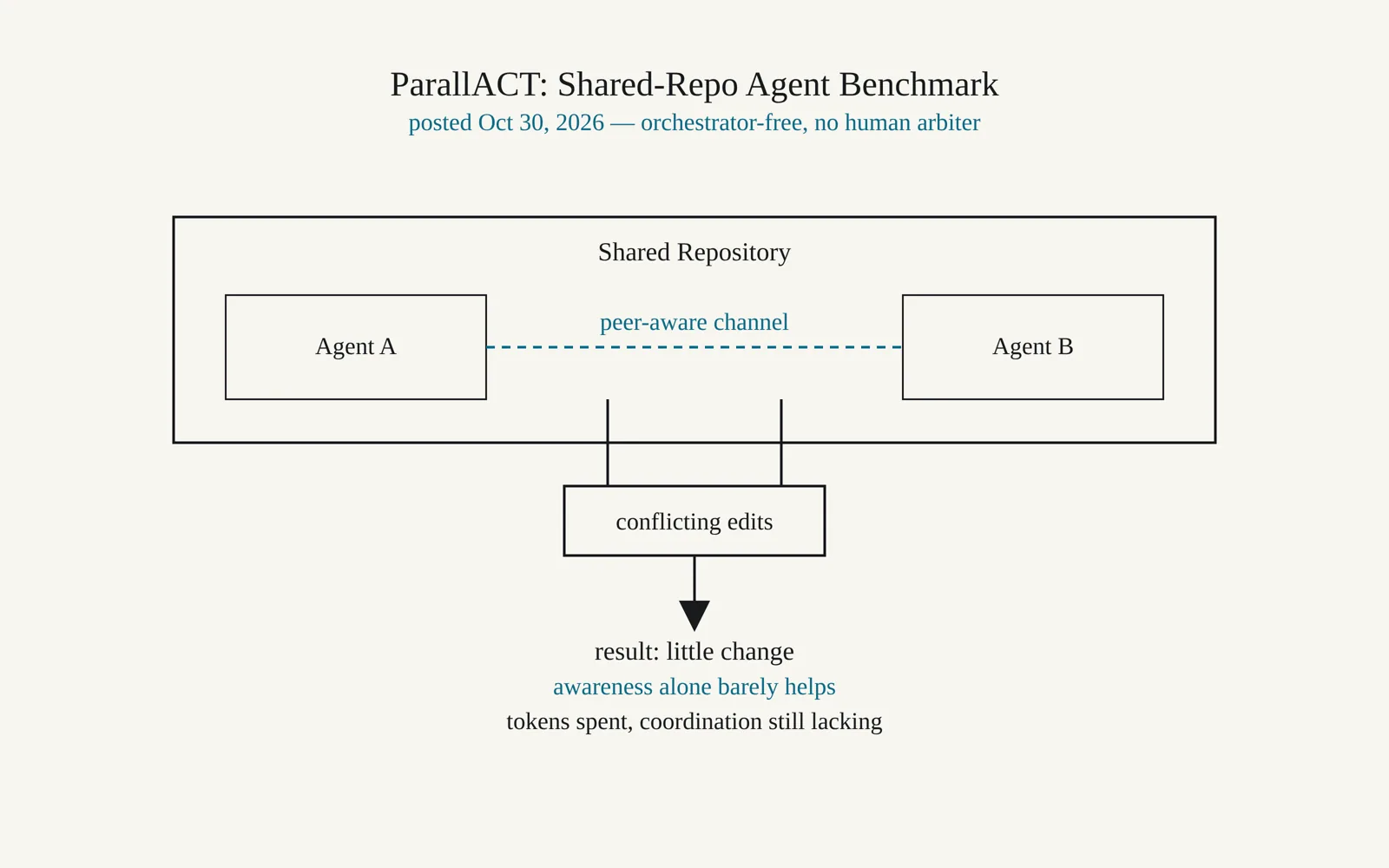
On October 30, 2026, researchers posted a paper introducing ParallACT, a benchmark that puts coding agents through orchestrator-free multi-agent tasks in a shared repository. It pits a single-agent oracle, given the combined set of two developers' requests, against separate agents working in parallel, including Claude Code running on Claude Opus 4.8, and measures how often their independently written changes still work once merged. (arXiv paper 2611.00314, Decentralized Multi-Agent Coordination and Communication in Shared Codebases, posted October 30, 2026)
Open the photograph at full size
Photograph: Diagram: AI Journey
Read the full description of this diagram
Diagram drawn for this item: Paper Tests Claude Opus 4.8 Agents on Conflicting Code Edits. On October 30, 2026, researchers posted a paper introducing ParallACT, a benchmark that puts coding agents through orchestrator-free multi-agent tasks in a shared repository. For anyone routing several coding agents at the same repository without a human arbiter, the result is a warning about what a bill for extra tokens buys: letting agents know a peer exists barely changes outcomes, and giving them a channel...
The numbers
Contradictory task score, solo
62%
Claude Code with Claude Opus 4.8 solving contradictory ParallACT tasks given to a single oracle agent
Contradictory task score, parallel
16%
Same pairing's score once two agents edit the same code independently and are merged
What it means for you
For anyone routing several coding agents at the same repository without a human arbiter, the result is a warning about what a bill for extra tokens buys: letting agents know a peer exists barely changes outcomes, and giving them a channel to talk recovers only part of the lost performance while adding cost, so the cheaper fix is still to serialize conflicting edits rather than pay for cross-agent chatter that does not reliably resolve them.
In more detail
The paper studies a scenario that any team running several coding agents against one repository will recognize: two separate, independently motivated requests arrive at once, each agent solves its own task, and the two solutions have to be merged into something that still works. The authors call this setting “multi-agent by necessity,” since nobody designed it that way, it just happens whenever more than one request lands on a shared codebase at the same time.
To measure it, the paper introduces ParallACT, a benchmark built from two kinds of task pairs. Complementary pairs are tasks that are each separately useful but need a shared interface to combine cleanly. Contradictory pairs require editing the same code in incompatible ways, so a naive merge of two independently correct solutions produces something that satisfies only one of the original requests. The researchers compare a single oracle agent handed both tasks together against several multi-agent arrangements that vary execution order, whether agents can see each other’s work, whether they are told a peer exists, and whether they share a communication channel.
The headline result is a sharp drop for parallel agents relative to the oracle, worst on contradictory tasks. For Claude Code running Claude Opus 4.8, the contradictory-task score falls from 62% for the oracle to 16% once two agents edit independently and their changes are merged. The paper reports the same pattern across six further pairings of two agent harnesses with three open-weight models, which suggests the problem is not specific to one vendor’s agent but a structural weakness in running agents without coordination.
Two mitigations tested barely help. Simply telling an agent that a peer is working on the same code does not meaningfully change outcomes. Giving agents a communication channel recovers only a small part of the lost performance, and it comes at an additional token cost, meaning teams would pay more per run for a partial fix rather than a reliable one.
The numbers
The 62% to 16% drop on contradictory tasks is the clearest figure in the paper for anyone deciding how to structure a multi-agent coding workflow today. It implies that where two agents’ tasks are likely to touch the same lines, serializing the work, or routing both through a single agent, still beats running them in parallel and hoping a merge step or a chat channel will catch the conflict. The paper frames this as a benchmark meant to isolate exactly which coordination strategies help and at what cost, rather than a finished solution, which leaves the practical choice of serialize, merge carefully, or pay for communication squarely with the team operating the agents.
Sources
Sources read
Cite this
AI Journey, "Paper Tests Claude Opus 4.8 Agents on Conflicting Code Edits", 4 Nov 2026, https://aijourney.space/updates/2026-11-04-decentralized-multi-agent-coordination-and-communication-in-shared-codeb/ (source: arXiv, verified 4 Nov 2026)
Next in the stream
Perplexity AI Researchers Detail LoRA Recipe For Converting Four Language Models To Diffusion
A paper associated with Perplexity AI describes BYOD, a LoRA-only method that converts standard autoregressive language models into diffusion language models without full retraining.
Previous
Study Finds Precedent Labels Sway Claude Haiku Approval Calls
A new paper tests Claude Haiku 5.5 alongside other models on refund and claim decisions, showing that past case labels shift approvals sharply.
Next
More in Anthropic
Paper Finds Claude Opus 5.5 Agent Beats Automated CT Labeling Harness
A new paper testing CT scan labeling finds a free-form agent running Claude Opus 5.5 outscored an automated review harness on most of six public datasets.
Paper Finds Claude Opus 5 Often Skips Procedure To Reach Right Outcome
A new benchmark testing patient-advocacy agents found Claude Opus 5 reached correct outcomes often but passed procedural checks far less consistently.
Paper Introduces TSFLab Workbench To Cut Agent Research Costs
A new paper proposes TSFLab, a workbench that lets coding agents such as Claude Code run time series forecasting research at lower cost and with less manual upkeep.