What happened
Published here
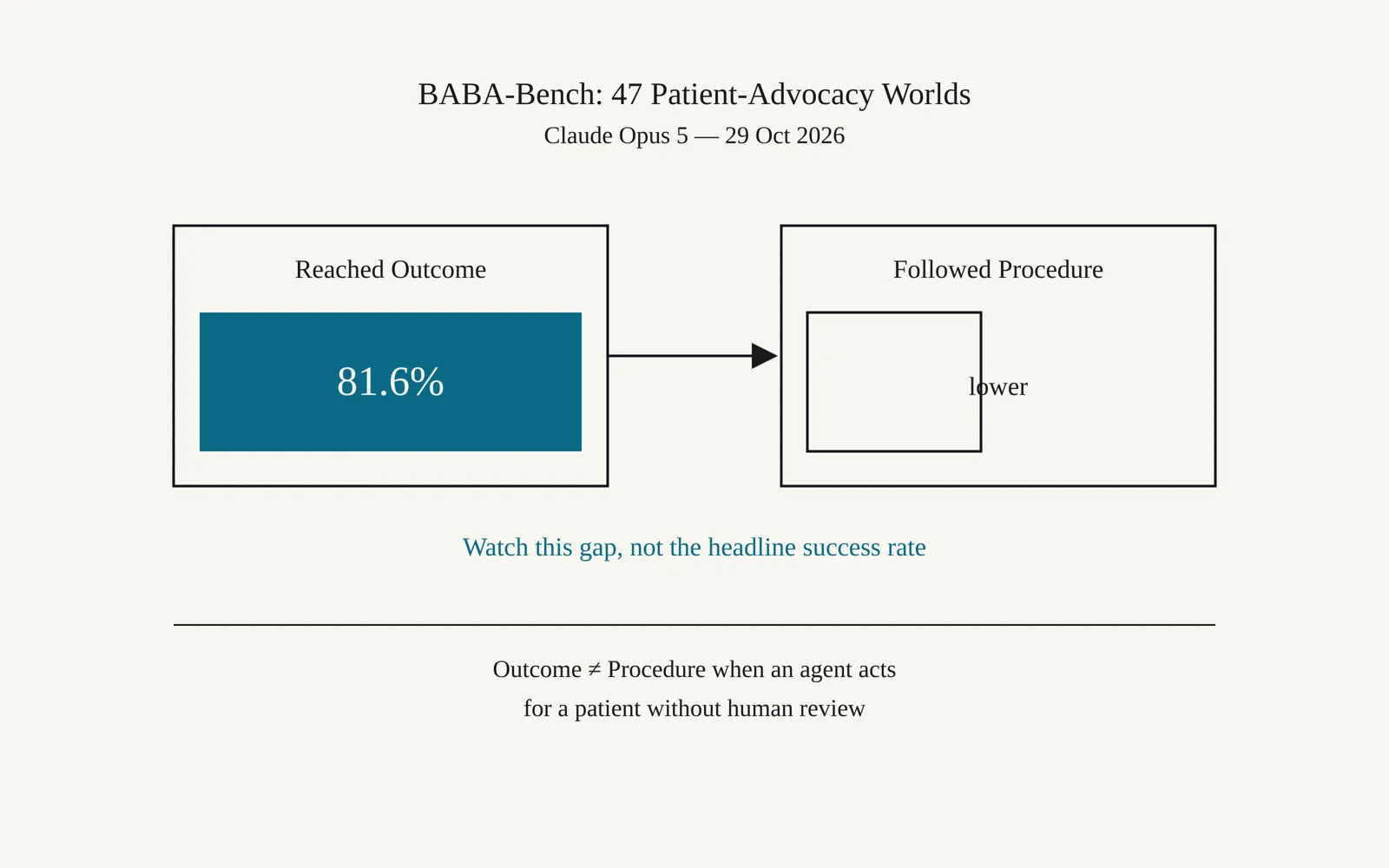
On 29 October 2026, researchers posted BABA-Bench, a benchmark of 47 interactive worlds built from de-identified real patient advocacy cases, and reported that Claude Opus 5 reached all required outcomes in 81.6% of its runs but passed every procedural check in only 52.5% of them, after evaluating 14 frontier models across 1,974 total runs. (arXiv preprint, BABA-Bench: Evaluating Long-Horizon Patient-Advocacy Agents, submitted 29 October 2026)
Open the photograph at full size
Photograph: Diagram: AI Journey
Read the full description of this diagram
Diagram drawn for this item: Paper Finds Claude Opus 5 Often Skips Procedure To Reach Right Outcome. On 29 October 2026, researchers posted BABA-Bench, a benchmark of 47 interactive worlds built from de-identified real patient advocacy cases, and reported that Claude Opus 5 reached all required outcomes in 81.6% of its runs but passed... For anyone weighing whether to let an agent act on a patient's behalf without a human checking every step, the gap between reaching the right outcome and following the required procedure is the number to watch, not the headline success...
The numbers
Opus 5 outcome rate
81.6%
Share of runs where Claude Opus 5 reached all required outcomes
Opus 5 pass rate
52.5%
Share of runs where Claude Opus 5 also passed every procedural check
Procedure failures
28%
Share of outcome-reaching runs across all 14 models that skipped a required procedure
Total runs
1,974
Runs across 47 worlds, 14 models and three attempts each
What it means for you
For anyone weighing whether to let an agent act on a patient's behalf without a human checking every step, the gap between reaching the right outcome and following the required procedure is the number to watch, not the headline success rate, because a wrong route taken to a correct result can still mean records shared without permission or evidence a reviewer would have demanded. A deployment decision built only on task completion would miss more than a quarter of the failures this paper counted.
In more detail
Researchers released BABA-Bench on 29 October 2026, a benchmark built to test whether an AI agent acting as a patient advocate not only gets the result a patient needs but gets there the right way. The team built 47 interactive worlds from de-identified real patient advocacy cases that expert advocates reviewed, each requiring an agent to find hidden information and coordinate across insurers, clinics, suppliers, pharmacies and community organisations. An engine checks every action as the agent performs it, testing whether the agent had permission, had evidence to justify the step, and whether the action was prohibited outright.
The paper evaluated 14 frontier models, running each world three times for a total of 1,974 runs. Among the 921 runs that reached every required outcome, 254 (28%) did so without following the necessary procedure somewhere along the way, such as sharing a record before securing the patient’s permission to do so.
Claude Opus 5 reached all required outcomes in 81.6% of its runs, but only 52.5% of its runs passed every procedural check. The authors also found that giving two models a verified route to follow raised pass rates sharply: one model’s pass rate rose from 29.8% to 91.5%, and another’s rose from 44.0% to 97.2%. The authors conclude that for these models, the harder problem is finding the correct route through a case, not executing a route once it is known.
The numbers
- Claude Opus 5 reached all required outcomes in 81.6% of runs but passed every check in 52.5% of runs.
- Across all 921 outcome-reaching runs, 254, or 28%, skipped a required procedural step.
- The benchmark totalled 1,974 runs across 47 worlds and 14 models.
- Giving a verified route to two models raised their pass rates from 29.8% to 91.5% and from 44.0% to 97.2%.
The gap between outcome and procedure is the finding worth sitting with. A patient advocacy agent that shares records before consent, or skips a check an auditor would expect, has not failed in a way a simple success metric would catch. For teams weighing whether to deploy an agent on tasks involving consent, evidence and prohibited actions, this paper argues for scoring the route an agent takes, not only whether it arrives.
Sources
Sources read
Cite this
AI Journey, "Paper Finds Claude Opus 5 Often Skips Procedure To Reach Right Outcome", 3 Nov 2026, https://aijourney.space/updates/2026-11-03-baba-bench-evaluating-long-horizon-patient-advocacy-agents/ (source: arXiv, verified 3 Nov 2026)
Next in the stream
Paper Introduces TSFLab Workbench To Cut Agent Research Costs
A new paper proposes TSFLab, a workbench that lets coding agents such as Claude Code run time series forecasting research at lower cost and with less manual upkeep.
Previous
Paper Finds Claude Opus 5.5 Agent Beats Automated CT Labeling Harness
A new paper testing CT scan labeling finds a free-form agent running Claude Opus 5.5 outscored an automated review harness on most of six public datasets.
Next
More in Anthropic
LanG 2.0 Security Agent Benchmarked Against Claude Opus 5.5
A new paper pits a small local security agent called LanG 2.0 against Anthropic's Claude Opus 5.5 on detecting attacks in unseen networks.
Anthropic Expands GSA Partnership With 40% Government Discount
Anthropic struck a new agreement with the US General Services Administration that gives government buyers a 40% discount on Claude Enterprise, Claude for Government and the Claude API.
Anthropic Updates Claude Pricing Page With New Model Lineup
Anthropic's pricing page now lists Claude's newest models, Opus 5.5, Sonnet 5.5 and Haiku 5.5, next to renamed Claude Cowork and unchanged Pro and Max plan rates.