What happened
Published here
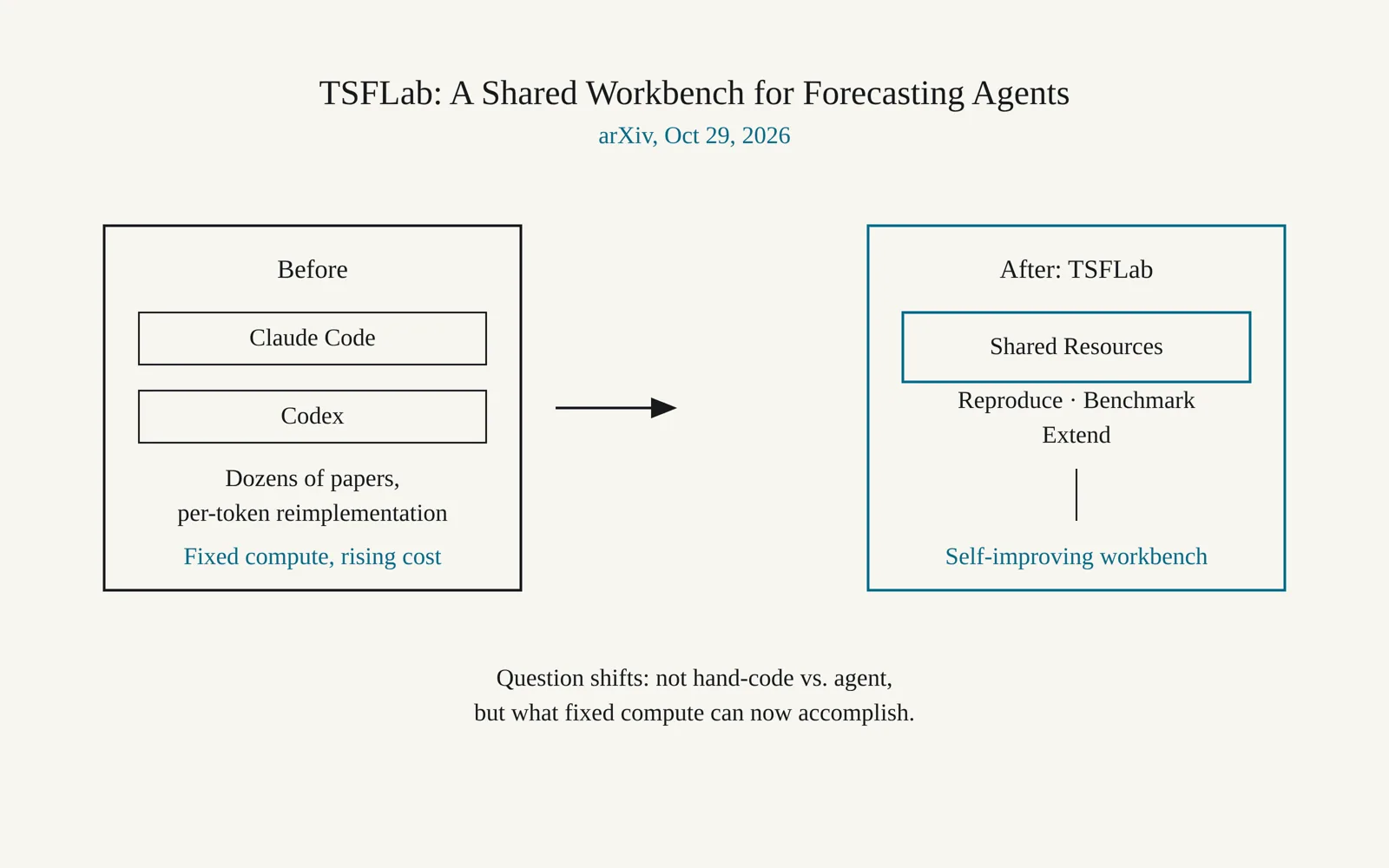
On October 29, 2026, researchers posted a paper on arXiv describing TSFLab, a self-improving workbench that equips coding agents, including Claude Code and Codex, with shared resources for reproducing, benchmarking and extending time series forecasting work, after the authors found that running those agents directly on research tasks was too costly to scale and left no way to maintain the code it produced. (arXiv abstract page for TSFLab, submitted 29 October 2026)
Open the photograph at full size
Photograph: Diagram: AI Journey
Read the full description of this diagram
Diagram drawn for this item: Paper Introduces TSFLab Workbench To Cut Agent Research Costs. On October 29, 2026, researchers posted a paper on arXiv describing TSFLab, a self-improving workbench that equips coding agents, including Claude Code and Codex, with shared resources for reproducing, benchmarking and extending time... For a lab paying per token to point Claude Code at dozens of forecasting papers, the open question stops being whether to hand-code a reimplementation or let an agent loose on it, because a shared workbench changes what a fixed compute...
The numbers
TSF papers with code
20%
Share of arXiv time series forecasting papers with a code link in the surveyed period
Submitted paper size
1,137 KB
Size of the first version of the paper as recorded by arXiv
Read from arXiv abstract page for TSFLab, submitted 29 October 2026
What they are saying
Outlets read
The New York Times, which has also sued OpenAI and Perplexity over similar claims, likens Brave to a "supplier, dealer, and distributor of stolen copyrighted content" for AI companies.
read
He gave the example of Anthropic, the AI company behind Claude that recently filed to go public in what could rank among the biggest IPOs in history.
read
But this has completely transformed video game modding because you now need drastically less time and computing knowledge to be able to pull off massive projects.
read
Our verdict
Coverage of Anthropic elsewhere this week sits far from a benchmarking paper about coding agents: a market commentator frames the company through its coming public listing, a technology outlet frames a rival browser through a copyright dispute over AI training data, and a culture desk frames AI tools through what hobbyists build with them rather than what researchers measure. None of the three outlets is looking at the cost and maintenance problem this paper is built to solve, which is the gap a workbench like TSFLab tries to close on its own.
What it means for you
For a lab paying per token to point Claude Code at dozens of forecasting papers, the open question stops being whether to hand-code a reimplementation or let an agent loose on it, because a shared workbench changes what a fixed compute budget and a fixed deadline can actually cover before either runs out, and it turns a one-off coding run into a maintained resource other researchers can reuse without repeating the setup cost.
In more detail
Researchers from a group spanning several US universities have published a paper proposing TSFLab, a workbench built to make coding agents useful for time series forecasting research without the cost and upkeep problems that come with pointing an agent at a research task directly. The paper names Claude Code and Codex as examples of existing coding agents that are suboptimal for this work when applied without modification, citing high running costs, poor scaling to large projects such as full benchmarking suites, and no built-in way to keep the resulting code maintained.
The authors’ starting problem is a familiar one in forecasting research: many published papers do not release working code, so anyone who wants to reproduce or build on prior results has to reimplement it, and independent reimplementations tend to drift apart in their experimental settings. The paper reports that only about 20% of arXiv time series forecasting papers carried a code link during the period it surveyed, which leaves most published results without a shared, checkable implementation.
TSFLab is described as agent-agnostic, meaning it is designed to equip a range of coding agents, rather than one vendor’s tool, with shared resources and tooling for reproduction, benchmarking and new method development, and to maintain those resources on an ongoing basis rather than leaving them to rot once a project ends. The authors report testing it across three settings: reproducing published results, running benchmarks across baselines, and a pilot study of agents developing new forecasting methods.
The numbers
- Only about 20% of arXiv time series forecasting papers in the surveyed period included a code link, which the authors cite as the gap TSFLab is meant to close.
- The first version of the paper, posted 29 October 2026, was recorded by arXiv at 1,137 KB.
- The authors report improvements to task completion and reductions in both fresh tokens spent and development time across their reproduction, benchmarking and method development experiments, though the exact ranges are specific to their chosen baselines and settings.
The paper sits inside a broader pattern of research groups treating commercial coding agents as infrastructure to be wrapped and managed rather than used off the shelf. For a field where most published code either does not exist or decays once its authors move on, a workbench that promises both lower running cost and continued upkeep changes the calculation for anyone deciding whether to reimplement a paper by hand or send an agent after it instead.
Sources
Sources read
arXiv abstract page for TSFLab, submitted 29 October 2026 (arxiv.org)
Paper read
Cite this
AI Journey, "Paper Introduces TSFLab Workbench To Cut Agent Research Costs", 3 Nov 2026, https://aijourney.space/updates/2026-11-03-tsflab-a-self-improving-agent-agnostic-workbench-for-time-series-forecas/ (source: arXiv, verified 3 Nov 2026)
Next in the stream
Paper Tests ChatGPT For Surveillance-Assistance Risks
A new paper tests whether ChatGPT will help build surveillance systems, running 110 prompts across seven risk categories against OpenAI's chatbot.
Previous
Paper Finds Claude Opus 5 Often Skips Procedure To Reach Right Outcome
A new benchmark testing patient-advocacy agents found Claude Opus 5 reached correct outcomes often but passed procedural checks far less consistently.
Next
More in Anthropic
Paper Finds Claude Opus 5.5 Agent Beats Automated CT Labeling Harness
A new paper testing CT scan labeling finds a free-form agent running Claude Opus 5.5 outscored an automated review harness on most of six public datasets.
LanG 2.0 Security Agent Benchmarked Against Claude Opus 5.5
A new paper pits a small local security agent called LanG 2.0 against Anthropic's Claude Opus 5.5 on detecting attacks in unseen networks.
Anthropic Expands GSA Partnership With 40% Government Discount
Anthropic struck a new agreement with the US General Services Administration that gives government buyers a 40% discount on Claude Enterprise, Claude for Government and the Claude API.