What happened
Published here
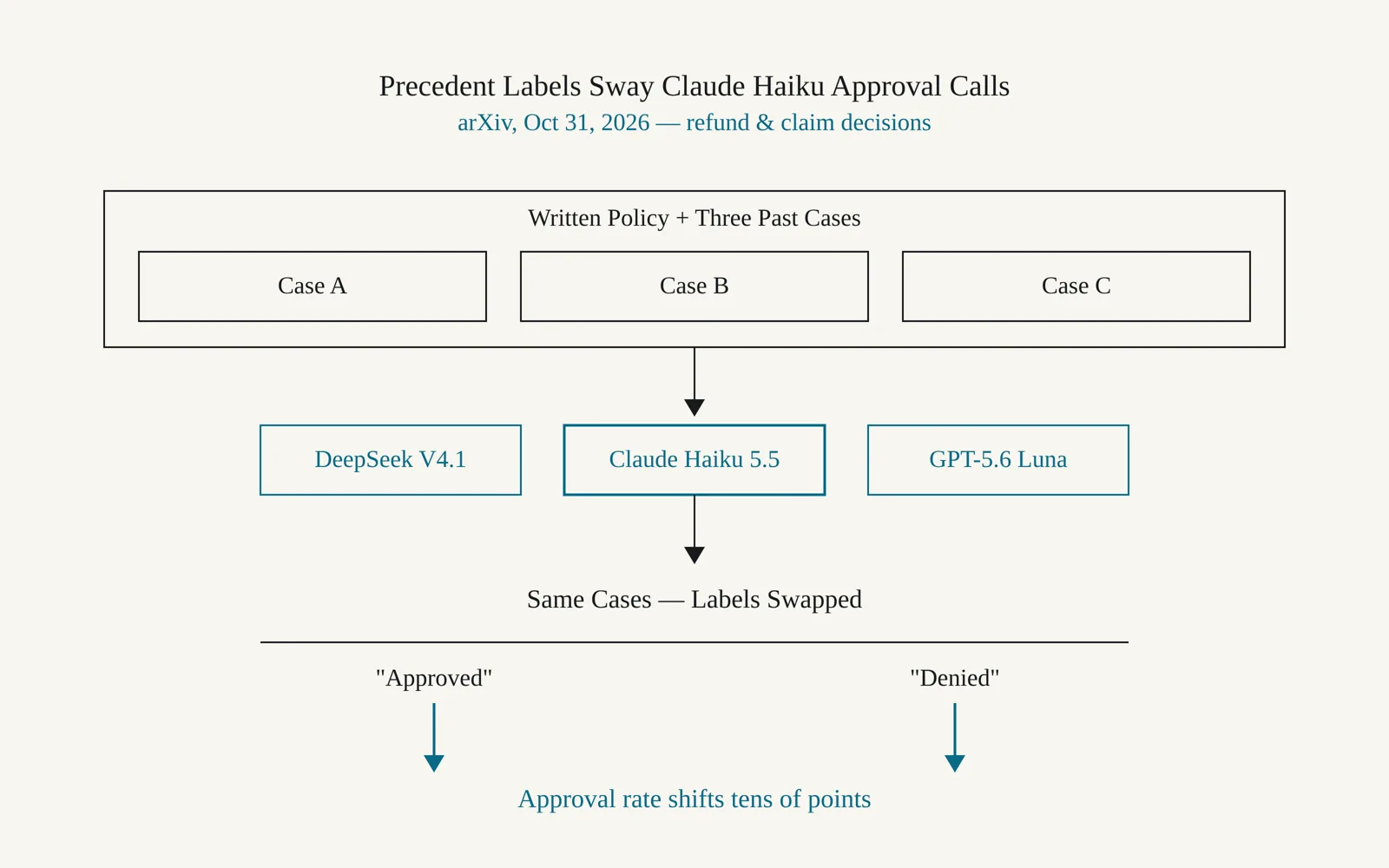
On October 31, 2026, researchers posted a paper on arXiv testing how DeepSeek V4.1 Flash, GPT-5.6 Luna and Claude Haiku 5.5 decide refund and claim requests under written policies when shown three past cases. The authors separated each past case into its facts and its recorded decision, holding the request fixed, then changed one part at a time and measured how approval rates moved on requests chosen because the models were inconsistent on them without any past cases shown. (arXiv paper, Precedent Labels and Facts Shift LLM Approval Decisions in Opposite Directions, posted October 31, 2026)
Open the photograph at full size
Photograph: Diagram: AI Journey
Read the full description of this diagram
Diagram drawn for this item: Study Finds Precedent Labels Sway Claude Haiku Approval Calls. On October 31, 2026, researchers posted a paper on arXiv testing how DeepSeek V4.1 Flash, GPT-5.6 Luna and Claude Haiku 5.5 decide refund and claim requests under written policies when shown three past cases. For anyone building an approval pipeline on Claude or a similar model, this is a warning about what gets fed in as precedent, because swapping only the labels on near-identical past cases moved approval by tens of percentage points while...
The numbers
Relabeled near-copy approval shift
30 to 55
Percentage point rise across three models when past-case decisions switch from DENY to APPROVE
Shift on a mismatched precedent
9
Percentage point move in DeepSeek's approval when near-copy cases belong to a different request
Facts effect, mismatched precedent
22
Percentage point drop in approval from facts supporting denial versus approval, same run
What it means for you
For anyone building an approval pipeline on Claude or a similar model, this is a warning about what gets fed in as precedent, because swapping only the labels on near-identical past cases moved approval by tens of percentage points while the underlying facts of the request never changed, so a support desk or claims queue that retrieves prior decisions as context could be training the model to match the record it is shown rather than the policy it is supposed to apply. A team wiring retrieval augmented approval workflows now has a concrete reason to check whether its retrieved cases carry stale or biased past decisions before trusting the model's answer, and to test the facts and the labels of its precedent store separately rather than assuming a consistent past record is a safe one.
In more detail
A paper posted to arXiv on October 31, 2026, tests how large language models decide refund and claim requests once they are shown a handful of past cases alongside a written policy. The authors, a team of seven researchers, split each past case into two pieces: the facts of what happened, and the decision that was recorded for it. By swapping one piece while holding the request itself fixed, they could isolate which part of a precedent actually moves a model’s judgment.
The study picked genuinely borderline requests. Without any past cases to look at, DeepSeek V4.1 Flash approved the same request on some tries and denied it on others across four attempts, which is the definition of a close call the researchers used to build their test set. Three models were then run against that set with precedents attached: DeepSeek V4.1 Flash, GPT-5.6 Luna and Claude Haiku 5.5.
The labels on near-copy precedents turned out to dominate. When the past cases were close variants of the request itself, flipping the recorded outcome from denial to approval raised the approval rate by roughly 30 to 55 percentage points across the named models, both on policies the authors wrote for the study and, for DeepSeek and Luna, on nine public policies paraphrased from real ones. The facts moved the decision in the opposite direction: shown without any attached outcome, past cases whose facts supported approval made Claude Haiku 5.5 and DeepSeek approve less often than past cases whose facts supported denial, as if the request looked weaker standing next to a strong case.
The numbers
The paper reports that this facts effect was not simply the model correcting toward the right answer. In an added DeepSeek analysis, it showed a similarly sized pull on requests that human annotators had separately judged approvable and on those judged deniable. A further DeepSeek run tested what happens when the near-copy precedents actually belong to a different request: the label-switching effect fell to 9 percentage points from 43, while the facts effect held at a 22 point gap between approval-supporting and denial-supporting facts.
The authors conclude that any system retrieving past decisions as context should test the labels and the facts of its precedent store separately, since the two push a model’s judgment in opposite directions and by very different amounts depending on how closely the retrieved case actually matches the request in front of it.
Sources
Sources read
Cite this
AI Journey, "Study Finds Precedent Labels Sway Claude Haiku Approval Calls", 4 Nov 2026, https://aijourney.space/updates/2026-11-04-precedent-labels-and-facts-shift-llm-approval-decisions-in-opposite-dire/ (source: arXiv, verified 4 Nov 2026)
Next in the stream
Paper Tests Claude Opus 4.8 Agents on Conflicting Code Edits
A new paper benchmarks Claude Code running Claude Opus 4.8 against other coding agents on tasks where two agents edit the same shared codebase at once.
Previous
Google.org Funds Five Groups Building AI Tools For Teachers
Google.org is funding five organizations building AI tools for teachers, pairing Google DeepMind's model work with grants aimed at classroom use.
Next
More in Anthropic
Paper Finds Claude Opus 5.5 Agent Beats Automated CT Labeling Harness
A new paper testing CT scan labeling finds a free-form agent running Claude Opus 5.5 outscored an automated review harness on most of six public datasets.
Paper Finds Claude Opus 5 Often Skips Procedure To Reach Right Outcome
A new benchmark testing patient-advocacy agents found Claude Opus 5 reached correct outcomes often but passed procedural checks far less consistently.
Paper Introduces TSFLab Workbench To Cut Agent Research Costs
A new paper proposes TSFLab, a workbench that lets coding agents such as Claude Code run time series forecasting research at lower cost and with less manual upkeep.