What happened
Published here
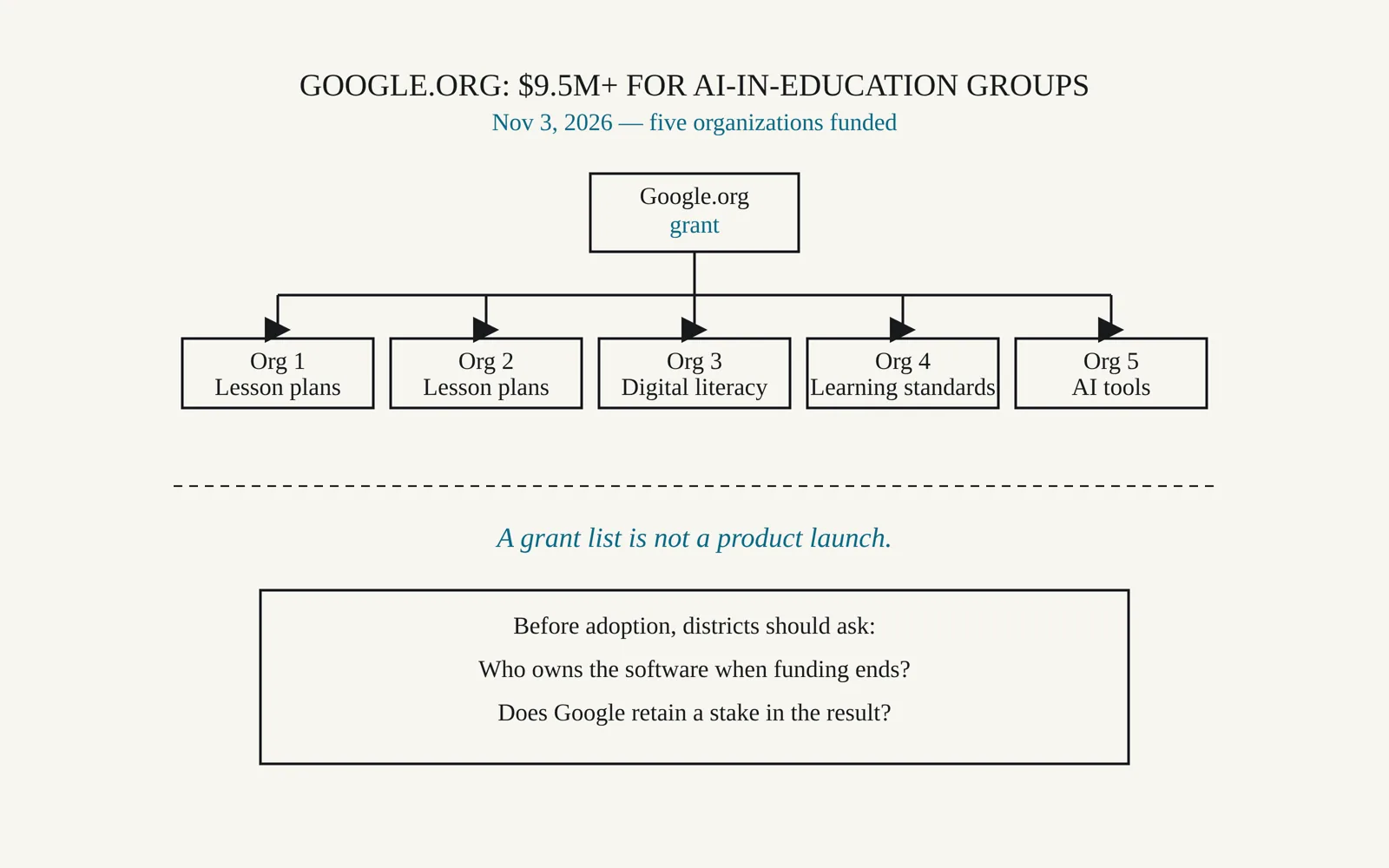
On November 3, 2026, Google.org said it is providing over $9.5 million in funding across five organizations building AI tools with and for educators, spanning lesson planning, digital literacy and learning standards work. (Google newsroom post on Google.org funding for AI education tools, published November 3, 2026)
Open the photograph at full size
Photograph: Diagram: AI Journey
Read the full description of this diagram
Diagram drawn for this item: Google.org Funds Five Groups Building AI Tools For Teachers. On November 3, 2026, Google.org said it is providing over $9.5 million in funding across five organizations building AI tools with and for educators, spanning lesson planning, digital literacy and learning standards work. A grant list is not a product launch, so a district weighing whether to adopt any resulting tool should ask who owns the software once the money runs out and whether Google keeps a stake in what gets built.
What it means for you
A grant list is not a product launch, so a district weighing whether to adopt any resulting tool should ask who owns the software once the money runs out and whether Google keeps a stake in what gets built.
In more detail
Google.org announced on November 3, 2026, that it is funding five organizations working on AI tools aimed at teachers and students, putting more than $9.5 million behind projects that range from classroom literacy work to shared technical standards. The post frames the funding as a continuation of the philanthropic arm’s earlier work supporting free AI training for educators, rather than a new program with its own name.
The five recipients cover different parts of the same problem. The City University of New York will use its share to build digital and computational literacy through its Computing Integrated Teacher Education initiative. Fab AI is working with Google DeepMind and the Gates Foundation to build open models meant to help teachers plan lessons and support early reading, which is the one recipient tying the grant directly to Google’s own research arm rather than to an outside curriculum group. The Krause Center for Innovation will help school districts bring what the post calls responsible AI education into classrooms. Teaching Lab is piloting something called Coherence OS, described as an operating system giving teachers and school leaders real time support. 1EdTech Global is building public infrastructure for learning standards that other vendors can build against.
The numbers
Google.org put the total at over $9.5 million spread across the five organizations, with no public breakdown by recipient in the post itself. The post does not state a grant period, a renewal date or any condition attached to continued funding, so a reader cannot yet tell whether this is a one time disbursement or the first of several rounds.
For schools and ed-tech buyers, the distinction between funding and procurement matters more than the headline figure. None of the five groups is shipping a Google branded product, and the post stops short of saying whether any resulting tool will carry licensing terms, data handling commitments or a support window once the grant period ends. A district that reads this as Google entering classroom software directly would be reading past what was actually announced, which is a set of grants to outside organizations rather than a new Google product.
Sources
Sources read
Google newsroom post on Google.org funding for AI education tools, published November 3, 2026 (blog.google)
Newsroom read
Cite this
AI Journey, "Google.org Funds Five Groups Building AI Tools For Teachers", 3 Nov 2026, https://aijourney.space/updates/2026-11-03-we-re-providing-funding-for-organizations-building-ai-for-teachers/ (source: Google, verified 3 Nov 2026)
Next in the stream
Perplexity AI Researchers Detail LoRA Recipe For Converting Four Language Models To Diffusion
A paper associated with Perplexity AI describes BYOD, a LoRA-only method that converts standard autoregressive language models into diffusion language models without full retraining.
Previous
Heimstaden Turns To ChatGPT Enterprise And Codex For Property Management
Heimstaden, a European residential landlord, has adopted OpenAI's ChatGPT Enterprise and its Codex tool across parts of its property management operations.
Next
More in Google
Gemini Negotiation Paper Finds Persona Effects Shift By Language
A new paper testing Google's Gemini model in buyer-seller negotiations found that the same persona instruction produced different deal outcomes in English and Korean.
Paper Finds Gemini Monitor Beats Small Models At Spotting Reward Hacking
A new paper tests whether Google's Gemini 3.1 Flash-Lite can tell real reward hacking apart from honest failure better than small local monitors.
Gemini Notebook Adds Free Textbooks From OpenStax And S Chand
Google added free textbooks to Gemini Notebook, letting students ground study guides and quizzes directly in course materials from OpenStax and S Chand.