What happened
Published here
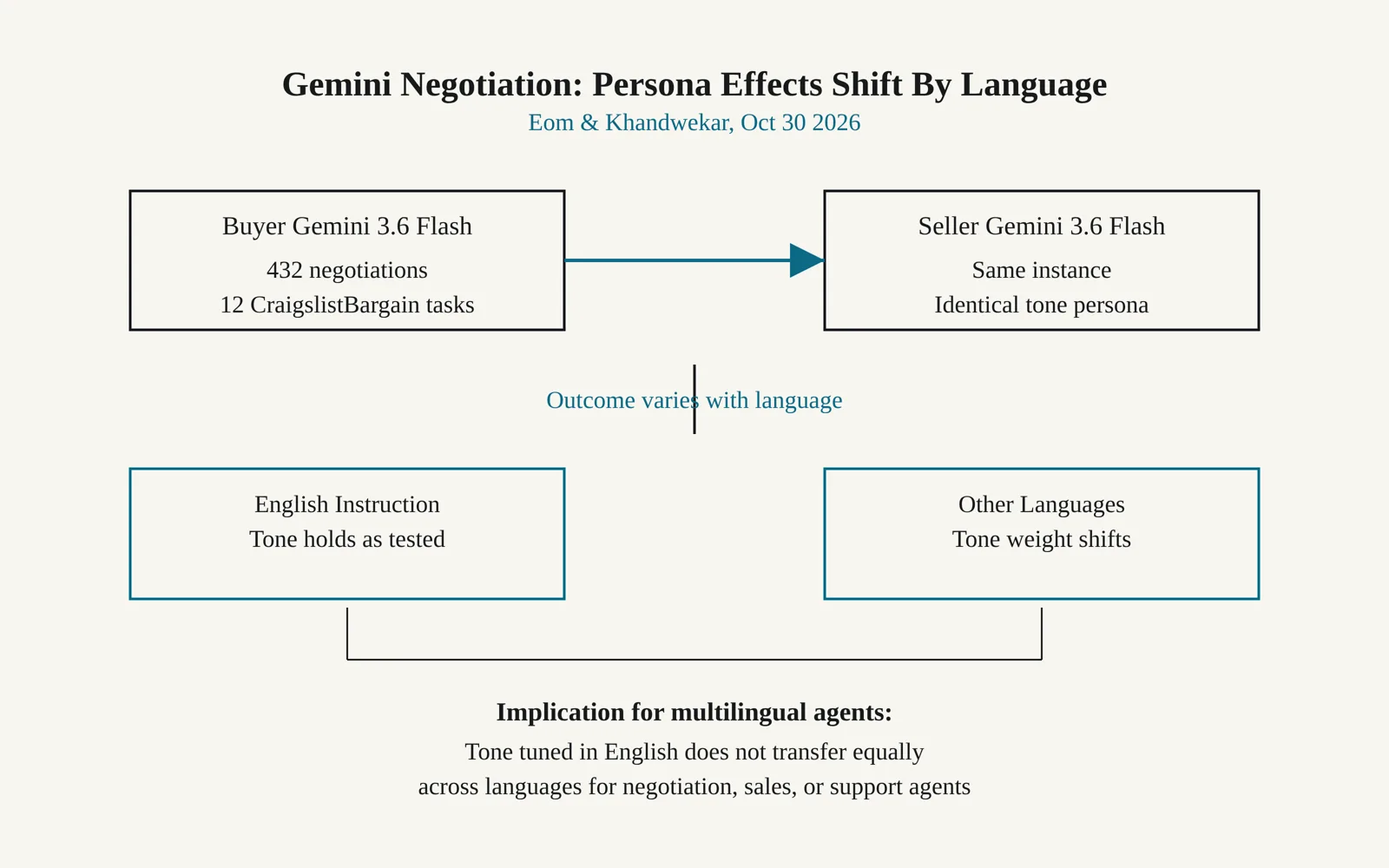
On October 30, 2026, researchers Saehee Eom and Tejas Khandwekar posted a paper describing 432 attempted negotiations run with identical buyer and seller instances of Google's Gemini 3.6 Flash, testing the same 12 CraigslistBargain scenarios in English and Korean under a pilot-scale design that crossed interaction language, seller urgency, and buyer persona. (arXiv paper, Cross-Lingual Persona Effects in LLM Negotiation, posted October 30, 2026)
Open the photograph at full size
Photograph: Diagram: AI Journey
Read the full description of this diagram
Diagram drawn for this item: Gemini Negotiation Paper Finds Persona Effects Shift By Language. On October 30, 2026, researchers Saehee Eom and Tejas Khandwekar posted a paper describing 432 attempted negotiations run with identical buyer and seller instances of Google's Gemini 3.6 Flash, testing the same 12 CraigslistBargain... For anyone building a Gemini powered negotiation, support, or sales agent meant to serve customers in more than one language, this work means a tone instruction tuned and tested in English cannot be assumed to carry the same weight once...
The numbers
Korean agreement rate
77.3%
Share of Korean-language negotiations that reached agreement
English agreement rate
52.5%
Share of English-language negotiations that reached agreement
Attempted negotiations
432
Total negotiations run across the 2x2x3 design
Seller politeness mitigation
11.7%
Share of Korean seller turns softening a face-threatening act, versus 3.6% in English
Read from arXiv paper, Cross-Lingual Persona Effects in LLM Negotiation, posted October 30, 2026
What it means for you
For anyone building a Gemini powered negotiation, support, or sales agent meant to serve customers in more than one language, this work means a tone instruction tuned and tested in English cannot be assumed to carry the same weight once the conversation shifts into Korean, so a team shipping that workflow abroad owes itself a fresh round of evaluation rather than a straight translation of its prompts.
In more detail
Researchers paired identical buyer and seller instances of Google’s Gemini 3.6 Flash and had them negotiate the same used-item scenarios twice, once in English and once in Korean, while holding the buyer’s persona, the seller’s urgency, and the item being haggled over fixed. The point of the exercise was to test what the authors call cross-lingual social-policy fidelity: whether telling a model to act “headstrong” or “cooperative” produces the same behavior no matter which language the conversation is conducted in.
It did not. Korean-language negotiations closed far more often than English ones, and the gap only showed up for buyers instructed to be neutral or headstrong; cooperative buyers were already reaching deals almost every time in both languages, leaving no room for a gap to appear. The opening offers buyers made barely changed between languages, so the difference was not in where the conversation started. It showed up later, through sellers who conceded more ground in Korean, landed on lower agreed prices, and wrapped up with a smaller final gap between the two sides’ positions. A second run using a different model, Qwen3.7 Flash, as both agents produced a smaller but directionally similar pattern of Korean sellers being more willing to settle.
The paper’s pragmatic analysis points to a mechanical explanation rather than a mysterious one: rejections and counter-offers appeared at similar rates in both languages, but Korean dialogue wrapped those same moves in far more politeness mitigation, particularly from sellers. A blunt “no” in English became a softened refusal in Korean, and that softening appears to have made sellers more willing to keep conceding.
The numbers
- Korean negotiations reached agreement 77.3% of the time, against 52.5% in English, a gap the authors report as statistically significant after correction.
- The study ran 432 attempted negotiations in total across its design.
- Korean sellers used politeness mitigation on 11.7% of turns that contained a face-threatening act such as a rejection, versus 3.6% for English sellers.
For teams building Gemini-based agents meant to operate in several languages, the lesson is not that Korean produces friendlier outcomes by accident. It is that a persona prompt is not a portable unit: its behavioral effect, measured here in whether a deal closes at all, can move by more than twenty points simply because the surrounding language carries different norms for softening a refusal, which argues for testing tone instructions separately in each deployed language rather than trusting one English evaluation to stand in for all of them.
Sources
Sources read
arXiv paper, Cross-Lingual Persona Effects in LLM Negotiation, posted October 30, 2026 (arxiv.org)
Paper read
Cite this
AI Journey, "Gemini Negotiation Paper Finds Persona Effects Shift By Language", 3 Nov 2026, https://aijourney.space/updates/2026-11-03-cross-lingual-persona-effects-in-llm-negotiation/ (source: arXiv, verified 3 Nov 2026)
Next in the stream
Paper Finds Gemini Monitor Beats Small Models At Spotting Reward Hacking
A new paper tests whether Google's Gemini 3.1 Flash-Lite can tell real reward hacking apart from honest failure better than small local monitors.
Previous
Perplexity AI Researchers Detail LoRA Recipe For Converting Four Language Models To Diffusion
A paper associated with Perplexity AI describes BYOD, a LoRA-only method that converts standard autoregressive language models into diffusion language models without full retraining.
Next
More in Google
Google.org Funds Five Groups Building AI Tools For Teachers
Google.org is funding five organizations building AI tools for teachers, pairing Google DeepMind's model work with grants aimed at classroom use.
Gemini Notebook Adds Free Textbooks From OpenStax And S Chand
Google added free textbooks to Gemini Notebook, letting students ground study guides and quizzes directly in course materials from OpenStax and S Chand.
Google Shows How to Turn Notes Into Resume Bullets With Gemini
Google's newsroom published a short guide showing how the Gemini app can turn rough, unedited notes about past jobs into polished resume bullets.