Event Published Models and productsGoogle
Google Shows How to Turn Notes Into Resume Bullets With Gemini
Google's newsroom published a short guide showing how the Gemini app can turn rough, unedited notes about past jobs into polished resume bullets.
What happened
Published here
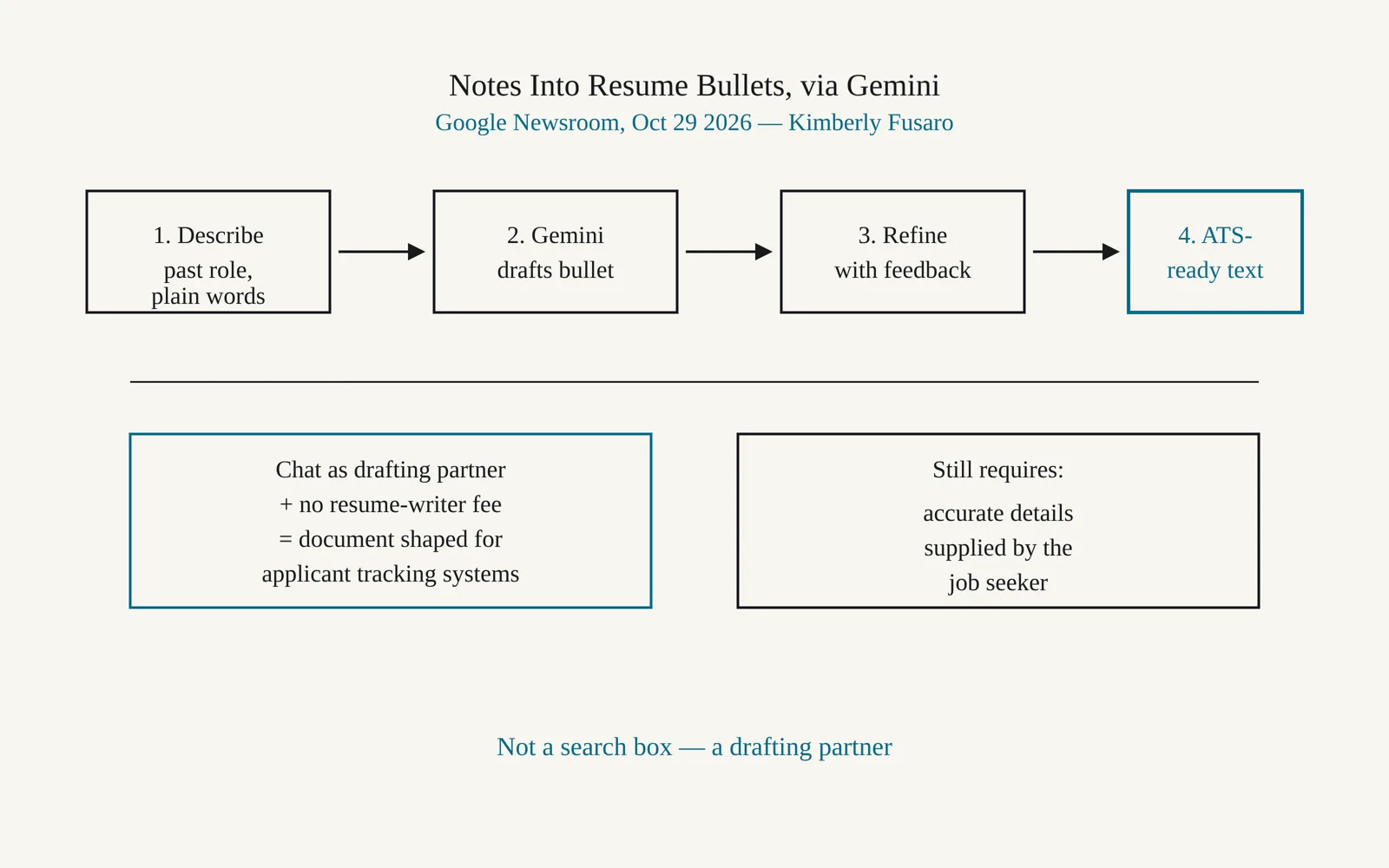
On October 29, 2026, Google published a newsroom post by contributor Kimberly Fusaro explaining a four step method for using the Gemini app to write resume bullets, in which a person describes their past roles in plain, unedited language, asks Gemini to act as a professional resume writer and produce four action verb bullets for a named role, chats back and forth to adjust tone and detail, then copies the result into their resume. (Google newsroom post, how to use Gemini to update your resume, published October 29, 2026)
Open the photograph at full size
Photograph: Diagram: AI Journey
Read the full description of this diagram
Diagram drawn for this item: Google Shows How to Turn Notes Into Resume Bullets With Gemini. On October 29, 2026, Google published a newsroom post by contributor Kimberly Fusaro explaining a four step method for using the Gemini app to write resume bullets, in which a person describes their past roles in plain, unedited language... A job seeker who treats a chat assistant as a drafting partner rather than a search box gets a document shaped for applicant tracking software without paying for a resume writer, but the method still asks the person to supply accurate...
What it means for you
A job seeker who treats a chat assistant as a drafting partner rather than a search box gets a document shaped for applicant tracking software without paying for a resume writer, but the method still asks the person to supply accurate details and to read every bullet back, since a model asked to sound executive and ATS-friendly will happily invent a polished phrase that overstates what actually happened on the job.
In more detail
Google’s newsroom used its Gemini App section to publish a short, practical post rather than a product launch: a four step method for turning scattered recollections of past jobs into resume copy. The post, credited to contributor Kimberly Fusaro and dated October 29, 2026, sits alongside other recent Gemini App posts about document generation and small business tools, suggesting the newsroom is treating everyday task guides as a recurring feature rather than a one-off.
The method itself is deliberately unstructured at the start. The first instruction tells a user to open Gemini and describe their past roles in raw, unpolished language rather than trying to write finished sentences. The second step hands Gemini a specific prompt: act as a professional resume writer, take the unedited notes, and produce four bullets for a named role, each opening with a strong action verb, in a tone the prompt itself calls executive, clear and ATS-friendly. The third step is a back and forth conversation to adjust details, tone and focus, and the fourth is simply copying the finished bullets into a resume document.
What the post does not mention is any safeguard against invented detail. A model prompted to sound executive and polished has every incentive to supply confident, specific sounding language even when the source notes were vague, and nothing in the four steps asks the user to verify that each bullet still matches what they actually did in the role. The guide also assumes the reader already has a sense of the role they are targeting, since the prompt requires naming a specific position before Gemini can write toward it.
The numbers
The guide is built around a fixed four step sequence, from rambling notes through a single structured prompt to a finished set of bullets. Each pass through the method is asked to return four bullets per role rather than a longer list, which keeps the output short enough to review and edit by hand before it reaches a real resume. No separate figures, such as a cost, a usage limit or a subscription tier, appear anywhere in the post, which reads as a plain workflow tip for the free Gemini app rather than a pitch for a paid feature.
For a reader who already uses Gemini for other writing tasks, the real change here is narrower than it sounds: Google is not shipping a new resume tool, it is publishing one specific prompt and expecting people to reuse it, which means the quality of the result depends entirely on how much detail the person types into the first step.
Sources
Sources read
Google newsroom post, how to use Gemini to update your resume, published October 29, 2026 (blog.google)
Newsroom read
Cite this
AI Journey, "Google Shows How to Turn Notes Into Resume Bullets With Gemini", 1 Nov 2026, https://aijourney.space/updates/2026-11-01-how-to-use-gemini-to-update-your-resume/ (source: Google, verified 1 Nov 2026)
Next in the stream
Gemini App Adds Immersive Explorations For Student Hub Users
Google added a library of immersive explorations to the Gemini app's student hub, letting learners move through topics layer by layer from one interactive panel.
Previous
Gemini Notebook Adds Free Textbooks From OpenStax And S Chand
Google added free textbooks to Gemini Notebook, letting students ground study guides and quizzes directly in course materials from OpenStax and S Chand.
Next
More in Google
Google.org Funds Five Groups Building AI Tools For Teachers
Google.org is funding five organizations building AI tools for teachers, pairing Google DeepMind's model work with grants aimed at classroom use.
Gemini Negotiation Paper Finds Persona Effects Shift By Language
A new paper testing Google's Gemini model in buyer-seller negotiations found that the same persona instruction produced different deal outcomes in English and Korean.
Paper Finds Gemini Monitor Beats Small Models At Spotting Reward Hacking
A new paper tests whether Google's Gemini 3.1 Flash-Lite can tell real reward hacking apart from honest failure better than small local monitors.