Event Published ResearchPerplexity AI
Perplexity AI Researchers Detail LoRA Recipe For Converting Four Language Models To Diffusion
A paper associated with Perplexity AI describes BYOD, a LoRA-only method that converts standard autoregressive language models into diffusion language models without full retraining.
What happened
Published here
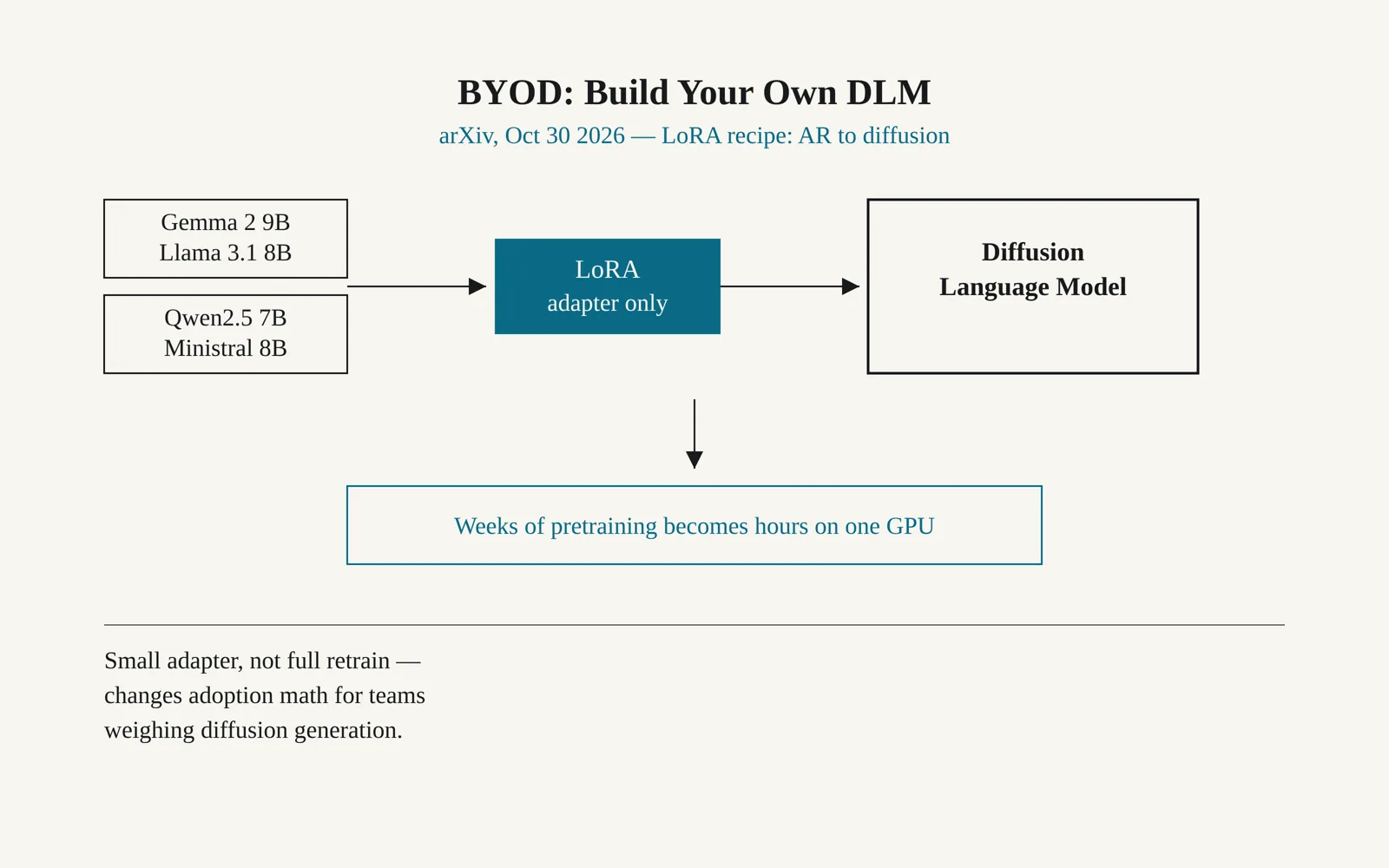
On October 30, 2026, researchers published a paper on arXiv titled BYOD: Build Your Own DLM, describing a parameter-efficient recipe that converts four autoregressive language models, Gemma 2 9B, Llama 3.1 8B, Qwen2.5 7B and Ministral 8B, into diffusion language models using only LoRA adapters while every base-model parameter stays frozen. (arXiv preprint, BYOD: Build Your Own DLM, submitted October 30, 2026)
Open the photograph at full size
Photograph: Diagram: AI Journey
Read the full description of this diagram
Diagram drawn for this item: Perplexity AI Researchers Detail LoRA Recipe For Converting Four Language Models To Diffusion. On October 30, 2026, researchers published a paper on arXiv titled BYOD: Build Your Own DLM, describing a parameter-efficient recipe that converts four autoregressive language models, Gemma 2 9B, Llama 3.1 8B, Qwen2.5 7B and Ministral 8B... For teams weighing whether to adopt diffusion generation, a recipe that touches only a small adapter rather than retraining a whole model changes the calculation from a multi-week pretraining budget to a few hours on one rented GPU, which...
The numbers
Adapter share of parameters
4.1-5.8%
LoRA adapters as a share of each converted model's final parameter count
Tokens per conversion
102.4M
Maximum tokens needed for a 25,000-iteration conversion run
BYOD-Gemma accuracy
50.6%
Average accuracy on the paper's nine-task evaluation
LLaDA 8B Instruct accuracy
51.9%
Same nine-task evaluation, for comparison
Read from arXiv preprint, BYOD: Build Your Own DLM, submitted October 30, 2026
What it means for you
For teams weighing whether to adopt diffusion generation, a recipe that touches only a small adapter rather than retraining a whole model changes the calculation from a multi-week pretraining budget to a few hours on one rented GPU, which lowers the bar for anyone who wants to test parallel decoding against an existing chat deployment rather than committing to it blind. The gap the paper reports at low step counts also tells a buyer exactly where the tradeoff still bites: faster generation comes with weaker open-ended text quality until more diffusion steps are spent, so a workflow built around short summaries or classification prompts has less to lose than one built around long free-form writing.
In more detail
Diffusion language models generate text by refining a fully masked sequence in parallel rather than producing one token after another, which in principle allows faster and more flexible output than the usual autoregressive approach. Building one from scratch has mostly meant expensive pretraining or fine-tuning every parameter of an existing model. The paper published on arXiv on October 30, 2026, proposes a cheaper middle path called BYOD, for Build Your Own DLM.
The method attaches LoRA adapters, small trainable additions that sit on top of a frozen base model, to four openly available models: Gemma 2 9B, Llama 3.1 8B, Qwen2.5 7B and Ministral 8B. The authors say this is the first reported conversion of a Mistral-family model into a diffusion generator. None of the base model’s own weights change during conversion, only the adapters do, and those adapters make up between 4.1 and 5.8 percent of the resulting model’s final parameter count. Each conversion runs for 25,000 iterations, needs at most 102.4 million tokens, and finishes in 3.1 to 4.0 hours on a single Google Colab GPU, a budget closer to a weekend side project than a training run requiring a data center.
All four converted models can generate text from a fully masked starting sequence and were shown in a controlled attention test to use context from both directions, the defining behavior of a diffusion model rather than a left-to-right one. The strongest conversion, built on Gemma, reached 50.6 percent average accuracy across nine evaluation tasks, close to the 51.9 percent scored by LLaDA 8B Instruct, an existing diffusion model trained from scratch, in the same test harness.
The paper is upfront about where the method still falls short. When generating 128 tokens in just 64 steps, a setting chosen to keep diffusion fast, BYOD’s perplexity ranged from 8.3 to 11.1, well above the 4.1 LLaDA achieved and far above the 2.2 to 3.0 the original autoregressive parent models scored on the same measure. The authors frame this gap, not the conversion cost, as the problem future work needs to close before adapter-based diffusion conversion becomes a practical substitute rather than a research demonstration.
The numbers
The adapters span 4.1 to 5.8 percent of each model’s final parameter count, each conversion needs at most 102.4 million tokens, BYOD-Gemma reached 50.6 percent average accuracy against LLaDA’s 51.9 percent on the same nine tasks, and generation quality at low step counts remains the open problem the authors flag for future work.
Sources
Sources read
arXiv preprint, BYOD: Build Your Own DLM, submitted October 30, 2026 (arxiv.org)
Paper read
Cite this
AI Journey, "Perplexity AI Researchers Detail LoRA Recipe For Converting Four Language Models To Diffusion", 3 Nov 2026, https://aijourney.space/updates/2026-11-03-byod-build-your-own-dlm-efficient-autoregressive-to-diffusion-language-m/ (source: arXiv, verified 3 Nov 2026)
Next in the stream
Gemini Negotiation Paper Finds Persona Effects Shift By Language
A new paper testing Google's Gemini model in buyer-seller negotiations found that the same persona instruction produced different deal outcomes in English and Korean.
Previous
Google.org Funds Five Groups Building AI Tools For Teachers
Google.org is funding five organizations building AI tools for teachers, pairing Google DeepMind's model work with grants aimed at classroom use.
Next
More in Perplexity AI
Paper Proposes Message-Passing Method For Compressing LLM Weights
A new arXiv paper proposes a message-passing method for compressing large language model weights, the kind of efficiency work that underlies answer engines like Perplexity AI.
Researchers Publish S-SALAAD Framework For Sparse Large Model Inference
A new paper on compressing large models for edge devices matters to Perplexity AI and any company whose answer engine has to run inference away from a data center.
Paper Proposes Meaning-Level Reward To Go Beyond Next-Token Prediction
A new arXiv paper proposes training language models to reward meaning rather than exact wording, a shift relevant to answer engines like Perplexity.