Event Published ResearchPerplexity AI
Paper Proposes Message-Passing Method For Compressing LLM Weights
A new arXiv paper proposes a message-passing method for compressing large language model weights, the kind of efficiency work that underlies answer engines like Perplexity AI.
What happened
Published here
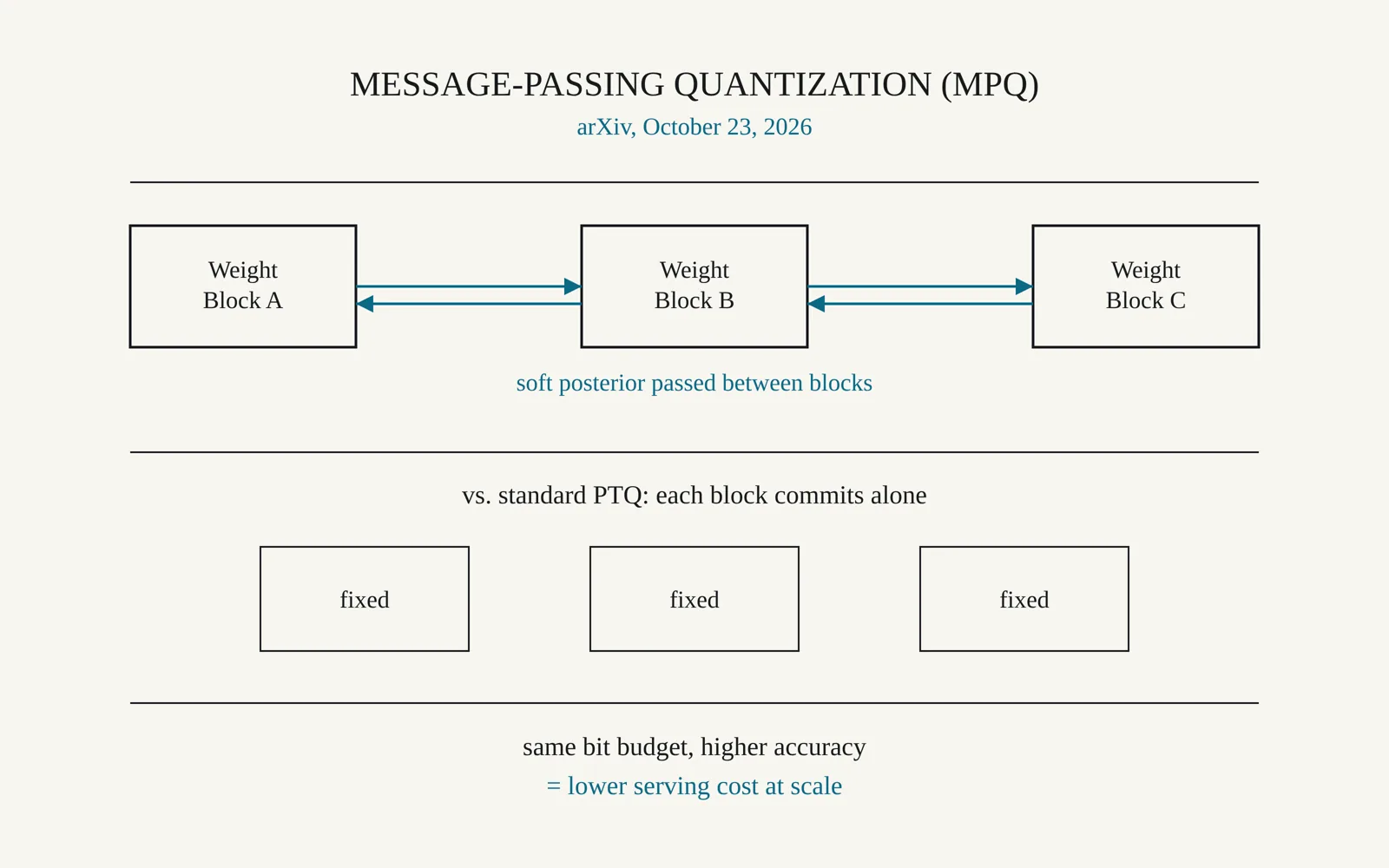
On October 23, 2026, researchers posted a paper to arXiv describing Message-Passing Quantization (MPQ), a post-training quantization method that keeps soft posterior information across weight blocks instead of committing each block to a single codeword immediately, and tested it on dense language models from the Llama, Qwen and Mistral families. (arXiv paper, MPQ: A Message-Passing View of Post-Training Quantization, submitted October 23, 2026)
Open the photograph at full size
Photograph: Diagram: AI Journey
Read the full description of this diagram
Diagram drawn for this item: Paper Proposes Message-Passing Method For Compressing LLM Weights. On October 23, 2026, researchers posted a paper to arXiv describing Message-Passing Quantization (MPQ), a post-training quantization method that keeps soft posterior information across weight blocks instead of committing each block to a... For any company running large models cheaply enough to answer millions of queries a day, a compression method that squeezes more accuracy out of the same bit budget changes the hardware bill rather than the headline feature list, and a...
The numbers
Lattice quantization
2-bit
One precision level MPQ was tested against for dense language models
Scalar quantization
4-bit
The higher of two scalar precision levels tested
Submission size
316 KB
Size of the uploaded paper as recorded in the submission history
Read from arXiv paper, MPQ: A Message-Passing View of Post-Training Quantization, submitted October 23, 2026
What it means for you
For any company running large models cheaply enough to answer millions of queries a day, a compression method that squeezes more accuracy out of the same bit budget changes the hardware bill rather than the headline feature list, and a reader comparing answer engines should ask whether the serving stack behind one has adopted a technique like this before assuming two products built on similarly sized models cost the same to run.
In more detail
Post-training quantization is the standard trick for shipping a large language model that does not need a rack of accelerators to answer a single prompt: weights get rounded down to a handful of bits after training, with no retraining step. The paper, posted to arXiv on October 23, 2026 by Yanshuo Chen, Chenxi Liu, Reza Shirkavand and Heng Huang, argues that the common solvers for this step, including GPTQ, LDLQ and block coordinate descent, all share a weakness. Each one locks a block of weights to its single best codeword before looking at the neighboring blocks, so any near-optimal alternative that a later block’s needs would have favored is thrown away the moment it is picked.
The authors reframe row-wise quantization as inference over a posterior distribution across discrete codebooks, and show that the existing solvers are what that framework looks like at zero temperature, where only the single top codeword per block survives. Their method, Message-Passing Quantization, instead carries soft posterior information between blocks for as long as possible and only commits to hard codewords at the very end. It does this in two stages: a vector approximate message passing step computes rough blockwise posteriors, and a second pass refines a hard-decision starting point with exact block coordinate descent.
The numbers
Testing covered 2-bit lattice quantization and 3- and 4-bit scalar quantization, run across dense language models drawn from the Llama, Qwen and Mistral families. The paper reports that MPQ improves both perplexity and zero-shot accuracy over the strongest hard-decision baselines at each precision level, and that it stacks cleanly with preprocessing steps such as activation-aware scaling and incoherence processing rather than competing with them. The submission itself runs to 316 KB and has been accepted at NeurIPS 2026, with code released alongside the paper.
For a reader outside the research community, the practical question is what a method like this changes about deploying a model rather than training one. Quantization quality at low bit widths sets how much memory and compute a served model needs per query, which in turn sets how cheaply a company can run an answer engine or a chat product at scale. A technique that narrows the accuracy gap between, say, 2-bit and full precision weights lets the same hardware serve a larger model, or the same model serve more users, without a retraining bill. None of that is visible in a product’s feature list, but it shows up eventually in what a plan costs or how fast it answers.
Sources
Sources read
Cite this
AI Journey, "Paper Proposes Message-Passing Method For Compressing LLM Weights", 27 Oct 2026, https://aijourney.space/updates/2026-10-27-mpq-a-message-passing-view-of-post-training-quantization/ (source: arXiv, verified 27 Oct 2026)
Next in the stream
Gemini 2.5 Pro Tested in Multi-Agent Drug Safety Causality Framework
Researchers built a four-agent causality assessment system using Google's Gemini 2.5 Pro and DeepSeek-V3.2 to review drug safety case reports against expert judgment.
Previous
New Paper Introduces Psi-0.6, a Unified Vision-Language World Model
A new paper introduces Psi-0.6, a unified vision-language world model that threads perception, language, geometry and simulation into one shared reasoning process.
Next
More in Perplexity AI
Perplexity AI Researchers Detail LoRA Recipe For Converting Four Language Models To Diffusion
A paper associated with Perplexity AI describes BYOD, a LoRA-only method that converts standard autoregressive language models into diffusion language models without full retraining.
Researchers Publish S-SALAAD Framework For Sparse Large Model Inference
A new paper on compressing large models for edge devices matters to Perplexity AI and any company whose answer engine has to run inference away from a data center.
Paper Proposes Meaning-Level Reward To Go Beyond Next-Token Prediction
A new arXiv paper proposes training language models to reward meaning rather than exact wording, a shift relevant to answer engines like Perplexity.