Event Published ResearchPerplexity AI
Paper Proposes Meaning-Level Reward To Go Beyond Next-Token Prediction
A new arXiv paper proposes training language models to reward meaning rather than exact wording, a shift relevant to answer engines like Perplexity.
What happened
Published here
On October 11, 2026, researchers Haoran Zheng and Chen Shani posted a paper on arXiv titled Conceptizer: Next-Token Prediction Is Not All You Need, describing a training framework that adds a meaning-level reward alongside standard next-token prediction, tested across 3 model families at 1B-8B parameters. (arXiv abstract page for Conceptizer: Next-Token Prediction Is Not All You Need, submitted October 11, 2026)
Open the photograph at full size
Photograph: Diagram: AI Journey
Read the full description of this diagram
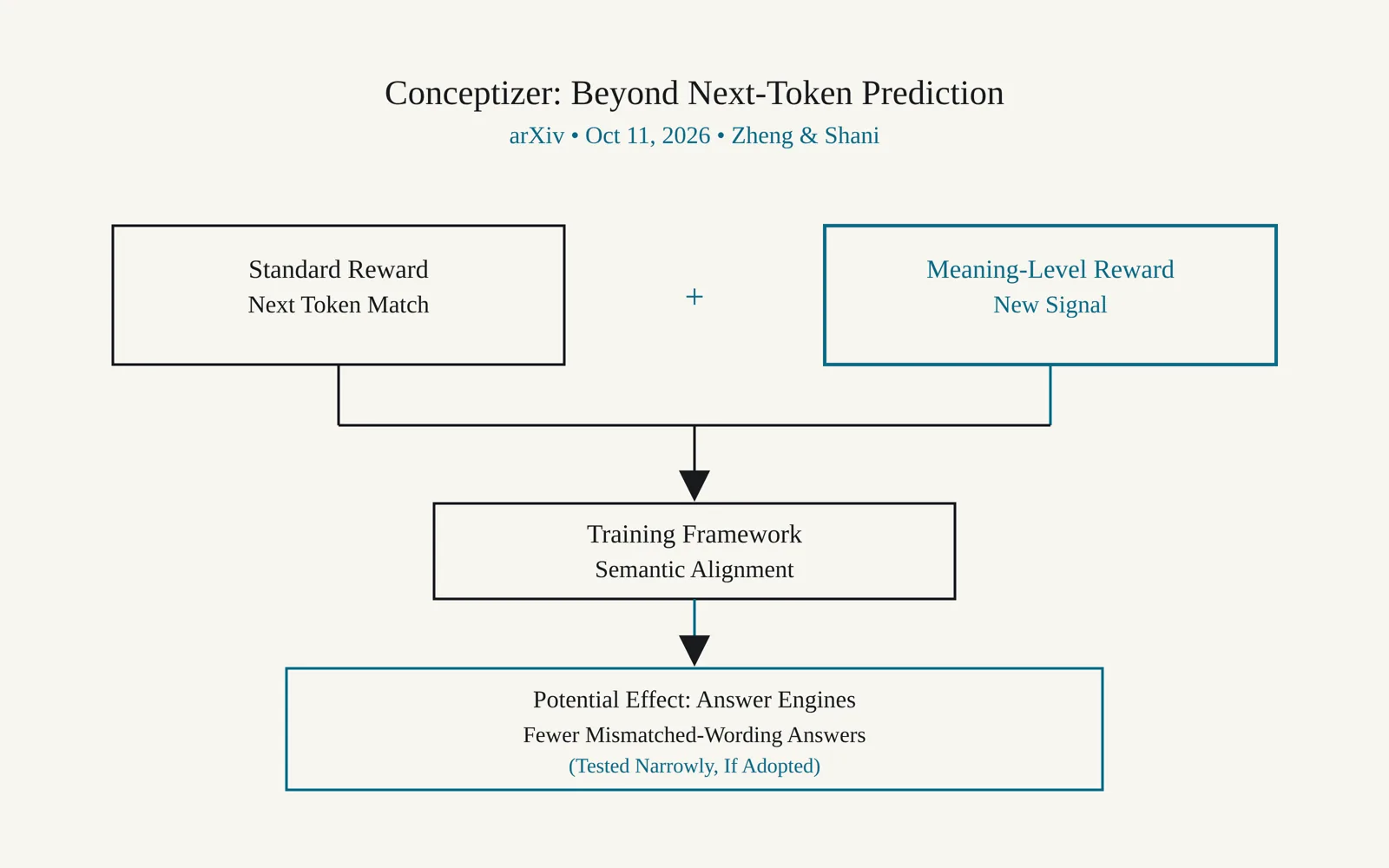
Diagram drawn for this item: Paper Proposes Meaning-Level Reward To Go Beyond Next-Token Prediction. On October 11, 2026, researchers Haoran Zheng and Chen Shani posted a paper on arXiv titled Conceptizer: Next-Token Prediction Is Not All You Need, describing a training framework that adds a meaning-level reward alongside standard... For a reader who relies on Perplexity's answer engine, a training method that rewards meaning rather than exact wording could mean fewer oddly phrased or synonym mismatched answers if such a method were adopted, though the paper tests only...
The numbers
Concept vocabulary
~9K
fixed, model-agnostic vocabulary of concepts built from contextual synonyms
Model families tested
3
model families the method was applied to
Parameter range
1B-8B
parameter sizes across the tested models
Baselines compared
3
baselines the method was measured against
What it means for you
For a reader who relies on Perplexity's answer engine, a training method that rewards meaning rather than exact wording could mean fewer oddly phrased or synonym mismatched answers if such a method were adopted, though the paper tests only smaller open research models and makes no claim about any shipped product. It is a reminder that the quality of an answer engine's prose depends on training choices made well before a query ever reaches the box.
In more detail
Standard language model training rewards a model for producing exactly one next word and penalizes every other way of saying the same thing, even a plain synonym. The paper, posted to arXiv on October 11, 2026 by Haoran Zheng and Chen Shani, argues that this punishes models for phrasing that is correct in meaning but not identical in wording, and proposes a fix called Conceptizer.
Conceptizer adds a second layer on top of ordinary next-token training. It builds a fixed, model-agnostic vocabulary of roughly 9,000 concepts drawn from contextual synonyms, then maps each next-token probability distribution onto a distribution over those concepts. When a model is rewarded for landing on the right meaning, that reward is shared across every wording that expresses the same concept, rather than being handed to a single correct token and withheld from its synonyms. The authors say this adds a concept-level training signal without adding any new parameters to the underlying model.
The method was tested across 3 model families ranging from 1B to 8B parameters. Against all 3 baselines, Conceptizer produced the lowest held-out perplexity measured at concept-target positions and assigned the highest probability to contextual synonyms at those same positions. It also raised performance on downstream knowledge and sentiment tasks while staying roughly level on commonsense reasoning tasks, according to the abstract.
The numbers
- The concept vocabulary used for training runs to roughly 9,000 entries, built from contextual synonyms rather than from the model’s own token set.
- The method was applied to 3 separate model families, spanning a parameter range of 1B to 8B.
- Across all 3 baselines tested, Conceptizer came out ahead on held-out perplexity at the positions where a concept, rather than one specific word, was the target.
For readers who use an answer engine such as Perplexity, this kind of research sits upstream of the product rather than inside it. The quality of a generated answer, including whether it sounds natural when paraphrasing a source rather than reproducing it word for word, is shaped by choices made at training time long before any underlying model is wired into a search box. The paper does not name Perplexity AI or any deployed product, and its tests stop at 8B-parameter research models, so any read-across to a commercial answer engine is a question for later work rather than a conclusion this paper draws itself.
Sources
Sources read
Cite this
AI Journey, "Paper Proposes Meaning-Level Reward To Go Beyond Next-Token Prediction", 27 Oct 2026, https://aijourney.space/updates/2026-10-27-conceptizer-next-token-prediction-is-not-all-you-need/ (source: arXiv, verified 27 Oct 2026)
Next in the stream
Paper Finds Generative Recommenders Vulnerable to Low-Volume Poisoning
A new preprint finds generative recommender systems can be pushed toward hidden targets once attackers plant a small share of fake interactions.
Previous
Nvidia Opens Vera Rubin Rack Designs to Open Compute Project
At the OCP Global Summit, Nvidia contributed Vera Rubin rack and compute tray designs to open standards, with Cisco, Google, Meta and Microsoft joining the effort.
Next
More in Perplexity AI
Perplexity AI Researchers Detail LoRA Recipe For Converting Four Language Models To Diffusion
A paper associated with Perplexity AI describes BYOD, a LoRA-only method that converts standard autoregressive language models into diffusion language models without full retraining.
Paper Proposes Message-Passing Method For Compressing LLM Weights
A new arXiv paper proposes a message-passing method for compressing large language model weights, the kind of efficiency work that underlies answer engines like Perplexity AI.
Researchers Publish S-SALAAD Framework For Sparse Large Model Inference
A new paper on compressing large models for edge devices matters to Perplexity AI and any company whose answer engine has to run inference away from a data center.