Event Published ResearchResearch
Paper Finds Generative Recommenders Vulnerable to Low-Volume Poisoning
A new preprint finds generative recommender systems can be pushed toward hidden targets once attackers plant a small share of fake interactions.
What happened
Published here
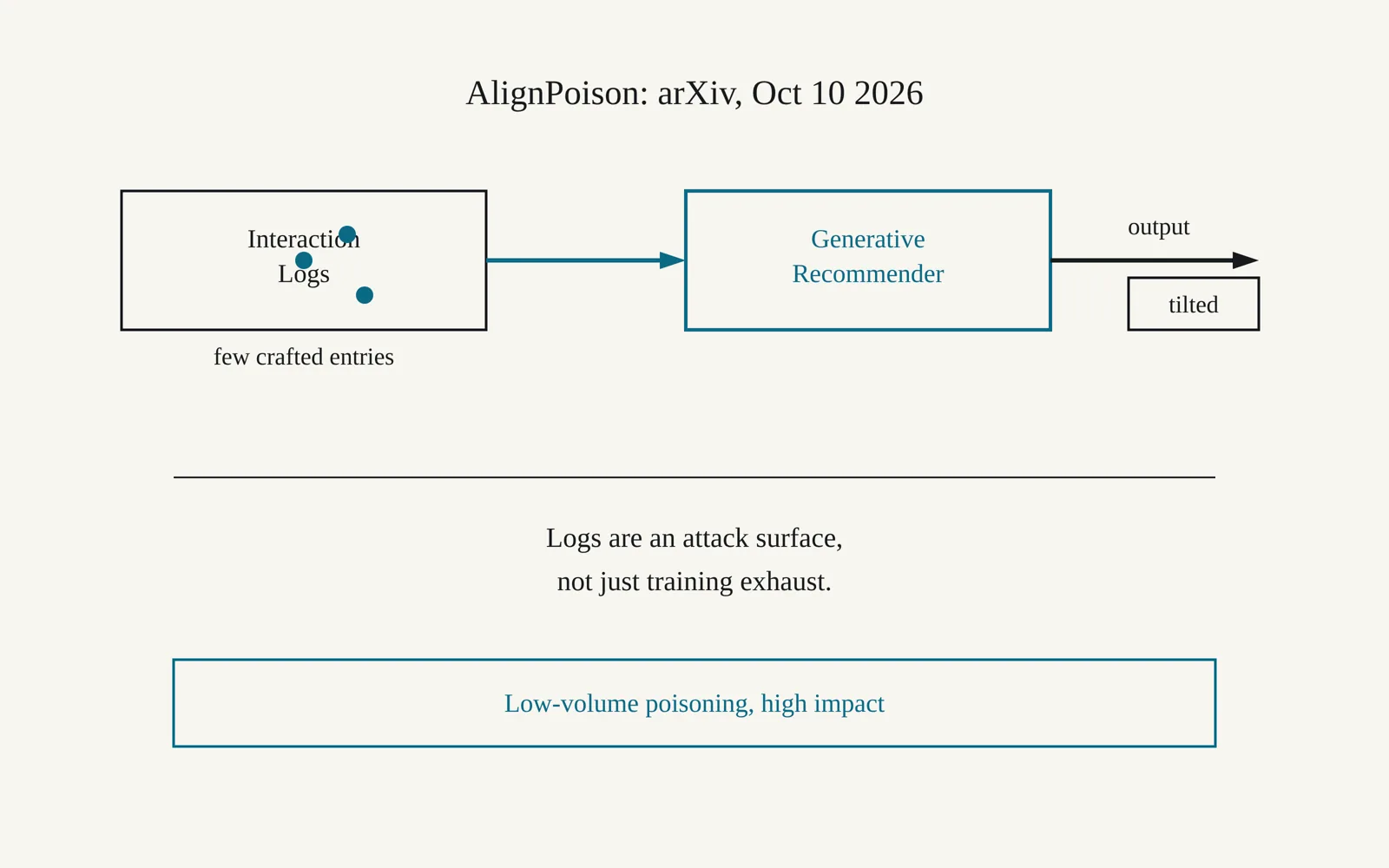
On October 10, 2026, researchers posted a preprint on arXiv titled AlignPoison, describing an attack on generative recommenders, systems that produce recommendations through autoregressive decoding rather than older ranking methods. Working under a black box setup where an adversary can only add a limited number of fake interactions and send queries to a recommendation API, the authors found that planting fewer than 1% synthetic interactions was enough to make the system far more likely to promote a chosen target whenever a specific trigger showed up in a user's history. (AlignPoison preprint on arXiv, posted October 10, 2026)
Open the photograph at full size
Photograph: Diagram: AI Journey
Read the full description of this diagram
Diagram drawn for this item: Paper Finds Generative Recommenders Vulnerable to Low-Volume Poisoning. On October 10, 2026, researchers posted a preprint on arXiv titled AlignPoison, describing an attack on generative recommenders, systems that produce recommendations through autoregressive decoding rather than older ranking methods. Any team running a generative recommender behind a public query interface should read this as a reason to treat its own interaction logs as an attack surface, not just training exhaust, since a handful of carefully shaped entries can tilt...
The numbers
Poisoning share
1%
Share of synthetic interactions injected that raised promotion odds
ASR lift
16.3 percentage points
Maximum improvement in attack success rate the method achieved over baselines
Read from AlignPoison preprint on arXiv, posted October 10, 2026
What it means for you
Any team running a generative recommender behind a public query interface should read this as a reason to treat its own interaction logs as an attack surface, not just training exhaust, since a handful of carefully shaped entries can tilt what gets surfaced to shoppers or viewers without anyone touching the model weights. It also raises an operational question for anyone who lets outside partners or scrapers contribute interaction data: a feed that looked statistically unremarkable last quarter might already carry a planted prefix waiting for its trigger.
In more detail
Generative recommenders have mostly been studied for how flexibly they model a user’s history, not for how easily that history can be tampered with. This preprint asks the second question directly: if an attacker can only touch a small slice of the interaction log and otherwise treats the recommender as a sealed box, how far can they push it toward recommending something it otherwise would not?
The team’s answer is further than expected. Working against both single-mode and multi-mode generative recommendation setups, they built a framework called AlignPoison that searches a recommender’s own outputs for short prefixes, the handful of interactions that come right before a trigger event, which the model already treats as common and strongly tied to that trigger. Planting a few of those prefixes was enough to make a chosen target item far more likely to appear once the trigger showed up again in a real user’s session, even though the attacker never saw the model’s parameters or training process.
The study frames the weakness as decoding dependent rather than data dependent in the usual sense. Older ranking systems can be poisoned too, but the paper’s authors argue that autoregressive decoding gives an attacker a sharper lever: a prefix that aligns with how the model predicts the next interaction does more damage per injected row than an attacker could get from simply flooding a target with generic fake clicks.
The numbers
Two figures anchor the claim. The attack worked with fewer than 1% synthetic interactions added to the pool, a share small enough to hide inside normal data churn at most platforms. Against competitive poisoning baselines, the crafted prefixes pushed attack success rate up by as much as 16.3 percentage points, a gap the authors attribute to matching the prefix to the model’s own induced transition pattern rather than to brute volume.
The paper does not name a deployed product or vendor, and the authors describe their tests as benchmark experiments rather than an attack carried out against a live service. That leaves an open question for anyone operating a generative recommender in production: whether existing anomaly detection built for ranking-style poisoning would catch a prefix this short and this well aligned with the model’s own decoding behavior, or whether it would need a different kind of check altogether.
Sources
Sources read
AlignPoison preprint on arXiv, posted October 10, 2026 (arxiv.org)
Paper read
Cite this
AI Journey, "Paper Finds Generative Recommenders Vulnerable to Low-Volume Poisoning", 16 Oct 2026, https://aijourney.space/updates/2026-10-16-alignpoison-conditional-targeted-poisoning-of-generative-recommenders-vi/ (source: arXiv, verified 16 Oct 2026)
Next in the stream
Paper Shows Perplexity Metric Hides KV-Cache Quality Losses
A new arXiv paper tests KV-cache compression on a tiny on-device model and shows the perplexity metric, the word behind Perplexity AI's name, hides real quality losses that a new test catches.
Previous
Paper Proposes Meaning-Level Reward To Go Beyond Next-Token Prediction
A new arXiv paper proposes training language models to reward meaning rather than exact wording, a shift relevant to answer engines like Perplexity.
Next
More in Research
Study Finds Precedent Labels Sway Claude Haiku Approval Calls
A new paper tests Claude Haiku 5.5 alongside other models on refund and claim decisions, showing that past case labels shift approvals sharply.
Paper Tests Claude Opus 4.8 Agents on Conflicting Code Edits
A new paper benchmarks Claude Code running Claude Opus 4.8 against other coding agents on tasks where two agents edit the same shared codebase at once.
Perplexity AI Researchers Detail LoRA Recipe For Converting Four Language Models To Diffusion
A paper associated with Perplexity AI describes BYOD, a LoRA-only method that converts standard autoregressive language models into diffusion language models without full retraining.