Event Published ResearchPerplexity AI
Paper Shows Perplexity Metric Hides KV-Cache Quality Losses
A new arXiv paper tests KV-cache compression on a tiny on-device model and shows the perplexity metric, the word behind Perplexity AI's name, hides real quality losses that a new test catches.
What happened
Published here
On October 10, 2026, researchers posted EdgeLLM-Nano to arXiv, a measurement study that audits KV-cache compression and weight pruning on a nano-scale 8.39M parameter, 33.6 MB decoder-only language model built as a testbed for on-device deployment, finding that a polar-guided key-cache quantizer and a consistency-anchored progressive pruner both underperform simpler baselines once the compressed cache is actually used during generation. (arXiv paper on EdgeLLM-Nano, a KV-cache compression audit, submitted October 10, 2026)
Open the photograph at full size
Photograph: Diagram: AI Journey
Read the full description of this diagram
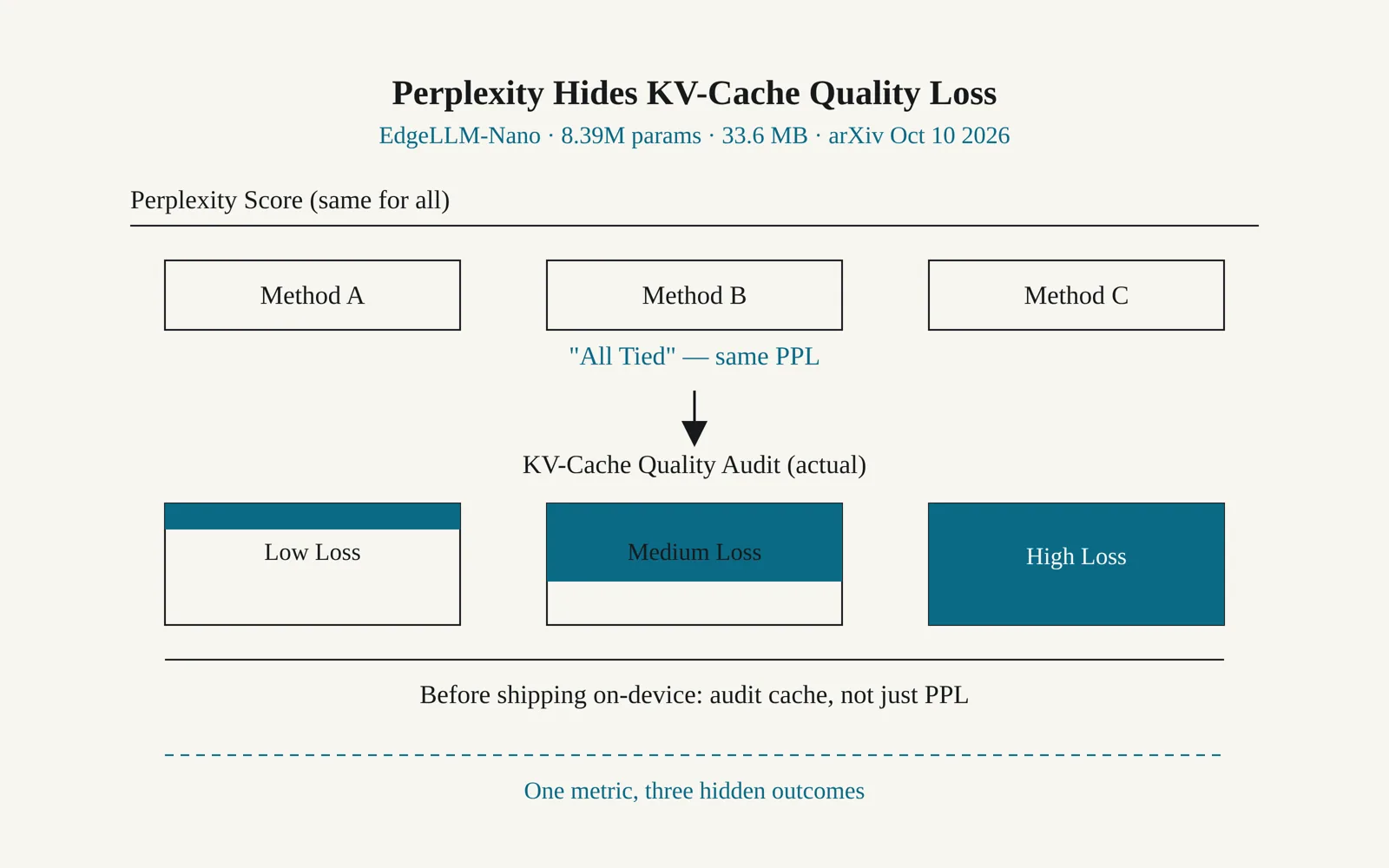
Diagram drawn for this item: Paper Shows Perplexity Metric Hides KV-Cache Quality Losses. On October 10, 2026, researchers posted EdgeLLM-Nano to arXiv, a measurement study that audits KV-cache compression and weight pruning on a nano-scale 8.39M parameter, 33.6 MB decoder-only language model built as a testbed for on-device... For anyone choosing a compression method before shipping a model onto a phone or a small board, the finding means the standard perplexity score can tell you every method is tied when they are not, so a team picking a key-cache quantizer...
The numbers
Testbed size
33.6 MB
Size of the nano-scale decoder-only LM used as the testbed
Parameter count
8.39M
Parameters in the testbed model
Flat perplexity score
5.461
Score perplexity assigns to every compression method tested
Read from arXiv paper on EdgeLLM-Nano, a KV-cache compression audit, submitted October 10, 2026
What it means for you
For anyone choosing a compression method before shipping a model onto a phone or a small board, the finding means the standard perplexity score can tell you every method is tied when they are not, so a team picking a key-cache quantizer off a leaderboard sorted by perplexity alone could ship the worse option without ever seeing the gap. It also means compressing the cache does not automatically save power at inference time, which changes the calculus for anyone trading memory for battery life.
In more detail
A team of four researchers, led by S M Mahbub Murshed, built a deliberately small language model, 8.39M parameters and 33.6 MB on disk, so they could trace exactly what happens inside a compressed key-value cache rather than treat it as a black box. The paper, EdgeLLM-Nano, argues that most existing evaluations of KV-cache compression never actually route inference through the compressed cache under test, which can mask the damage compression does.
Two specific methods come out of the audit looking worse than advertised. A polar-guided key-cache quantizer loses an order of magnitude more fidelity than a plain round-to-nearest baseline, and a consistency-anchored progressive weight pruner performs no better, and sometimes worse, than one-shot magnitude-based pruning, a far simpler technique. Both results run against the usual pitch for these newer, more elaborate compression schemes.
The paper’s sharper point is methodological. Standard perplexity, the token-prediction metric that gives language models their field’s name, assigns an identical 5.461 score to every compression backend the authors tested, even though the backends behave very differently once used for actual generation. To see that difference, the authors introduce Long-Context Decode Fidelity (LCDF), a token-by-token test of teacher-forced log-losses computed through the compressed cache itself rather than around it, paired across seeds so the effect sizes are measurable rather than anecdotal.
A companion test on a Raspberry Pi 5 adds an energy result that cuts against the usual assumption behind compression. Every compression backend the team measured used more energy per generated token than uncompressed FP16 inference, meaning the memory savings did not translate into power savings on that hardware. Only one tested method, KIVI, came close to lossless under the new LCDF test; everything else left room for improvement that perplexity alone would never have surfaced.
The numbers
- 33.6 MB: the full size of the nano-scale testbed model, small enough to trace every backend, seed and power sample end to end.
- 8.39M: the parameter count behind that 33.6 MB footprint.
- 5.461: the perplexity score given to every compression method tested, regardless of how each one actually performed once its cache was used during generation, which is the gap LCDF was built to expose.
For engineers deciding how to compress a model before it ships on constrained hardware, the paper’s practical advice is to check a candidate method against a fidelity test that actually runs through the compressed cache, and to budget for energy rather than assume a smaller cache means a smaller power draw.
Sources
Sources read
arXiv paper on EdgeLLM-Nano, a KV-cache compression audit, submitted October 10, 2026 (arxiv.org)
Paper read
Cite this
AI Journey, "Paper Shows Perplexity Metric Hides KV-Cache Quality Losses", 14 Oct 2026, https://aijourney.space/updates/2026-10-14-edgellm-nano-auditing-polar-guided-key-cache-compression-and-consistency/ (source: arXiv, verified 14 Oct 2026)
Next in the stream
Paper Shows Portable Skill Matches Complex RAG Using Claude Code
A new paper describes a customer support deployment where a single portable skill, run through Claude Code, matched a complex retrieval pipeline's accuracy.
Previous
Paper Finds Generative Recommenders Vulnerable to Low-Volume Poisoning
A new preprint finds generative recommender systems can be pushed toward hidden targets once attackers plant a small share of fake interactions.
Next
More in Perplexity AI
Perplexity AI Researchers Detail LoRA Recipe For Converting Four Language Models To Diffusion
A paper associated with Perplexity AI describes BYOD, a LoRA-only method that converts standard autoregressive language models into diffusion language models without full retraining.
Paper Proposes Message-Passing Method For Compressing LLM Weights
A new arXiv paper proposes a message-passing method for compressing large language model weights, the kind of efficiency work that underlies answer engines like Perplexity AI.
Researchers Publish S-SALAAD Framework For Sparse Large Model Inference
A new paper on compressing large models for edge devices matters to Perplexity AI and any company whose answer engine has to run inference away from a data center.