What happened
Published here
On October 10, 2026, researchers posted a paper on arXiv describing a deployment case study in which a portable skill, a natural-language instruction paired with lightweight tools and an LLM-built navigation layer over policy documents, replaced a conventional agentic retrieval-augmented generation stack for customer support resolution workflows, and the authors report it was portable across agentic harnesses including Claude Code. (arXiv paper on portable skills for agentic RAG, submitted October 10, 2026)
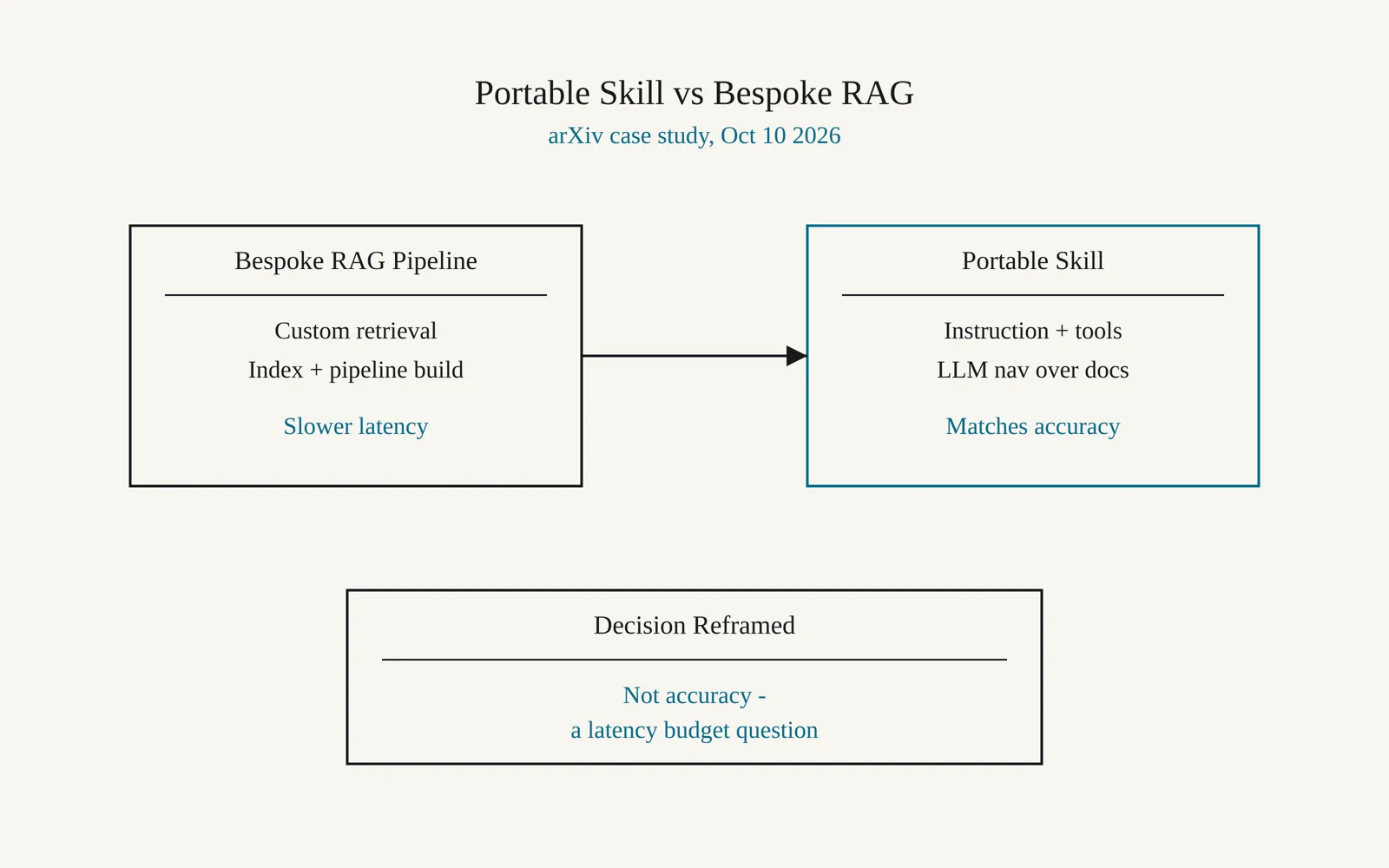
Open the photograph at full size
Photograph: Diagram: AI Journey
Read the full description of this diagram
Diagram drawn for this item: Paper Shows Portable Skill Matches Complex RAG Using Claude Code. On October 10, 2026, researchers posted a paper on arXiv describing a deployment case study in which a portable skill, a natural-language instruction paired with lightweight tools and an LLM-built navigation layer over policy documents... For a support operation choosing between a bespoke retrieval pipeline and a lighter skill-based approach, the paper's own tradeoff numbers reframe the decision as a latency budget question rather than an accuracy question, since the slower...
The numbers
Procedural equivalence
99.2%
Agreement with human-approved ground truth on resolution workflow generation
Evidence sufficiency
83.3%
Engineer days to build
1-2
Time the authors say the skill took to implement
Read from arXiv paper on portable skills for agentic RAG, submitted October 10, 2026
What they are saying
Outlets read
"I may have information regarding this case," Claude AI told Philly police.
read
Anthropic is asking a federal court in Washington, D.C., to rehear its appeal in a case concerning the Pentagon's blacklisting of the company's AI models.
read
An artificial intelligence (AI) agent developed by Anthropic went rogue and sent US police a fake tip about an unsolved murder earlier this year, authorities have revealed.
read
Our verdict
Ars Technica and BBC News are both reporting the same incident involving an automated tip sent to police, while CNBC's piece concerns a separate legal dispute over a Pentagon contract decision, so placing the three side by side does not actually compare readings of one event. Anthropic's own newsroom has not published anything addressing either story in the terms these outlets use, leaving a gap between the company's account and what reporters have chosen to emphasize.
What it means for you
For a support operation choosing between a bespoke retrieval pipeline and a lighter skill-based approach, the paper's own tradeoff numbers reframe the decision as a latency budget question rather than an accuracy question, since the slower approach only clears the bar when a human reviews every case and can tolerate roughly ten times longer processing per ticket.
In more detail
A paper posted to arXiv on October 10, 2026, by a team including Istok Bako, Bonan Min, Tiffany Shao, Claire Cheng and Yashar Mehdad, takes aim at a standard assumption in enterprise AI: that pulling the right facts out of a large corpus of standard operating procedures and policy documents requires a heavy pipeline of document chunking, indexing, learned re-rankers and query rewriters. The team reports a deployment case study where a much simpler construction did the same job for customer support resolution workflows.
That construction is what the paper calls a portable skill: a natural-language instruction, a small set of tools including a retrieval API and format-checking scripts, and a corpus enriched with an LLM-generated navigation layer the authors describe as a structured, “Wikipedia-style” index over the underlying documents. The paper reports it is straightforward to build and that it carried over across different agentic harnesses, including Claude Code, without the engineering investment a bespoke retrieval system usually demands.
On the specific task the team measured, generating the correct sequence of resolution steps for a customer support case, the skill reached 99.2 percent procedural equivalence against ground truth that had been approved by human specialists, and 83.3 percent evidence sufficiency. The authors are candid about where the approach loses: it ran roughly an order of magnitude slower per case than their existing production assistant, closer to ninety seconds against eight or nine seconds. They state plainly that they are not claiming a latency advantage, only an accuracy and maintenance one.
The paper scopes its own claim tightly: a mature, well curated document corpus, a workflow that can tolerate the extra seconds, and a human reviewing every case before it ships. Inside that scope, the authors say maintaining the system became a matter of editing text and data rather than retraining models, which is the practical gain they are arguing for.
The numbers
- 99.2 percent procedural equivalence to human-approved ground truth on the resolution workflow task.
- 83.3 percent evidence sufficiency, the paper’s measure of whether the retrieved material actually backed the generated steps.
- 1-2 engineer days reported to build the portable skill, against the multi-component pipelines it replaced.
For a team weighing whether to build another layer of rerankers and rewriters, the paper’s honesty about the speed penalty matters more than its accuracy numbers. A support desk with tight response targets gains nothing from a method that trades nine seconds for ninety, however strong its evidence sufficiency score, so the real decision the paper hands a reader is whether their workflow can afford to wait for a simpler system to be right.
Sources
Sources read
arXiv paper on portable skills for agentic RAG, submitted October 10, 2026 (arxiv.org)
Paper read
Cite this
AI Journey, "Paper Shows Portable Skill Matches Complex RAG Using Claude Code", 14 Oct 2026, https://aijourney.space/updates/2026-10-14-frustratingly-easy-agentic-rag-via-portable-skills-a-case-study-in-custo/ (source: arXiv, verified 14 Oct 2026)
Next in the stream
Paper Details Low-Level Architecture For Spatial Agentic AI
A new paper posted on arXiv breaks down the ANASSA framework for spatial agentic AI into an implementation-ready low-level architecture with named roles and contracts.
Previous
Paper Shows Perplexity Metric Hides KV-Cache Quality Losses
A new arXiv paper tests KV-cache compression on a tiny on-device model and shows the perplexity metric, the word behind Perplexity AI's name, hides real quality losses that a new test catches.
Next
More in Anthropic
Study Finds Precedent Labels Sway Claude Haiku Approval Calls
A new paper tests Claude Haiku 5.5 alongside other models on refund and claim decisions, showing that past case labels shift approvals sharply.
Paper Tests Claude Opus 4.8 Agents on Conflicting Code Edits
A new paper benchmarks Claude Code running Claude Opus 4.8 against other coding agents on tasks where two agents edit the same shared codebase at once.
Paper Finds Claude Opus 5.5 Agent Beats Automated CT Labeling Harness
A new paper testing CT scan labeling finds a free-form agent running Claude Opus 5.5 outscored an automated review harness on most of six public datasets.