Event Published ResearchResearch
Paper Details Low-Level Architecture For Spatial Agentic AI
A new paper posted on arXiv breaks down the ANASSA framework for spatial agentic AI into an implementation-ready low-level architecture with named roles and contracts.
What happened
Published here
On October 9, 2026, researchers Constantinos Papantoniou and Brian Hilton posted a paper on arXiv describing how the ANASSA framework for spatial agentic AI, first introduced as a high-level orchestration model, is decomposed into a low-level architecture with 47 logical roles, versioned task graphs, typed contracts, and governance and provenance controls for geospatial AI systems. (arXiv preprint, ANASSA: From High-Level Framework to Low-Level Architecture for Spatial Agentic AI, posted October 9, 2026)
Open the photograph at full size
Photograph: Diagram: AI Journey
Read the full description of this diagram
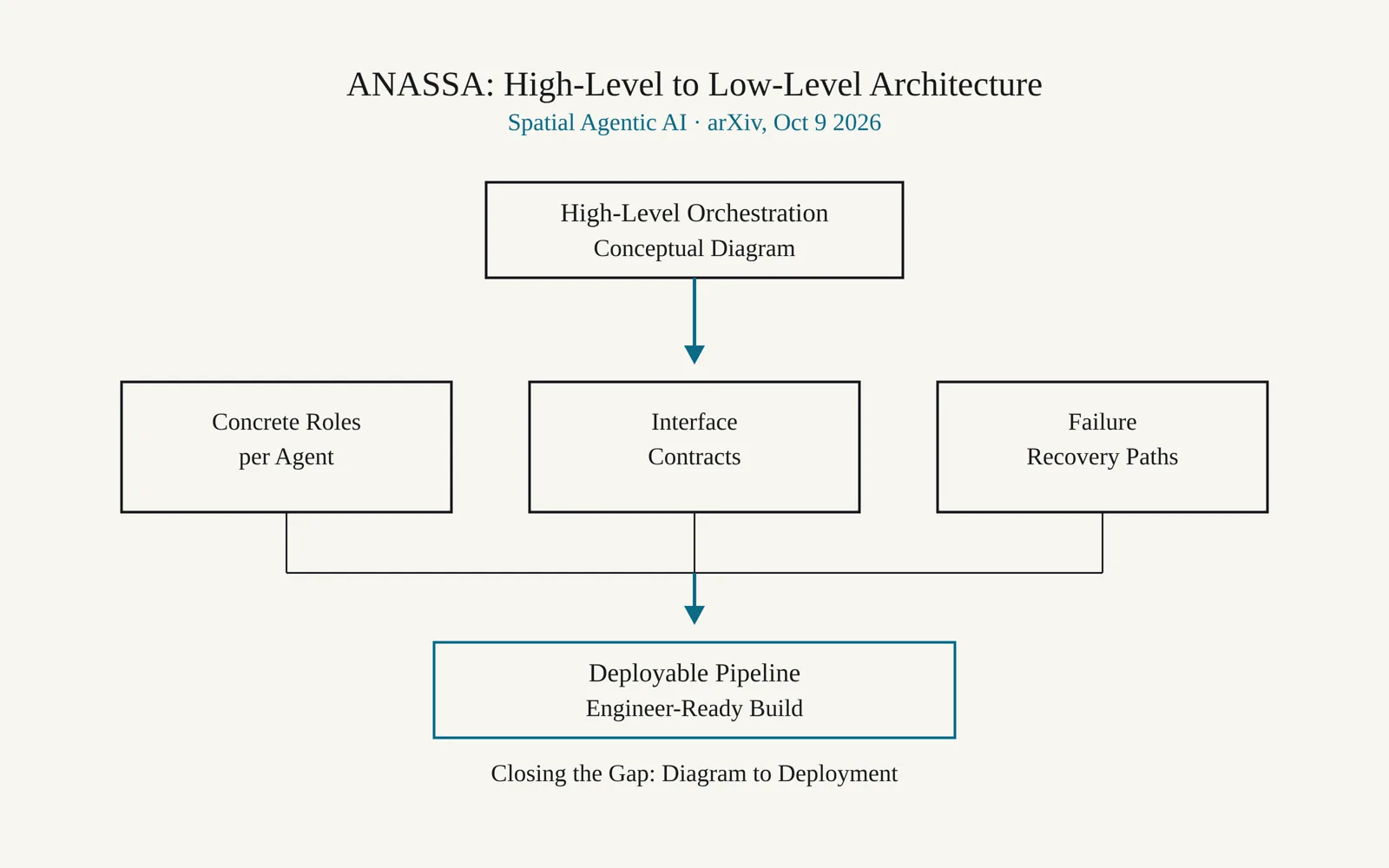
Diagram drawn for this item: Paper Details Low-Level Architecture For Spatial Agentic AI. On October 9, 2026, researchers Constantinos Papantoniou and Brian Hilton posted a paper on arXiv describing how the ANASSA framework for spatial agentic AI, first introduced as a high-level orchestration model, is decomposed into a... For teams building geospatial AI agents, this closes a gap between a conceptual orchestration diagram and something an engineer could actually wire into a deployment pipeline, since the paper names concrete roles, contracts and recovery...
The numbers
Logical roles
47
Logical roles defined in the low-level architecture
Paper length
14
Pages in the submitted paper
Tables
13
Tables included in the paper
Figures
2
Figures included in the paper
What it means for you
For teams building geospatial AI agents, this closes a gap between a conceptual orchestration diagram and something an engineer could actually wire into a deployment pipeline, since the paper names concrete roles, contracts and recovery paths rather than leaving implementers to guess how governance and audit trails should be coded.
In more detail
Geospatial agentic AI, the practice of letting autonomous AI agents plan and act on mapping, sensing and location data, has mostly existed as a set of high-level diagrams describing what the agents should do, not how to build them. The paper filed on arXiv on October 9, 2026, by Constantinos Papantoniou and Brian Hilton tries to close that gap for one specific framework, called ANASSA, which an earlier paper had set out as a high-level orchestration model for governed spatial agent execution.
The new work applies a method called Design Science Research to turn that high-level model into something closer to a build spec. Instead of naming only broad components such as “orchestration” or “governance”, the authors decompose those responsibilities into concrete architectural pieces: 47 logical roles an agent system can fill, versioned task graphs that record how a job moved through the system, capability-based selection for choosing which agent handles a step, typed contracts between components, explicit runtime states, spatial validation checks, governance controls, failure and recovery paths, and provenance records that trace where a result came from. The authors demonstrate the design with an end-to-end execution trace and evaluate it against four criteria: requirements traceability, internal consistency, responsibility preservation and whether the design stays independent of any particular AI model, mapping platform or deployment setup.
The stated goal is a bridge between the original ANASSA framework and whoever eventually implements it, so that a governed spatial agent workflow can be inspected, rebuilt and tested without committing to one vendor’s model, protocol or cloud environment ahead of time.
The numbers
- The architecture specifies 47 logical roles an agent in the system can occupy, covering orchestration, validation, governance and recovery duties separately rather than as one catch-all agent.
- The paper runs 14 pages, with 13 tables carrying the decomposition detail and 2 figures illustrating the architecture and its execution trace.
For anyone deciding whether to build a spatial agent pipeline on a published framework rather than a proprietary one, the practical question is usually whether the framework specifies enough to code against without reverse-engineering someone else’s assumptions. A high-level framework alone leaves that work undone; naming 47 distinct roles and typed contracts between them gives an implementer something closer to an interface list than a mission statement, which changes the build decision from “interpret this diagram” to “implement this contract.” Whether other teams adopt ANASSA specifically, the paper is a data point in how academic agentic-AI work is moving from architecture diagrams toward specifications detailed enough to hand to an engineering team.
Sources
Sources read
Cite this
AI Journey, "Paper Details Low-Level Architecture For Spatial Agentic AI", 16 Oct 2026, https://aijourney.space/updates/2026-10-16-anassa-from-high-level-framework-to-low-level-architecture-for-spatial-a/ (source: arXiv, verified 16 Oct 2026)
Next in the stream
New Benchmark Tests Whether AI Agents Can Investigate Causal Systems
A new paper posted to arXiv introduces a benchmark that checks whether AI agents can gather causal evidence rather than just answer prompts.
Previous
Paper Shows Portable Skill Matches Complex RAG Using Claude Code
A new paper describes a customer support deployment where a single portable skill, run through Claude Code, matched a complex retrieval pipeline's accuracy.
Next
More in Research
Study Finds Precedent Labels Sway Claude Haiku Approval Calls
A new paper tests Claude Haiku 5.5 alongside other models on refund and claim decisions, showing that past case labels shift approvals sharply.
Paper Tests Claude Opus 4.8 Agents on Conflicting Code Edits
A new paper benchmarks Claude Code running Claude Opus 4.8 against other coding agents on tasks where two agents edit the same shared codebase at once.
Perplexity AI Researchers Detail LoRA Recipe For Converting Four Language Models To Diffusion
A paper associated with Perplexity AI describes BYOD, a LoRA-only method that converts standard autoregressive language models into diffusion language models without full retraining.