Event Published ResearchResearch
New Benchmark Tests Whether AI Agents Can Investigate Causal Systems
A new paper posted to arXiv introduces a benchmark that checks whether AI agents can gather causal evidence rather than just answer prompts.
What happened
Published here
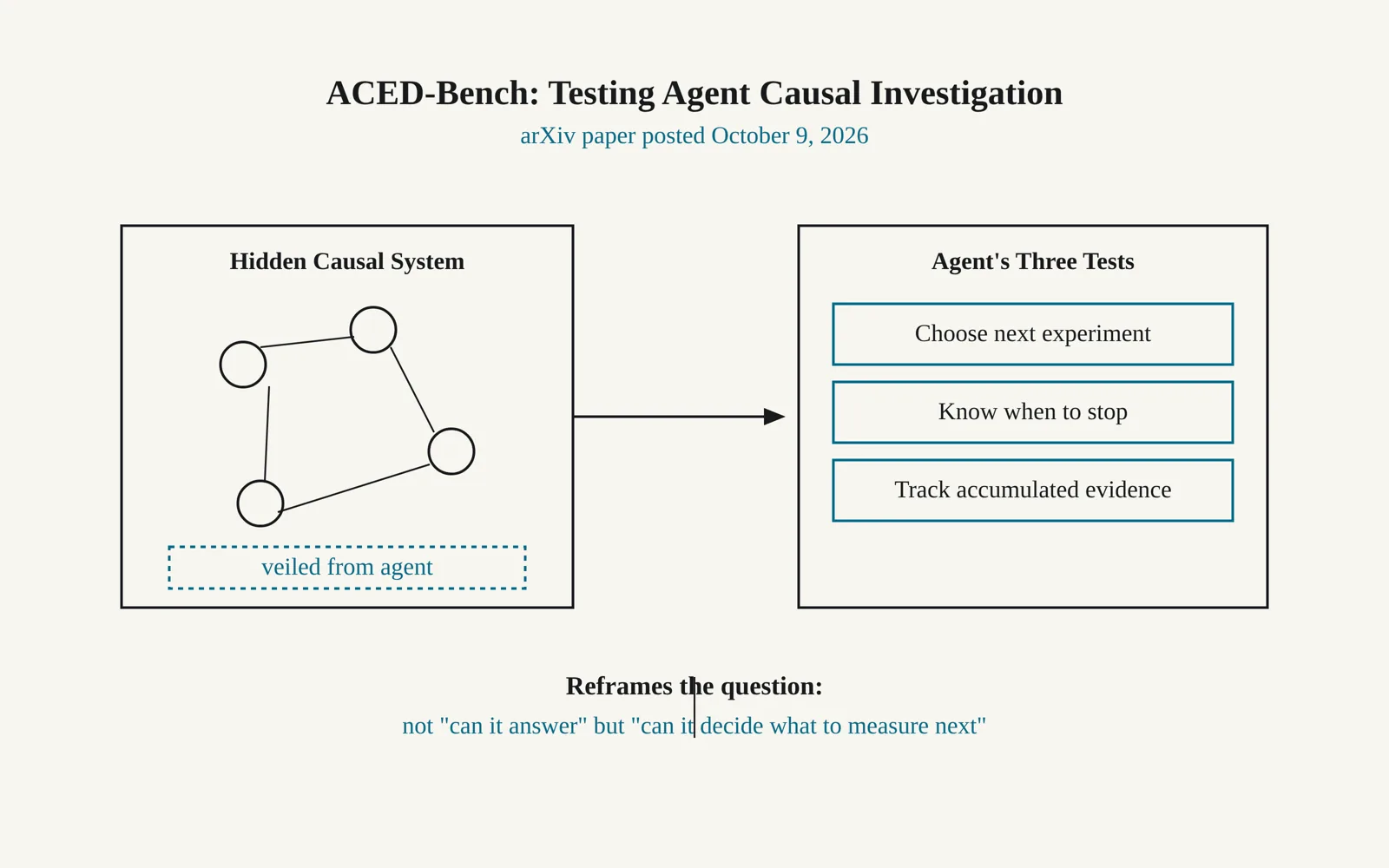
On October 9, 2026, researchers posted a paper on arXiv describing ACED-Bench, a benchmark built to test whether large language model agents can choose experiments, interpret limited evidence and make causal decisions inside a hidden probabilistic world, rather than simply answering a single question from a prompt. (arXiv preprint, ACED-Bench, submitted October 9, 2026)
Open the photograph at full size
Photograph: Diagram: AI Journey
Read the full description of this diagram
Diagram drawn for this item: New Benchmark Tests Whether AI Agents Can Investigate Causal Systems. On October 9, 2026, researchers posted a paper on arXiv describing ACED-Bench, a benchmark built to test whether large language model agents can choose experiments, interpret limited evidence and make causal decisions inside a hidden... For anyone weighing whether to hand a research pipeline to an autonomous agent, the result reframes the choice from can it answer a question to can it decide what to measure next, when to stop measuring and whether it has kept track of...
The numbers
ACED-CORE tasks
180
Tasks on the main leaderboard
Ancestry/descendancy tasks
60
Set-valued causal ancestry and descendancy questions
Causal-decision tasks
120
Constrained causal-decision tasks
Read from arXiv preprint, ACED-Bench, submitted October 9, 2026
What it means for you
For anyone weighing whether to hand a research pipeline to an autonomous agent, the result reframes the choice from can it answer a question to can it decide what to measure next, when to stop measuring and whether it has kept track of what it already found, which is a different workflow than most current chatbot evaluations test for.
In more detail
A new benchmark called ACED-Bench asks a question that most existing AI evaluations skip over: not whether a model can produce a correct answer, but whether it can work out what evidence it needs to gather before it answers at all. The paper, posted to arXiv on October 9, 2026, builds what its authors call a neuro-symbolic benchmark. A large language model writes the readable surface of each scientific scenario, the prose a person would read, while a hidden probabilistic graphical model underneath fixes the real causal graph, the data-generating process, what each possible intervention actually does, and the correct oracle answer. An agent exploring the scenario sees natural language. The system grading it sees exact structure, which is what lets the benchmark be run at scale and scored without a human in the loop.
The authors tested seven current large language models and two older-generation models across three different agent designs, which is to say three different ways of letting an agent choose what to investigate and when to stop. Two separate test sets make up the evaluation. ACED-QUAL is a smaller qualification check that only asks whether an agent can draw a correct yes or no conclusion once evidence already exists. ACED-CORE is the harder main leaderboard, where the agent has to decide which intervention to run, interpret the result, and commit to an answer rather than continuing to probe indefinitely.
The paper’s evidence-ledger analysis is the part worth reading closely: it traces failures back to specific moments in an agent’s own investigation rather than just scoring a final wrong answer. The authors report agents testing the wrong intervention, losing track of evidence they had already collected, or continuing to probe a system after they already had enough evidence to answer correctly.
The numbers
ACED-CORE holds 180 tasks in total, split into 60 set-valued causal ancestry and descendancy questions and 120 constrained causal-decision tasks. The separate qualification check, ACED-QUAL, adds a further 150-question yes/no test built on the same hidden interface. Nine models in all, seven of them current and two from an earlier generation, were run across three agent designs against that combined set.
For a team deciding whether to let an agent run its own experiments rather than answer a fixed prompt, the paper’s failure analysis is the more useful artifact than the leaderboard score itself, since it shows where an agent’s own bookkeeping, not its reasoning, breaks down first.
Sources
Sources read
arXiv preprint, ACED-Bench, submitted October 9, 2026 (arxiv.org)
Paper read
Cite this
AI Journey, "New Benchmark Tests Whether AI Agents Can Investigate Causal Systems", 15 Oct 2026, https://aijourney.space/updates/2026-10-15-aced-bench-evaluating-how-llm-agents-acquire-and-act-on-causal-evidence/ (source: arXiv, verified 15 Oct 2026)
Next in the stream
Paper Sets Out 44 Meta-Requirements For AI Robustness Audits
A new paper on arXiv proposes 44 meta-requirements that any AI robustness auditing framework should support, built from a literature review and validated by practitioners.
Previous
Paper Details Low-Level Architecture For Spatial Agentic AI
A new paper posted on arXiv breaks down the ANASSA framework for spatial agentic AI into an implementation-ready low-level architecture with named roles and contracts.
Next
More in Research
Study Finds Precedent Labels Sway Claude Haiku Approval Calls
A new paper tests Claude Haiku 5.5 alongside other models on refund and claim decisions, showing that past case labels shift approvals sharply.
Paper Tests Claude Opus 4.8 Agents on Conflicting Code Edits
A new paper benchmarks Claude Code running Claude Opus 4.8 against other coding agents on tasks where two agents edit the same shared codebase at once.
Perplexity AI Researchers Detail LoRA Recipe For Converting Four Language Models To Diffusion
A paper associated with Perplexity AI describes BYOD, a LoRA-only method that converts standard autoregressive language models into diffusion language models without full retraining.