Event Published ResearchResearch
Paper Sets Out 44 Meta-Requirements For AI Robustness Audits
A new paper on arXiv proposes 44 meta-requirements that any AI robustness auditing framework should support, built from a literature review and validated by practitioners.
What happened
Published here
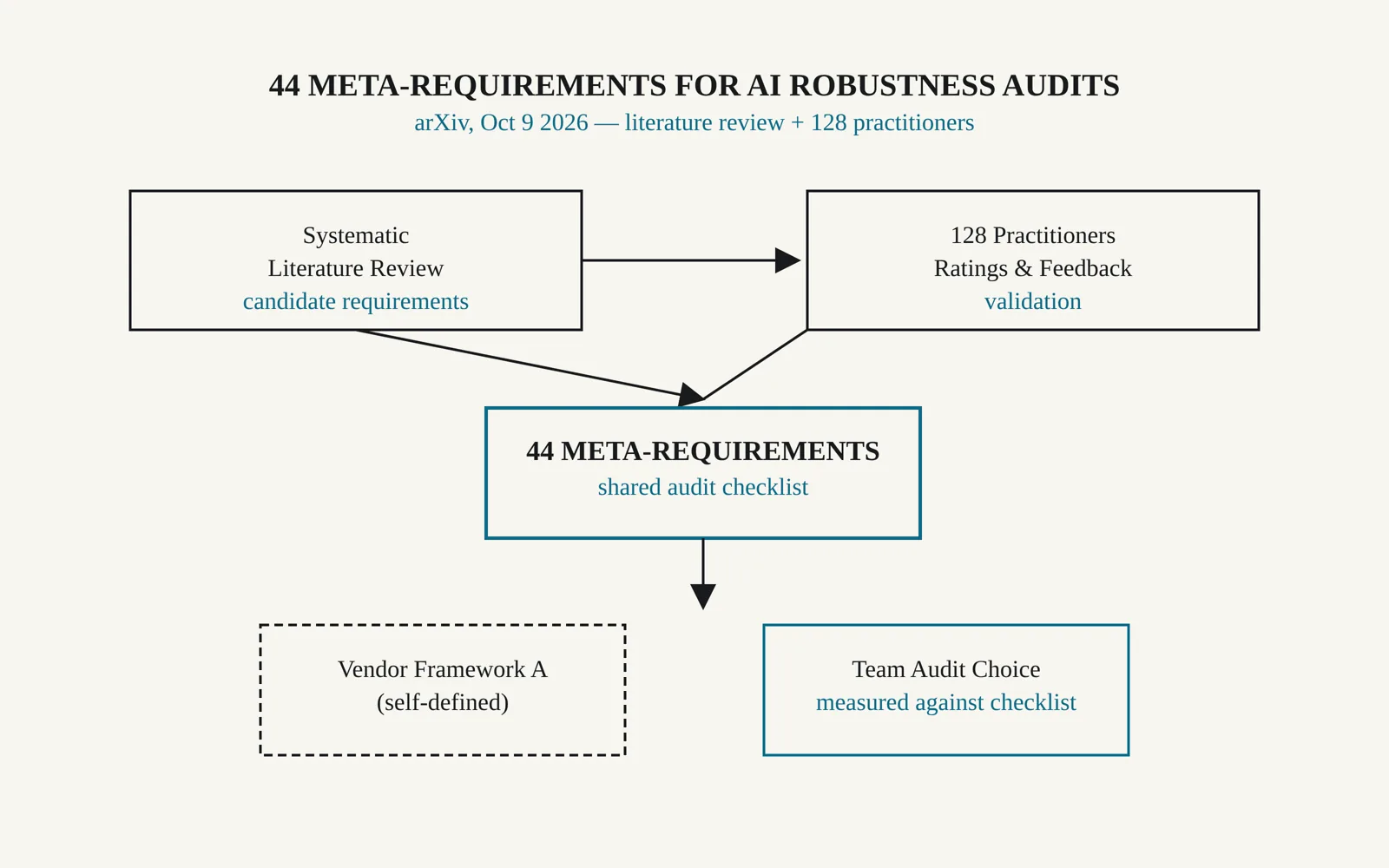
On October 9, 2026, researchers posted a paper on arXiv setting out meta-requirements for AI robustness auditing frameworks, derived from a systematic literature review and then tested with 128 practitioners who supplied ratings and written comments. (arXiv abstract page for Actionable Meta-Requirements for AI Robustness Auditing, submitted October 9, 2026)
Open the photograph at full size
Photograph: Diagram: AI Journey
Read the full description of this diagram
Diagram drawn for this item: Paper Sets Out 44 Meta-Requirements For AI Robustness Audits. On October 9, 2026, researchers posted a paper on arXiv setting out meta-requirements for AI robustness auditing frameworks, derived from a systematic literature review and then tested with 128 practitioners who supplied ratings and... A team choosing between competing audit templates now has a checklist to measure gaps against, rather than relying on one vendor's own framework to decide what counts as sufficient evidence of robustness.
The numbers
Records screened
2,890
Records the systematic literature review screened
Records retained
74
Records retained after screening
Rating agreement
81.20%
Share of practitioner ratings indicating agreement or strong agreement
Final requirements
44
Meta-requirements in the final set across 16 categories
What it means for you
A team choosing between competing audit templates now has a checklist to measure gaps against, rather than relying on one vendor's own framework to decide what counts as sufficient evidence of robustness.
In more detail
A team of researchers, led by Joshua Owotogbe, posted a paper on arXiv on October 9, 2026, addressing a gap that robustness auditing of AI systems has lacked: no consolidated list of what such an audit should actually check for. The authors frame the problem in design science terms. An auditing framework needs to decide whether available evidence supports a robustness conclusion, but nobody had agreed on what that framework itself must cover.
To build that list the team ran a systematic literature review, screening thousands of records down to a working set they judged relevant, then drew an initial batch of meta-requirements from that smaller body of work. Rather than stopping at a desk review, they took the draft list to 128 practitioners and asked for both quantitative ratings and free-text comments on each item. That step matters because a requirements list built only from papers can miss what auditors run into on the ground, and the practitioner round surfaced exactly one such gap: a requirement about external components and supply chain dependencies that the literature pass had not captured.
The numbers
The review screened 2,890 records and retained 74 of them as the literature base, from which 43 meta-requirements emerged across 16 categories. The practitioner survey produced 5,504 individual ratings and 586 substantive written comments, with 81.20% of those ratings showing agreement or strong agreement with the proposed requirements. Of the original 43, 41 came back strongly supported. Adding the one practitioner-identified gap brought the final set to 44 meta-requirements, of which 43 carry quantitative validation from the survey round.
For anyone building or buying an audit of an AI system’s robustness, a consolidated checklist like this changes the comparison available. Instead of taking a vendor’s internal audit process on trust, a buyer or a regulator can hold that process against a named set of categories and ask which ones it actually addresses and which it skips. It also gives framework designers a concrete yardstick rather than a general sense of thoroughness: a framework missing coverage of supply chain dependencies, for instance, is now missing something named and counted rather than something vaguely implied.
The paper stops short of naming any specific commercial auditing product or vendor, and its authors present the meta-requirements as a foundation for organizations assessing or building their own frameworks rather than as a finished standard. Whether any regulator or industry body adopts this particular list as a reference point is not yet established, and the paper itself does not claim that outcome. What it does supply is a tested, categorized starting point that previously did not exist in consolidated form.
Sources
Sources read
Cite this
AI Journey, "Paper Sets Out 44 Meta-Requirements For AI Robustness Audits", 15 Oct 2026, https://aijourney.space/updates/2026-10-15-actionable-meta-requirements-for-ai-robustness-auditing/ (source: arXiv, verified 15 Oct 2026)
Next in the stream
Google Researchers Publish Harness^2 Recursive Agent Framework
A paper with Google-affiliated authors proposes Harness^2, a framework that lets agent harnesses edit themselves and reports gains on Gemini 3.5 Flash.
Previous
New Benchmark Tests Whether AI Agents Can Investigate Causal Systems
A new paper posted to arXiv introduces a benchmark that checks whether AI agents can gather causal evidence rather than just answer prompts.
Next
More in Research
Study Finds Precedent Labels Sway Claude Haiku Approval Calls
A new paper tests Claude Haiku 5.5 alongside other models on refund and claim decisions, showing that past case labels shift approvals sharply.
Paper Tests Claude Opus 4.8 Agents on Conflicting Code Edits
A new paper benchmarks Claude Code running Claude Opus 4.8 against other coding agents on tasks where two agents edit the same shared codebase at once.
Perplexity AI Researchers Detail LoRA Recipe For Converting Four Language Models To Diffusion
A paper associated with Perplexity AI describes BYOD, a LoRA-only method that converts standard autoregressive language models into diffusion language models without full retraining.