What happened
Published here
On October 9, 2026, researchers including authors with Google affiliations posted a paper to arXiv describing Harness^2, a recursive agent harnessing framework meant for open-world tasks. The paper tests the method on four model-harness configurations, including Gemini 3.5 Flash and GLM-5, across three professional benchmarks, reporting that a single recursive editing step raises scores over each model's base harness without needing a ground-truth verifier to check the edits. (Harness^2 paper abstract page, arXiv:2610.14224, submitted October 9, 2026)
Open the photograph at full size
Photograph: Diagram: AI Journey
Read the full description of this diagram
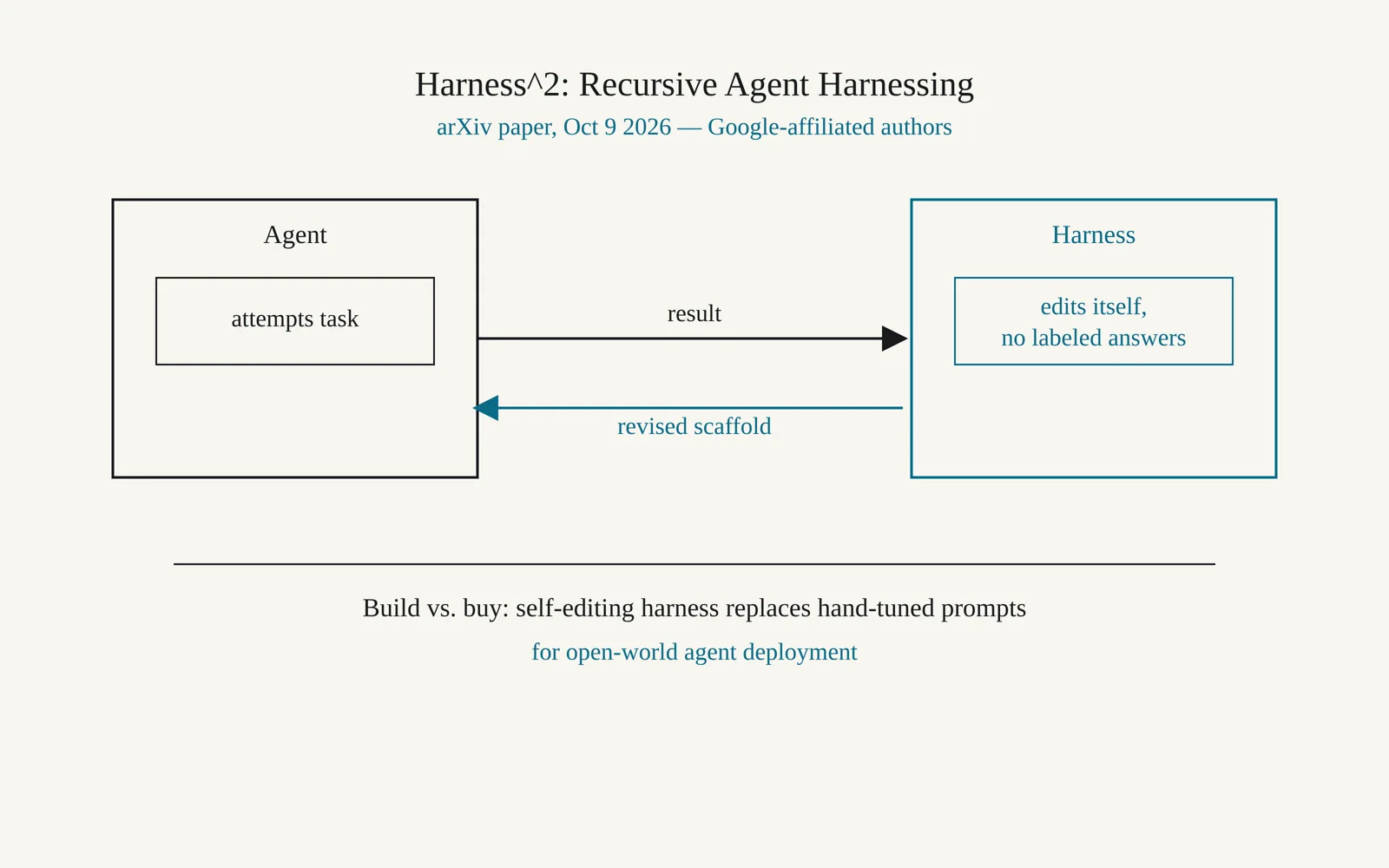
Diagram drawn for this item: Google Researchers Publish Harness^2 Recursive Agent Framework. On October 9, 2026, researchers including authors with Google affiliations posted a paper to arXiv describing Harness^2, a recursive agent harnessing framework meant for open-world tasks. For a team deciding whether to build a custom agent scaffold or buy one off the shelf, a harness that edits itself without labeled answers changes the calculus: the expensive part of agent deployment has usually been hand-tuning prompts...
The numbers
WorkBuddy-Bench gain
11.5 points
Improvement from a single recursive editing step over the base harness
JobBench gain
4.5 points
Improvement reported on the JobBench benchmark
LAB gain
11.8 percentage points
Improvement reported on the LAB benchmark
Read from Harness^2 paper abstract page, arXiv:2610.14224, submitted October 9, 2026
What it means for you
For a team deciding whether to build a custom agent scaffold or buy one off the shelf, a harness that edits itself without labeled answers changes the calculus: the expensive part of agent deployment has usually been hand-tuning prompts and tool-call sequences for each new task, and this work argues that step can be automated even when nobody has scored the task in advance. If the approach generalizes past these three benchmarks, it lowers the engineering bill for adapting an agent to a new workflow rather than lowering the price of the underlying model itself, which is a different kind of saving than the headline figures published elsewhere on this site usually track.
In more detail
Researchers including authors affiliated with Google posted a paper to arXiv on October 9, 2026, describing a framework called Harness^2 that aims to let an AI agent’s execution harness improve itself while the agent is working on open-world tasks it has never seen before. An execution harness is the scaffolding around a model: the prompts, the tool-call sequences and the retry logic that decide how a raw model turns into something that finishes a task. The paper’s authors argue that most prior attempts at recursive self-improvement for harnesses stall in the open world because there is no ground-truth verifier sitting beside a novel task to tell the system whether an edit helped.
Harness^2 answers that with two connected loops. A task-level loop runs a contrastive step the authors call Propose-Probe-Compose, which edits the current task’s harness without needing a labeled correct answer, and can be run again in parallel or in sequence to push further gains. A second, harnessing-level loop then pulls lessons out of those edits and folds them into a longer-running memory, so later tasks start from an already-improved harness rather than from scratch.
The team tested the framework on four model-harness pairings, including Gemini 3.5 Flash and GLM-5, across three benchmarks aimed at professional work. A single editing step raised scores over each model’s unedited harness on every configuration tested, and the authors report that running the task-level loop for a larger budget produces further gains beyond that first step.
The numbers
The paper reports gains of up to 11.5 points on a benchmark called WorkBuddy-Bench, 4.5 points on JobBench, and 11.8 percentage points on a benchmark called LAB, all measured as the improvement a single recursive editing step produced over each model’s base harness, before any additional recursion budget is spent. The paper frames these as a floor rather than a ceiling, since it states that further recursion raises scores again.
The work sits in the growing body of research treating the harness, not just the underlying model, as the thing worth tuning automatically, which matters for anyone weighing whether to license a bigger model or invest in better scaffolding around the one they already have.
Sources
Sources read
Harness^2 paper abstract page, arXiv:2610.14224, submitted October 9, 2026 (arxiv.org)
Paper read
Cite this
AI Journey, "Google Researchers Publish Harness^2 Recursive Agent Framework", 15 Oct 2026, https://aijourney.space/updates/2026-10-15-harness-2-recursive-agent-harnessing-for-an-open-world/ (source: arXiv, verified 15 Oct 2026)
Next in the stream
Stanford Team Publishes Next-Concept Modeling Paper on Faster Text Generation
Researchers tied to Perplexity AI's orbit published a paper describing Next-Concept Modeling, a coarse-to-fine method that generates text far faster than diffusion language models.
Previous
Paper Sets Out 44 Meta-Requirements For AI Robustness Audits
A new paper on arXiv proposes 44 meta-requirements that any AI robustness auditing framework should support, built from a literature review and validated by practitioners.
Next
More in Google
Google.org Funds Five Groups Building AI Tools For Teachers
Google.org is funding five organizations building AI tools for teachers, pairing Google DeepMind's model work with grants aimed at classroom use.
Gemini Negotiation Paper Finds Persona Effects Shift By Language
A new paper testing Google's Gemini model in buyer-seller negotiations found that the same persona instruction produced different deal outcomes in English and Korean.
Paper Finds Gemini Monitor Beats Small Models At Spotting Reward Hacking
A new paper tests whether Google's Gemini 3.1 Flash-Lite can tell real reward hacking apart from honest failure better than small local monitors.