Event Published ResearchPerplexity AI
Stanford Team Publishes Next-Concept Modeling Paper on Faster Text Generation
Researchers tied to Perplexity AI's orbit published a paper describing Next-Concept Modeling, a coarse-to-fine method that generates text far faster than diffusion language models.
What happened
Published here
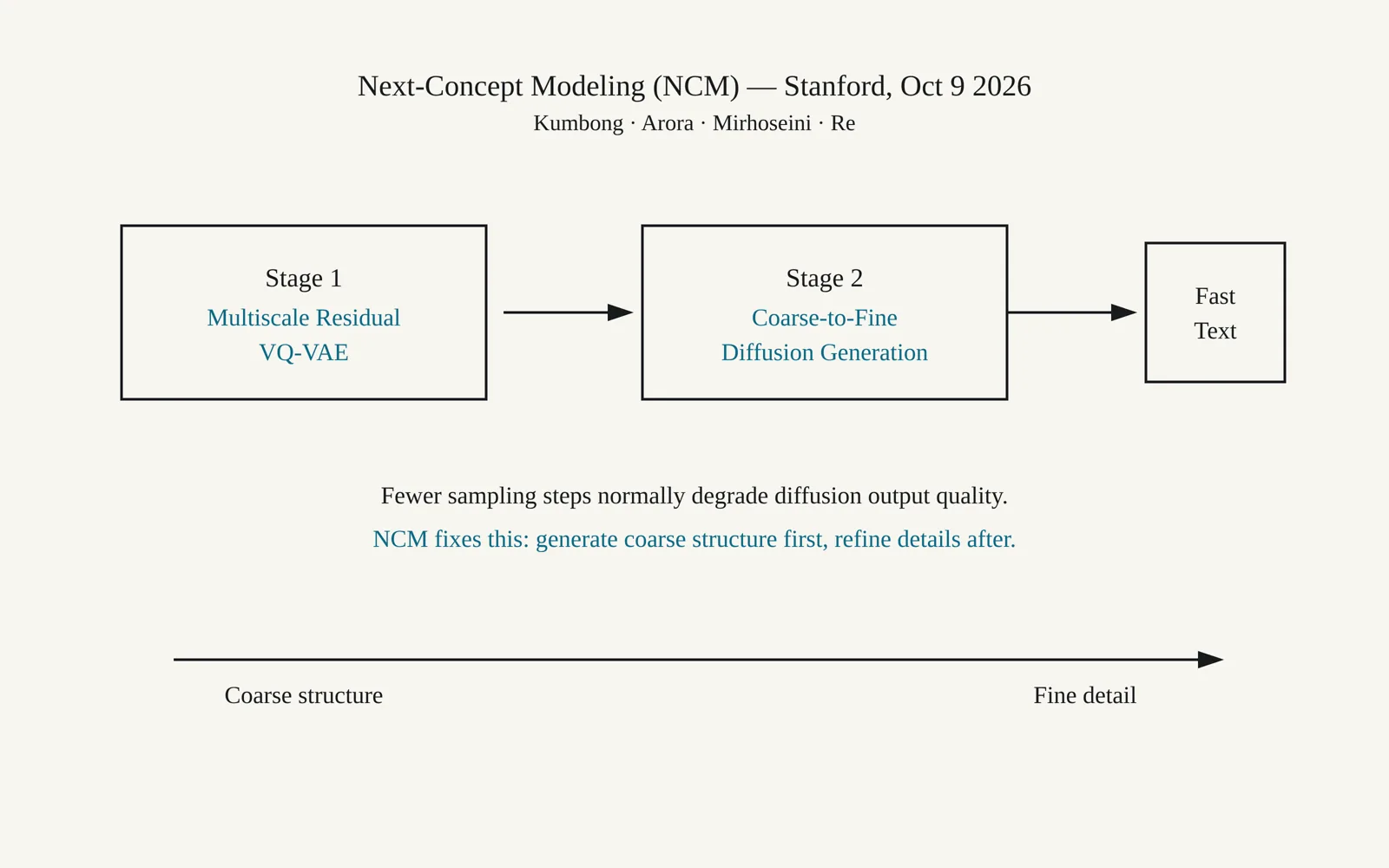
On October 9, 2026, researchers including Hermann Kumbong, Simran Arora, Azalia Mirhoseini and Christopher Re posted a paper to arXiv describing Next-Concept Modeling (NCM), a two stage framework that pairs a multiscale residual VQ-VAE encoder with a transformer that generates one level of codes at a time, predicting every code within a level in parallel rather than token by token. (arXiv paper, Next-Concept Modeling: Fast, Parallel Coarse-to-Fine Text Generation, submitted October 9, 2026)
Open the photograph at full size
Photograph: Diagram: AI Journey
Read the full description of this diagram
Diagram drawn for this item: Stanford Team Publishes Next-Concept Modeling Paper on Faster Text Generation. On October 9, 2026, researchers including Hermann Kumbong, Simran Arora, Azalia Mirhoseini and Christopher Re posted a paper to arXiv describing Next-Concept Modeling (NCM), a two stage framework that pairs a multiscale residual VQ-VAE... For anyone weighing how a chat answer engine gets built underneath, the paper argues that the biggest brake on diffusion language models, namely degraded output once sampling steps are cut, can be loosened by generating coarse structure...
What it means for you
For anyone weighing how a chat answer engine gets built underneath, the paper argues that the biggest brake on diffusion language models, namely degraded output once sampling steps are cut, can be loosened by generating coarse structure first and filling detail afterward, which changes the tradeoff between a cheaper inference bill and answer quality that a service like Perplexity has to balance on every query it serves.
In more detail
A team of researchers working in the area Perplexity AI draws its own models and infrastructure thinking from has published a paper describing a new way to generate text that sidesteps a weakness of diffusion language models. The paper, posted to arXiv on October 9, 2026, by Hermann Kumbong and eight co-authors including Simran Arora, Azalia Mirhoseini and Christopher Re, introduces Next-Concept Modeling, or NCM.
Diffusion language models have become attractive because they sample many tokens at once rather than one at a time, which should make them faster than the autoregressive models that power most chat products today, including the one behind an answer engine like Perplexity. The paper’s authors note that this promise breaks down in practice: diffusion models lose quality quickly once the number of sampling steps is reduced, they have to process an entire sequence at every single step regardless of how little of it is uncertain, and they need many passes over training data before reaching usable quality.
NCM’s answer is a two stage pipeline. First, a multiscale residual VQ-VAE turns a passage of text into a hierarchy of discrete codes, coarse structure at the top, fine detail further down. Second, a transformer generates that hierarchy one level at a time, predicting every code inside a level in parallel rather than working through the sequence token by token. The idea borrows the logic of coarse-to-fine image generation and applies it to language.
The numbers
Across three benchmarks the authors report sizable speed gains alongside matched or better quality. On the LM1B benchmark, NCM beat the strongest diffusion baseline on generative perplexity while running faster. On OpenWebText it stayed competitive with the strongest diffusion model while running faster still. On the summarization benchmark XSum, it matched the strongest diffusion baseline’s ROUGE-L score while running faster than that too. On the Sudoku reasoning task, the authors report that NCM outperformed both autoregressive and diffusion baselines across every difficulty level tested, while using fewer function evaluations per solution.
For a company whose entire product is an answer engine rather than a model, work like this is a reminder that the inference costs behind a query, not just the headline model behind it, decide what a subscription can afford to serve. If generation methods like NCM close the quality gap between fast parallel sampling and slower step-by-step decoding, a provider could serve more detailed answers at the same compute budget, or hold prices steady while demand on inference keeps climbing. The paper does not describe any product deployment, so the practical change for Perplexity’s users, if any, is still a few steps away.
Sources
Sources read
Cite this
AI Journey, "Stanford Team Publishes Next-Concept Modeling Paper on Faster Text Generation", 14 Oct 2026, https://aijourney.space/updates/2026-10-14-next-concept-modeling-fast-parallel-coarse-to-fine-text-generation/ (source: arXiv, verified 14 Oct 2026)
Next in the stream
New MathVis Benchmark Tests Claude and Rivals on Diagram Reasoning
A new benchmark called MathVis found Claude Fable 5 and rival models struggle to reason through drawing on frontier mathematical problems.
Previous
Google Researchers Publish Harness^2 Recursive Agent Framework
A paper with Google-affiliated authors proposes Harness^2, a framework that lets agent harnesses edit themselves and reports gains on Gemini 3.5 Flash.
Next
More in Perplexity AI
Perplexity AI Researchers Detail LoRA Recipe For Converting Four Language Models To Diffusion
A paper associated with Perplexity AI describes BYOD, a LoRA-only method that converts standard autoregressive language models into diffusion language models without full retraining.
Paper Proposes Message-Passing Method For Compressing LLM Weights
A new arXiv paper proposes a message-passing method for compressing large language model weights, the kind of efficiency work that underlies answer engines like Perplexity AI.
Researchers Publish S-SALAAD Framework For Sparse Large Model Inference
A new paper on compressing large models for edge devices matters to Perplexity AI and any company whose answer engine has to run inference away from a data center.