Event Published ResearchPerplexity AI
Researchers Publish S-SALAAD Framework For Sparse Large Model Inference
A new paper on compressing large models for edge devices matters to Perplexity AI and any company whose answer engine has to run inference away from a data center.
What happened
Published here
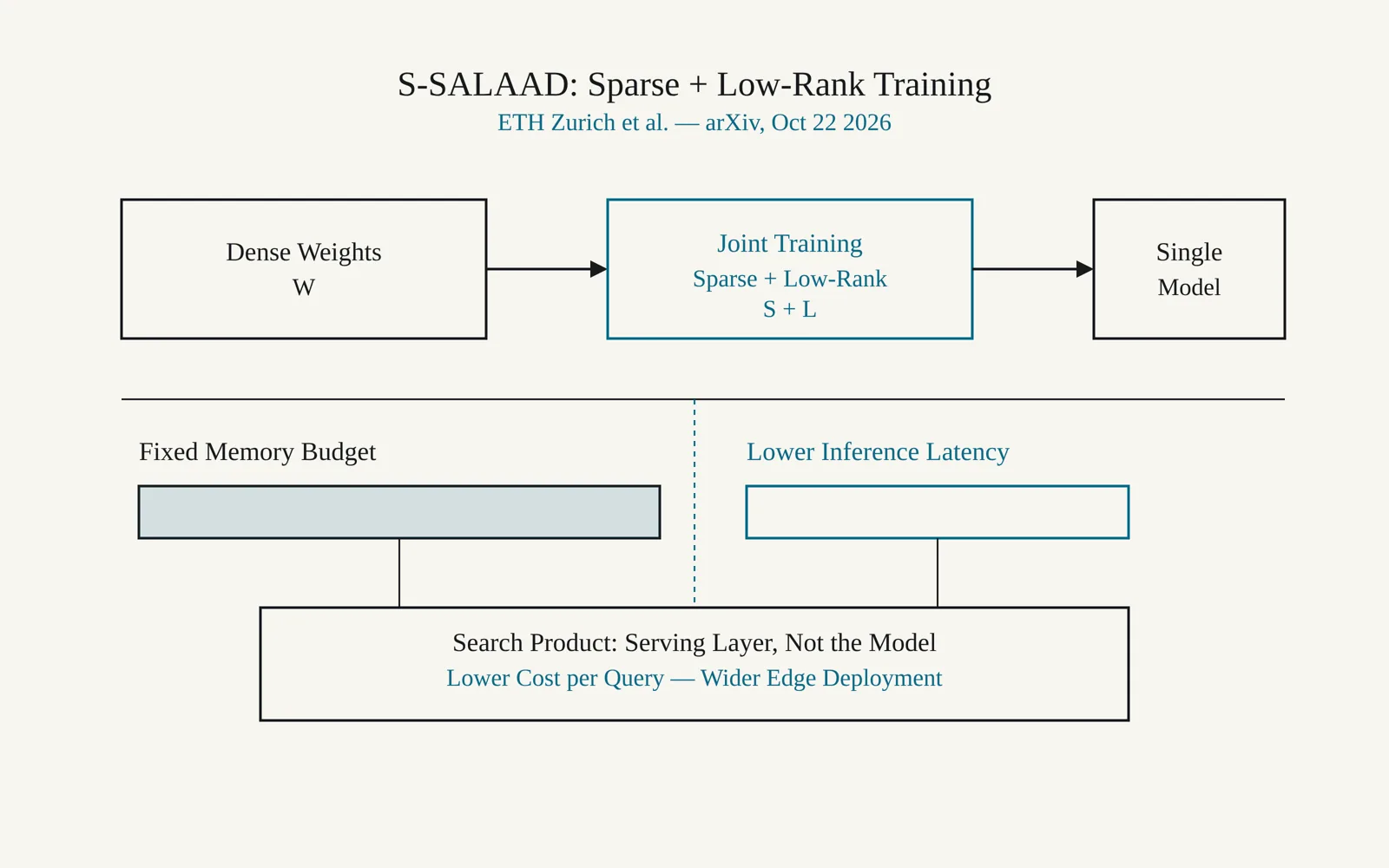
On October 22, 2026, researchers from ETH Zurich and collaborators posted a paper on arXiv describing S-SALAAD, a training framework that jointly learns model weights alongside structured sparse and low rank components so a single checkpoint can be compressed to several memory budgets without the usual slowdown from unstructured sparsity. (arXiv paper 2610.31897, Learning Structured Sparsity for Large Models, posted October 22, 2026)
Open the photograph at full size
Photograph: Diagram: AI Journey
Read the full description of this diagram
Diagram drawn for this item: Researchers Publish S-SALAAD Framework For Sparse Large Model Inference. On October 22, 2026, researchers from ETH Zurich and collaborators posted a paper on arXiv describing S-SALAAD, a training framework that jointly learns model weights alongside structured sparse and low rank components so a single... For a company selling a search box that answers in prose, where the product is the serving layer rather than a model, cutting inference latency at a fixed memory budget changes the bill per query and widens the hardware a local or edge...
The numbers
Paper length
35 pages
Length of the submitted manuscript
Figures included
26 figures
Figure count in the submission
Tables included
14 tables
Table count in the submission
Read from arXiv paper 2610.31897, Learning Structured Sparsity for Large Models, posted October 22, 2026
What it means for you
For a company selling a search box that answers in prose, where the product is the serving layer rather than a model, cutting inference latency at a fixed memory budget changes the bill per query and widens the hardware a local or edge deployment can run on without a separate checkpoint for every device tier.
In more detail
A team from ETH Zurich, working with Microsoft Research, published a paper on arXiv on October 22, 2026, describing a method for compressing large language models so they run efficiently on edge devices rather than only in a data center. The paper, titled “Learning Structured Sparsity for Large Models,” introduces a framework called S-SALAAD. It targets a gap the authors say earlier compression work has not closed: a model can be made smaller on paper while running no faster in practice, because the indexing overhead of unstructured sparse components and the irregular memory access patterns that come with them can erase the computational savings a smaller parameter count promises.
S-SALAAD trains a model’s weights together with low rank and structured sparse components, rather than compressing a model after the fact. The structured patterns it learns are built to match real hardware, and the framework pairs that structure with dedicated CPU and GPU kernels written to exploit it, plus a budget aware compression step so one checkpoint can be squeezed to fit several different memory targets rather than needing a separate trained model for each one. The authors tested the approach on Llama2 and Qwen3 models, across both pretraining and distillation, and report that it moves the trade off between perplexity, memory use and inference latency further out than the baselines they compared it against, across more than one type of hardware.
The numbers
The submission runs 35 pages and carries 26 figures and 14 tables documenting the experiments across the two model families and multiple hardware platforms, giving reviewers a fairly dense record of how the latency and memory gains were measured rather than a single headline benchmark.
The practical case the authors make is about deployment, not accuracy. Unreliable network connectivity, communication delay, and privacy rules all push some workloads toward running locally rather than calling out to a cloud model, and that only works if a compressed model is genuinely faster, not merely lighter. A company such as Perplexity AI, whose whole product is the serving layer around a model rather than the model itself, has a direct interest in any technique that lets one trained checkpoint serve several hardware tiers cheaply, since that is closer to how an answer engine actually has to be run across a mixed fleet of devices and connections.
Sources
Sources read
Cite this
AI Journey, "Researchers Publish S-SALAAD Framework For Sparse Large Model Inference", 27 Oct 2026, https://aijourney.space/updates/2026-10-27-learning-structured-sparsity-for-large-models-bridging-model-compressibi/ (source: arXiv, verified 27 Oct 2026)
Next in the stream
Paper Finds Claude Opus 5.5 Stays Coherent on Hidden-Variable Probability Tests
A new paper tests seven models, including Claude Opus 5.5 and Claude Haiku 5.5, on whether their probability judgments obey a basic law of probability.
Previous
OpenAI Details Tighter Security For Frontier Model Training
OpenAI said it strengthened containment around how it trains frontier models, moving some ChatGPT-building work to offline environments with heavier red-teaming.
Next
More in Perplexity AI
Perplexity AI Researchers Detail LoRA Recipe For Converting Four Language Models To Diffusion
A paper associated with Perplexity AI describes BYOD, a LoRA-only method that converts standard autoregressive language models into diffusion language models without full retraining.
Paper Proposes Message-Passing Method For Compressing LLM Weights
A new arXiv paper proposes a message-passing method for compressing large language model weights, the kind of efficiency work that underlies answer engines like Perplexity AI.
Paper Proposes Meaning-Level Reward To Go Beyond Next-Token Prediction
A new arXiv paper proposes training language models to reward meaning rather than exact wording, a shift relevant to answer engines like Perplexity.