What happened
Published here
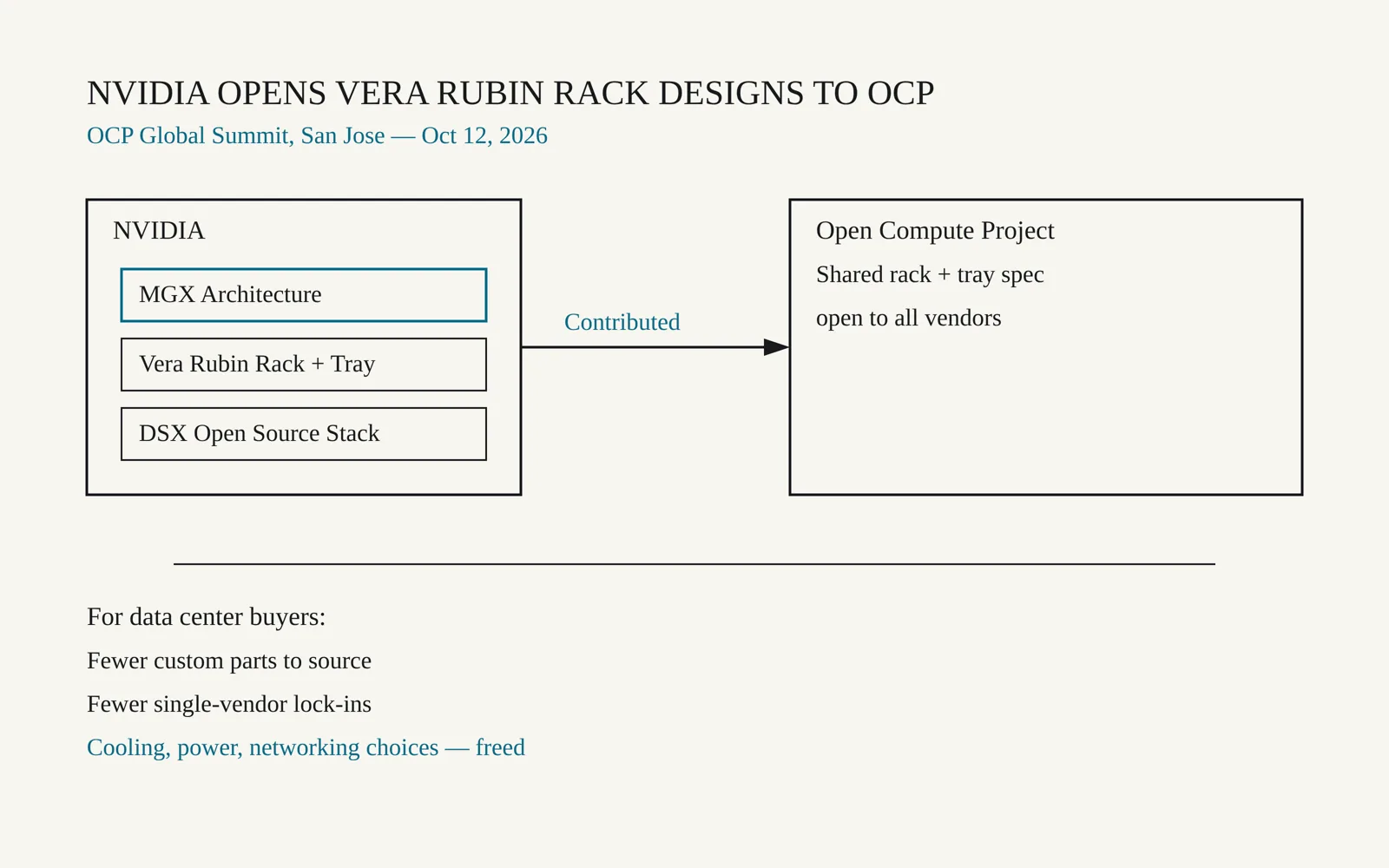
On October 12, 2026, at the OCP Global Summit in San Jose, Nvidia contributed Vera Rubin rack and compute tray designs to the Open Compute Project through its open MGX architecture, alongside new open source software for its DSX AI Factory platform, a jointly published Open Data Center Specification and grid resilience standard, an 800 VDC design from Visionbay, a Meta networking collaboration on Spectrum-6, a new USFP optical connector with Cisco, and Falcon Transport support with Google. (Nvidia newsroom post on OCP Global Summit announcements, published October 12, 2026)
Open the photograph at full size
Photograph: Diagram: AI Journey
Read the full description of this diagram
Diagram drawn for this item: Nvidia Opens Vera Rubin Rack Designs to Open Compute Project. On October 12, 2026, at the OCP Global Summit in San Jose, Nvidia contributed Vera Rubin rack and compute tray designs to the Open Compute Project through its open MGX architecture, alongside new open source software for its DSX AI Factory... For anyone buying rack space or planning a build, a shared rack and tray spec means fewer custom parts to source and fewer single vendor lock-ins when a data center operator is choosing cooling, power and networking gear years before the...
The numbers
Spectrum-6 switch capacity
102.4Tb/s
Ethernet switches Meta is adopting for Vera Rubin AI factories
USFP power efficiency gain
1.3x
Greater power efficiency claimed for the new pluggable optics form factor
Max MGX 1.2 rack power
250kW
Rack deployments supported by the updated MGX 1.2 specification
Multiplane GPU scale
100,000
GPUs an agentic AI factory can scale beyond using Spectrum-X Multiplane
Read from Nvidia newsroom post on OCP Global Summit announcements, published October 12, 2026
What it means for you
For anyone buying rack space or planning a build, a shared rack and tray spec means fewer custom parts to source and fewer single vendor lock-ins when a data center operator is choosing cooling, power and networking gear years before the compute itself ships. A grid resilience standard that commits large AI sites to staying connected and restoring load within seconds also shifts risk away from utilities and toward the operators who sign these specs, which matters to any reader weighing where new AI capacity gets sited and who pays when it strains a local grid.
In more detail
Nvidia used the Open Compute Project’s Global Summit in San Jose to push its Vera Rubin generation of AI hardware toward becoming an industry standard rather than a proprietary design. The company contributed Vera Rubin rack and compute tray designs to OCP through its MGX architecture, meaning system builders outside Nvidia can now manufacture compatible racks rather than wait for a single-source part. The updated MGX 1.2 specification adds blind-mate liquid cooling, a 5,000A busbar and support for rack deployments up to 250kW, alongside native 19-inch equipment support for operators who still run older gear alongside new Vera Rubin systems.
Several partners filed in alongside the core contribution. Meta said it is adopting Nvidia’s Spectrum-6 Ethernet switches, which run at 102.4Tb/s, to build larger Vera Rubin AI factories on open networking, pairing them with its own FBOSS operating system. Nvidia and Cisco separately proposed USFP, a new pluggable optics form factor meant to replace the widely used OSFP standard with roughly four times the bandwidth density and about 1.3 times the power efficiency. Google and Nvidia announced that future ConnectX-10 SuperNICs will support Google’s Falcon transport protocol, letting the two companies’ networking hardware talk over a shared transport layer. Visionbay unveiled an 800 VDC AI factory design built around Nvidia’s reference architecture, aimed at handling higher rack power densities without a full facility rebuild.
Nvidia, Google, Meta, AMD and Microsoft also co-published two facility-level standards: an Open Data Center Specification covering power and cooling layout, and a Grid Resilience Specification describing how large AI sites should behave during utility disturbances, including restoring near-full load within seconds of a disruption.
The numbers
Meta’s adopted Spectrum-6 switches run at 102.4Tb/s, roughly twice the per-lane bandwidth of the prior Spectrum-4 generation. The proposed USFP optical module promises about 1.3 times the power efficiency of current pluggable optics while packing more lanes into a similar footprint. MGX 1.2 racks are rated to support up to 250kW of load, a sharp increase over earlier rack generations. Spectrum-X Multiplane technology is described as letting agentic AI factories scale beyond 100,000 GPUs using fewer network switch tiers.
Taken together, the announcements describe infrastructure decisions, rack dimensions, power busbars, optical connectors and grid behaviour, made roughly a generation ahead of the chips that will sit inside them, which is the stage at which standards either take hold across an industry or get locked behind one vendor’s part numbers.
Sources
Sources read
Nvidia newsroom post on OCP Global Summit announcements, published October 12, 2026 (blogs.nvidia.com)
Newsroom read
Cite this
AI Journey, "Nvidia Opens Vera Rubin Rack Designs to Open Compute Project", 13 Oct 2026, https://aijourney.space/updates/2026-10-13-ocp-global-summit-amid-ecosystem-adoption-nvidia-opens-vera-rubin-archit/ (source: Nvidia, verified 13 Oct 2026)
Next in the stream
Paper Proposes Meaning-Level Reward To Go Beyond Next-Token Prediction
A new arXiv paper proposes training language models to reward meaning rather than exact wording, a shift relevant to answer engines like Perplexity.
Previous
Google Opens Gemini 4 Argon to Developers and Paying Subscribers
Google made Gemini 4 Argon available to developers through the Gemini API, Google AI Studio, Android Studio and Antigravity on October 13, 2026.
Next
More in Nvidia
Nvidia RTX Spark Laptops Add Transcription Model and New Game Support
Nvidia detailed new RTX Spark laptop updates, including a transcription model from its Nemotron line and support for Liquid AI's LFM3 models.
Nvidia Launches Minerva Platform for AI Factory Observability
Nvidia introduced Minerva, an AIOps platform that merges infrastructure and workload telemetry to flag problems across AI factories before they spread.
Nvidia Expands Agent Toolkit With Data Grounding Tools
Nvidia expanded its open source Agent Toolkit on October 21, 2026, adding an Agent Knowledge Foundation that grounds enterprise agents in company data without moving it.