What happened
Published here
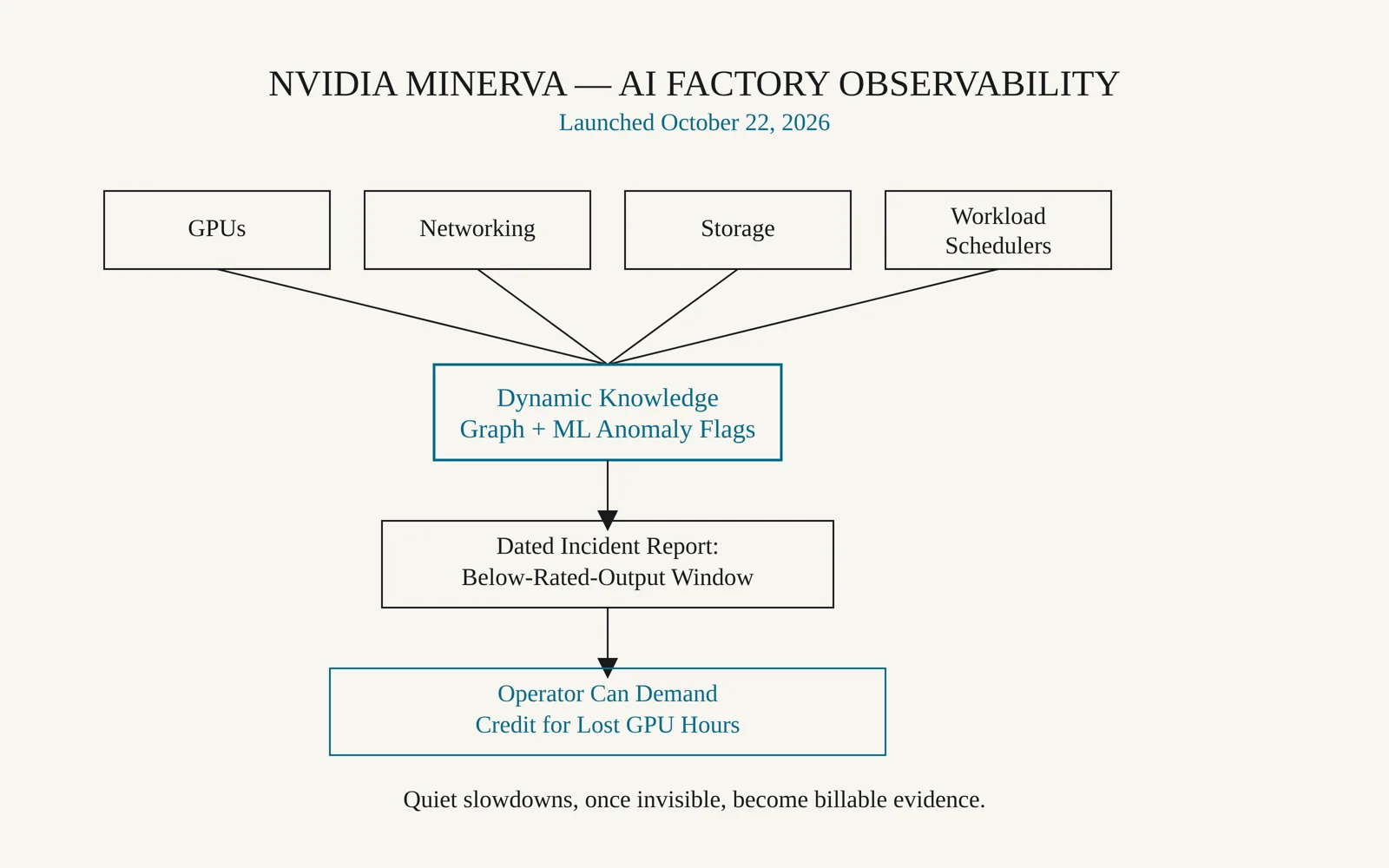
On October 22, 2026, Nvidia launched Minerva, a new AIOps platform that combines telemetry from GPUs, networking, storage and workload schedulers into one dynamic knowledge graph, using machine learning to flag anomalies and group related alerts into a single incident for operators running large AI factories. (Nvidia newsroom post announcing Minerva, published October 22, 2026)
Open the photograph at full size
Photograph: Diagram: AI Journey
Read the full description of this diagram
Diagram drawn for this item: Nvidia Launches Minerva Platform for AI Factory Observability. On October 22, 2026, Nvidia launched Minerva, a new AIOps platform that combines telemetry from GPUs, networking, storage and workload schedulers into one dynamic knowledge graph, using machine learning to flag anomalies and group related... For a reader weighing a GPU rental bill, the real cost sits in the hours a cluster runs below its rated output without anyone noticing, so a tool that turns a quiet slowdown into a dated incident report changes what an operator can demand...
What it means for you
For a reader weighing a GPU rental bill, the real cost sits in the hours a cluster runs below its rated output without anyone noticing, so a tool that turns a quiet slowdown into a dated incident report changes what an operator can demand from a cloud partner's uptime claim. It also shifts the ops workflow from separate networking, compute and machine learning dashboards toward one shared view, which is a different job for the people who staff those teams, not just a faster one.
In more detail
Nvidia launched Minerva on October 22, 2026, an AIOps platform meant to give operators of large AI factories one place to watch infrastructure and workloads instead of several. The company says traditional monitoring tools split that view across networking, compute, site reliability and machine learning teams, so a slow training job can take time to trace back to the one overheating GPU or degraded NVMe drive behind it. Minerva builds what Nvidia calls a dynamic knowledge graph, logically mapping GPUs, SuperNICs, switches, cables and the jobs running across them, and applies supervised and unsupervised machine learning to learn normal behavior, flag anomalies it has not seen before and group related alerts into one incident with a likely root cause rather than a flood of separate warnings.
The platform also ships with a native AI assistant that connects to live telemetry, letting an operator ask about cluster health in plain language and get a recommended fix back, with a person deciding whether to apply it manually or let Minerva push it through automation and infrastructure APIs. Nvidia frames the whole platform around a single idea it calls AI factory yield, the useful output a cluster produces measured through GPU hours, goodput, uptime and token production, rather than through uptime alone.
The numbers
Nvidia did not publish a count of alerts suppressed or dollars saved, so the evidence here is about scale and partners rather than a verified figure. The company says Minerva can trace a single slow job back to its cause across a factory running hundreds of thousands of GPUs, and that its models process the telemetry at a rate of billions of data points every hour. On the customer side, IREN is already using Minerva in production, with Aolani, Bitdeer AI, IBM, Jio, Lambda, Quake AI and Tesla named as planning deployments. Dell Technologies, Lenovo and Supermicro will offer the platform through their own AI factory operations portfolios, which puts Minerva on the shelf for buyers who never deal with Nvidia directly.
IREN’s chief technology officer, Denis Skrinnikoff, said the platform gives his operations team one view across the network, GPUs and jobs together, framing it as a move from troubleshooting toward proactive maintenance. That is the pitch Nvidia is making to every operator buying GPU capacity at scale: the chips are the same chips, but the software layer watching them decides how much of that capacity actually ships as finished work.
Sources
Sources read
Nvidia newsroom post announcing Minerva, published October 22, 2026 (blogs.nvidia.com)
Newsroom read
Cite this
AI Journey, "Nvidia Launches Minerva Platform for AI Factory Observability", 23 Oct 2026, https://aijourney.space/updates/2026-10-23-nvidia-unveils-minerva-to-bring-end-to-end-observability-for-ai-factorie/ (source: Nvidia, verified 23 Oct 2026)
Next in the stream
New Paper Proposes CiteAnchor to Catch Hallucinated Citations
A new arXiv preprint introduces CiteAnchor, a method for detecting and resolving hallucinated citations in scientific writing, alongside a benchmark dataset.
Previous
Paper Finds Anthropic and OpenAI Models Decline Reports by Racial Description
A new paper tests whether Anthropic's Claude and OpenAI models refuse to weigh an informant's report based on racial description alone, not evidence.
Next
More in Nvidia
Nvidia RTX Spark Laptops Add Transcription Model and New Game Support
Nvidia detailed new RTX Spark laptop updates, including a transcription model from its Nemotron line and support for Liquid AI's LFM3 models.
Nvidia Expands Agent Toolkit With Data Grounding Tools
Nvidia expanded its open source Agent Toolkit on October 21, 2026, adding an Agent Knowledge Foundation that grounds enterprise agents in company data without moving it.
Nvidia RTX Spark Laptops Go On Sale From $2,399
Nvidia marked the retail arrival of its RTX Spark laptops with launch events worldwide, as partner Windows PCs built around the new chip reached buyers.