Event Published ResearchResearch
New Paper Proposes CiteAnchor to Catch Hallucinated Citations
A new arXiv preprint introduces CiteAnchor, a method for detecting and resolving hallucinated citations in scientific writing, alongside a benchmark dataset.
What happened
Published here
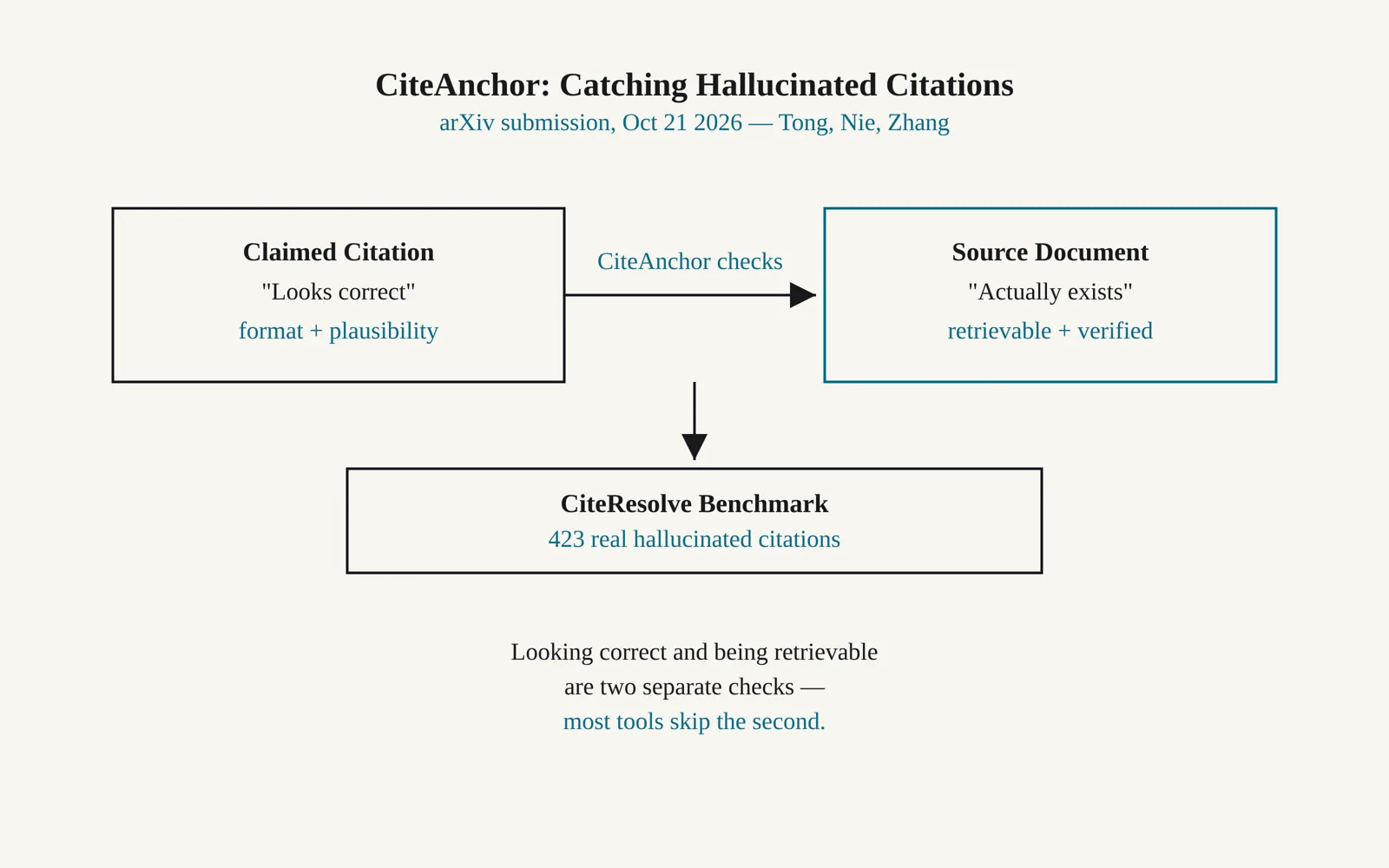
On October 21, 2026, researchers Chenyi Tong, Ping Nie and Yu Zhang submitted a paper to arXiv describing CiteAnchor, a source-aware framework for finding hallucinated citations, and CiteResolve, a benchmark of 423 real-world hallucinated citations annotated for whether their underlying source can actually be recovered. (arXiv preprint 2610.30355, submitted October 21, 2026)
Open the photograph at full size
Photograph: Diagram: AI Journey
Read the full description of this diagram
Diagram drawn for this item: New Paper Proposes CiteAnchor to Catch Hallucinated Citations. On October 21, 2026, researchers Chenyi Tong, Ping Nie and Yu Zhang submitted a paper to arXiv describing CiteAnchor, a source-aware framework for finding hallucinated citations, and CiteResolve, a benchmark of 423 real-world hallucinated... For anyone relying on a chatbot or a research assistant to draft a literature review, this work is a reminder that a citation looking correct and a citation pointing to a real, retrievable document are two separate checks, and most...
The numbers
Benchmark citations
423
Real-world hallucinated citations in the CiteResolve benchmark
Detection F1
0.841
CiteAnchor's F1 score with the GPT-5.6 Luna backbone on an existing detection benchmark
Task success, strong backbone
74.7%
End-to-end task success on CiteResolve with GPT-5.6 Luna
Task success, open backbone
70.7%
End-to-end task success on CiteResolve with an open-weight backbone
Read from arXiv preprint 2610.30355, submitted October 21, 2026
What it means for you
For anyone relying on a chatbot or a research assistant to draft a literature review, this work is a reminder that a citation looking correct and a citation pointing to a real, retrievable document are two separate checks, and most automated tools today only perform the first one, leaving a reader to discover the gap only when they click through and the paper does not exist.
In more detail
Citations that look plausible but point nowhere real have become a familiar failure mode of generative AI writing tools, and a new preprint tries to separate two questions that most detection methods blur together: is a citation valid, and can its source actually be found. The authors call the problem bibliographic drift. Records for the same work can differ across preprint versions, journal reprints and conference proceedings, so a system that only checks whether a cited title and author list look like a real paper will pass through citations that are internally consistent but unverifiable, and reject some genuine ones whose metadata happens to vary between databases.
The paper’s first contribution is CiteResolve, a benchmark built from 423 real-world hallucinated citations, each one annotated for whether a unique underlying source can be recovered at all. That annotation step matters because not every fabricated-looking citation is equally fixable: some can be traced to a real document once a search strategy accounts for the right source type, while others genuinely have no retrievable match.
The second contribution is CiteAnchor itself, a framework that adapts its retrieval and field-level verification to the kind of source being checked, rather than applying one matching strategy to every reference. It treats validity and source recoverability as separate judgments instead of collapsing them into a single plausibility score.
The numbers
On an existing hallucinated-citation detection benchmark, CiteAnchor reaches an F1 score of 0.841 when paired with the GPT-5.6 Luna backbone and 0.784 with an open-weight backbone, which the authors report as gains of 7.9 and 36.8 points over a baseline using the same backbones. On the authors’ own CiteResolve benchmark, the framework achieves 74.7% and 70.7% end-to-end task success with those same two backbones, which the paper describes as large improvements over web search baselines.
The authors have released their code and data, which is what lets the field check these numbers rather than take them on trust, the same gap the paper is trying to close for citations themselves.
Sources
Sources read
arXiv preprint 2610.30355, submitted October 21, 2026 (arxiv.org)
Paper read
Cite this
AI Journey, "New Paper Proposes CiteAnchor to Catch Hallucinated Citations", 25 Oct 2026, https://aijourney.space/updates/2026-10-25-citeanchor-source-aware-grounding-for-hallucinated-citation-detection-an/ (source: arXiv, verified 25 Oct 2026)
Next in the stream
Paper Finds Self-Rewarded Moral Argument Training Boosts Consistency, Not Validity
A new arXiv preprint finds that training language models to argue morality via self-judged tournaments makes them more decisive but not more correct.
Previous
Nvidia Launches Minerva Platform for AI Factory Observability
Nvidia introduced Minerva, an AIOps platform that merges infrastructure and workload telemetry to flag problems across AI factories before they spread.
Next
More in Research
Study Finds Precedent Labels Sway Claude Haiku Approval Calls
A new paper tests Claude Haiku 5.5 alongside other models on refund and claim decisions, showing that past case labels shift approvals sharply.
Paper Tests Claude Opus 4.8 Agents on Conflicting Code Edits
A new paper benchmarks Claude Code running Claude Opus 4.8 against other coding agents on tasks where two agents edit the same shared codebase at once.
Perplexity AI Researchers Detail LoRA Recipe For Converting Four Language Models To Diffusion
A paper associated with Perplexity AI describes BYOD, a LoRA-only method that converts standard autoregressive language models into diffusion language models without full retraining.