Event Published ResearchResearch
Paper Finds Self-Rewarded Moral Argument Training Boosts Consistency, Not Validity
A new arXiv preprint finds that training language models to argue morality via self-judged tournaments makes them more decisive but not more correct.
What happened
Published here
On October 21, 2026, researchers posted a preprint describing a reinforcement learning policy trained in a self-judged tournament where a language model's generated moral arguments are judged pairwise on quality by that same model, with its reasoning masked from the judging step, using authentic dilemmas drawn from classic novels and checked with a logic solver. (arXiv preprint 2610.30349, posted October 21, 2026)
Open the photograph at full size
Photograph: Diagram: AI Journey
Read the full description of this diagram
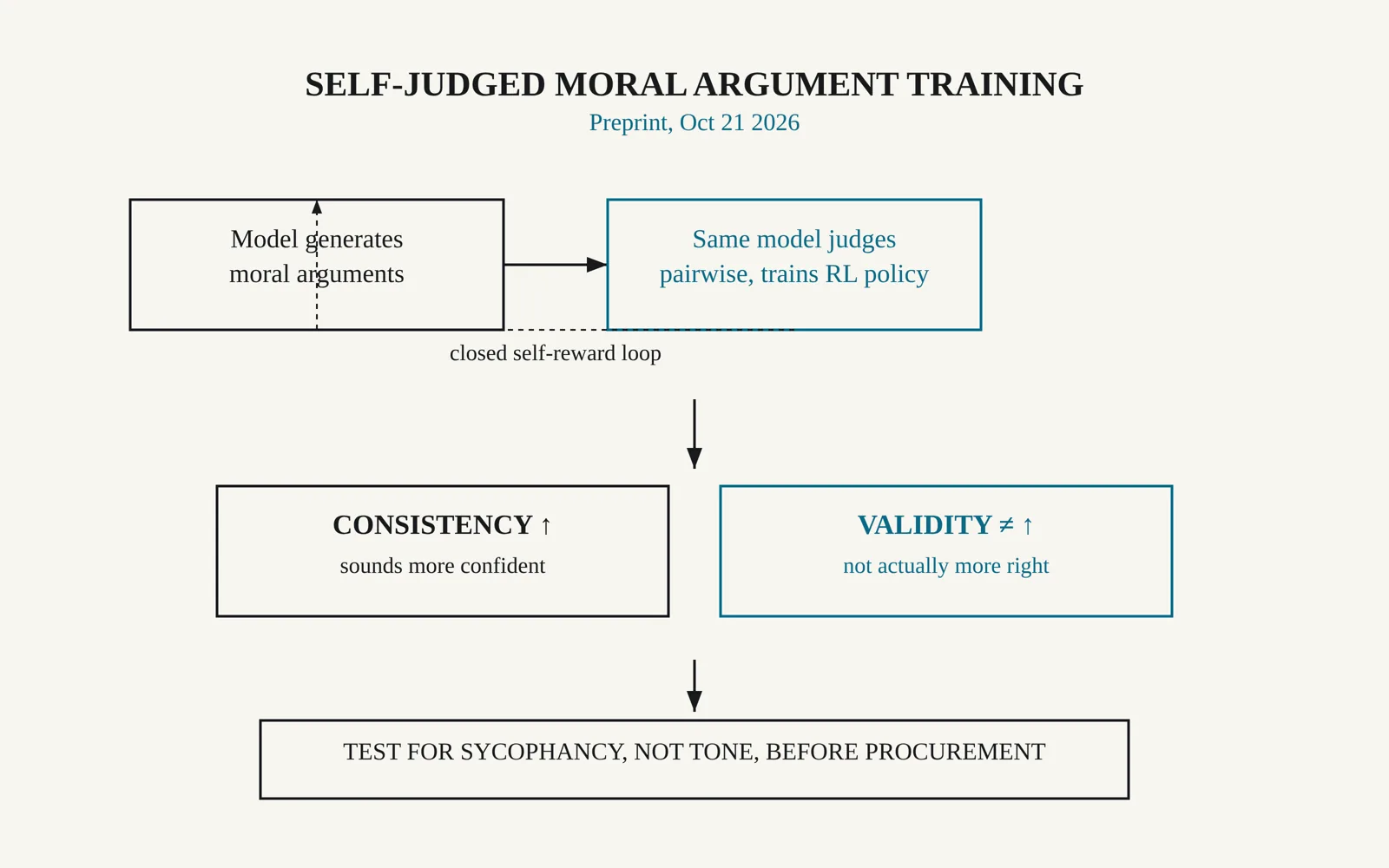
Diagram drawn for this item: Paper Finds Self-Rewarded Moral Argument Training Boosts Consistency, Not Validity. On October 21, 2026, researchers posted a preprint describing a reinforcement learning policy trained in a self-judged tournament where a language model's generated moral arguments are judged pairwise on quality by that same model, with... For anyone building or buying a chatbot pitched as a moral advisor, this draws a line between a system sounding sure of itself and a system being right, which should push procurement teams to test for sycophancy and reframing rather than...
What it means for you
For anyone building or buying a chatbot pitched as a moral advisor, this draws a line between a system sounding sure of itself and a system being right, which should push procurement teams to test for sycophancy and reframing rather than trust a confident tone as a proxy for sound judgment.
In more detail
Researchers behind a new preprint posted to arXiv on October 21, 2026 set out to test whether training a language model to argue well about moral dilemmas would also make its judgments better. The premise sounds reasonable: a model that can construct a stronger case for a position might also be more likely to land on the right one. The study finds the opposite split holds instead. Argument quality training made the model’s verdicts far more stable and consistent, but it did not make those verdicts more sound by the measures the authors used to check validity.
The method is a self-judged tournament. A reinforcement learning policy, built from a state-of-the-art language model, generates competing moral arguments and then judges those arguments against each other for quality, with its own reasoning steps hidden from the judging process so the policy cannot simply reward arguments that match its existing answer. To source real dilemmas rather than invented toy cases, the team pulled conflicts from classic novels and ran each one through a logic solver to confirm it actually represented a genuine moral conflict rather than a false dichotomy.
The team found their self-judge rated argument quality in a way that lined up with human annotators, and that the trained policy began adopting the style of language that earned it the highest reward. Tested against three external benchmarks for moral reasoning, the policy became markedly more decisive and stopped flipping its answer depending on the order options were presented in. But the paper is explicit that two known failure modes, sycophancy toward a suggested framing and sensitivity to how a question is reworded, remained largely unaddressed. Two follow-up ablation tests, run with synthetic dilemmas and with the model’s reasoning left unmasked during judging, reproduced the ordering-consistency gains but showed a weaker shift in language style and, notably, higher sycophancy than the main setup.
The numbers
- The paper reports 20 pages, 10 figures and 9 tables backing its findings.
- Three external benchmarks, MoralChoice, ELEPHANT and MORABLES, were used to test the trained policy.
- Two ablation studies were run, one with synthetic dilemmas and one with unmasked thinking during judging.
The authors’ own framing is blunt: consistency is not validity. A policy can be optimized to stop contradicting itself across rephrasings of the same question without becoming any more trustworthy in what it actually decides, a distinction that matters wherever a model’s steadiness is mistaken for its being correct.
Sources
Sources read
arXiv preprint 2610.30349, posted October 21, 2026 (arxiv.org)
Paper read
Cite this
AI Journey, "Paper Finds Self-Rewarded Moral Argument Training Boosts Consistency, Not Validity", 25 Oct 2026, https://aijourney.space/updates/2026-10-25-consistency-is-not-validity-self-rewarded-moral-argumentation-makes-lang/ (source: arXiv, verified 25 Oct 2026)
Next in the stream
Paper Describes Data-Centric Continual Pretraining Method For Arabic LLMs
A new paper describes AQL-Lite, a quality-first data pipeline and partial-parameter training recipe that adapts multilingual language models to Modern Standard Arabic at lower cost.
Previous
New Paper Proposes CiteAnchor to Catch Hallucinated Citations
A new arXiv preprint introduces CiteAnchor, a method for detecting and resolving hallucinated citations in scientific writing, alongside a benchmark dataset.
Next
More in Research
Study Finds Precedent Labels Sway Claude Haiku Approval Calls
A new paper tests Claude Haiku 5.5 alongside other models on refund and claim decisions, showing that past case labels shift approvals sharply.
Paper Tests Claude Opus 4.8 Agents on Conflicting Code Edits
A new paper benchmarks Claude Code running Claude Opus 4.8 against other coding agents on tasks where two agents edit the same shared codebase at once.
Perplexity AI Researchers Detail LoRA Recipe For Converting Four Language Models To Diffusion
A paper associated with Perplexity AI describes BYOD, a LoRA-only method that converts standard autoregressive language models into diffusion language models without full retraining.