Event Published ResearchResearch
Paper Describes Data-Centric Continual Pretraining Method For Arabic LLMs
A new paper describes AQL-Lite, a quality-first data pipeline and partial-parameter training recipe that adapts multilingual language models to Modern Standard Arabic at lower cost.
What happened
Published here
On October 21, 2026, researchers Houssam Eddine Boukhalfa, Mourad Bouache and Mourad Dahmane posted a paper to arXiv describing AQL-Lite, a framework that curates web text for Modern Standard Arabic and trains a multilingual model on it using a partial-parameter continual pretraining recipe rather than updating every weight in the network. (arXiv preprint 2610.30344, AQL-Lite, submitted October 21, 2026)
Open the photograph at full size
Photograph: Diagram: AI Journey
Read the full description of this diagram
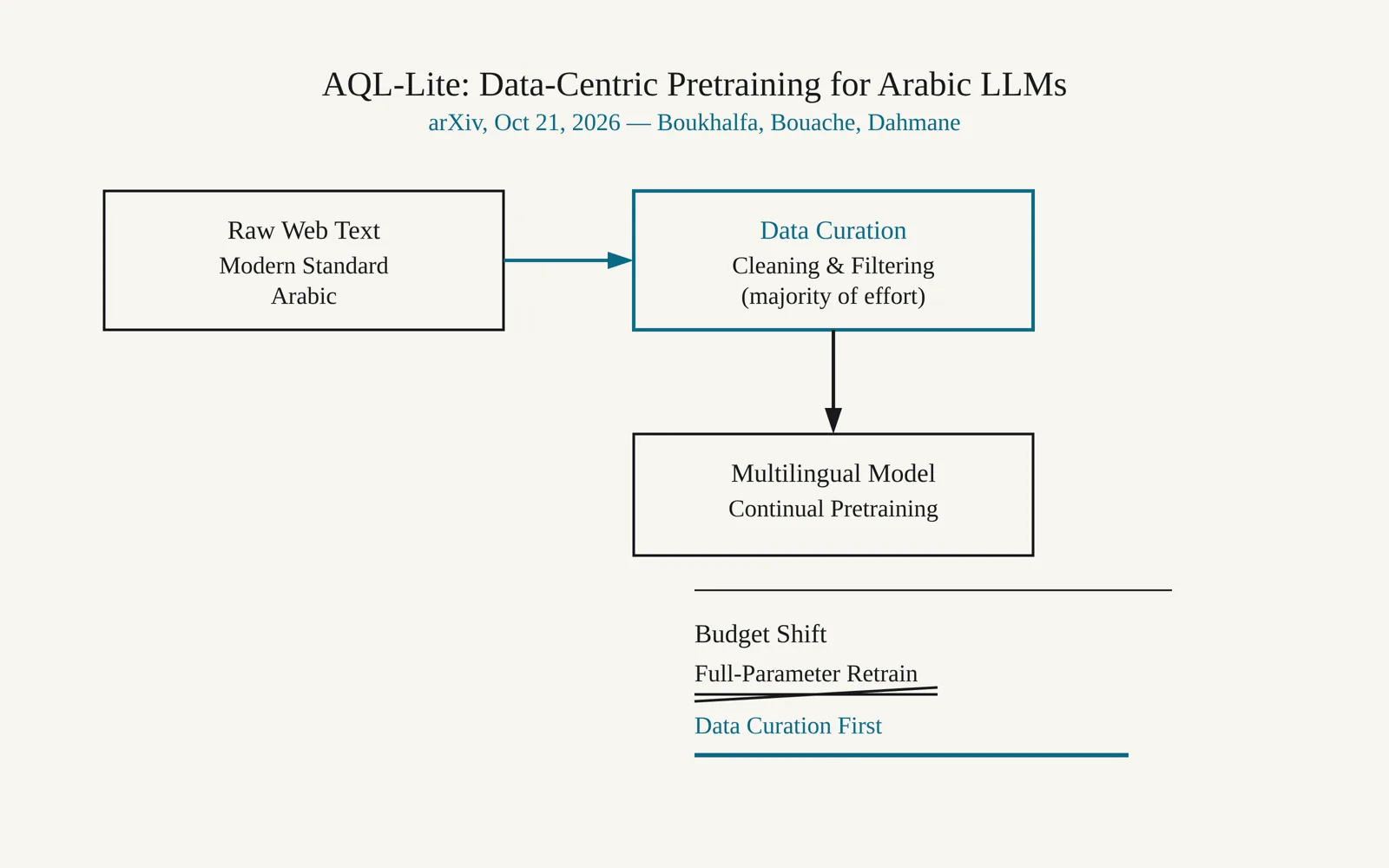
Diagram drawn for this item: Paper Describes Data-Centric Continual Pretraining Method For Arabic LLMs. On October 21, 2026, researchers Houssam Eddine Boukhalfa, Mourad Bouache and Mourad Dahmane posted a paper to arXiv describing AQL-Lite, a framework that curates web text for Modern Standard Arabic and trains a multilingual model on it... For anyone budgeting a language adaptation project, the result reframes the choice away from a blanket full-parameter retrain and toward spending first on data curation, since the paper reports that cleaning raw web text accounts for most...
The numbers
Four-benchmark gain
3.51
Points gained on a four-benchmark Arabic mean using curated over raw web text at a matched 1B-token budget
Gain recovered
94%
Share of full-parameter continual pretraining's gain reached by AQL-Lite at 5B tokens
Wall-clock share
52%
Share of the wall-clock time full-parameter training took, at the 5B-token comparison
OALL v2 score
75.3
Score of the scaled 12B model on the seven-benchmark Open Arabic LLM Leaderboard v2 suite
Read from arXiv preprint 2610.30344, AQL-Lite, submitted October 21, 2026
What it means for you
For anyone budgeting a language adaptation project, the result reframes the choice away from a blanket full-parameter retrain and toward spending first on data curation, since the paper reports that cleaning raw web text accounts for most of the gain before any training method is chosen. A team with a fixed compute allowance for Arabic or another underserved language can read this as a reason to cut the training budget in half rather than the data budget, provided the curation pipeline is built first.
In more detail
The paper addresses a specific cost problem in building Arabic language models: web text scraped for Arabic is noisy, mixes dialects with Modern Standard Arabic (MSA), and continual pretraining on a multilingual base model is expensive when every parameter is updated. The authors propose AQL-Lite, which pairs a curation pipeline, structural cleaning, filtering by heuristics and by a model, MSA selection and deduplication, with a training recipe that touches only part of the network: low-rank adapters placed across layers, the last eight transformer blocks, and the embedding matrix, all under layer-wise learning rates rather than a single global rate.
The central comparison in the paper isolates how much of the benefit comes from the data versus the training method. At a matched 1B-token budget, training on raw, uncurated web text produced no measurable improvement over the untouched base model, while training on the curated AQL data raised a four-benchmark Arabic average by 3.51 points. That result puts the curation step, not the training recipe, as the first lever worth pulling.
A second, 5B-token comparison then tests the training recipe itself against a full-parameter continual pretraining baseline. AQL-Lite reached 94% of the full-parameter run’s benchmark gain while using 52% of its wall-clock time, and beat adapter-only baselines on every benchmark tested. A follow-up ablation found that the adapters, the unfrozen transformer blocks, and the embedding-matrix training each added something on their own, rather than one component carrying the whole effect.
The numbers
- 3.51 points: the four-benchmark Arabic mean gain from curated data over raw web text, at the same 1B-token budget, with raw text alone yielding no gain.
- 94% and 52%: the share of full continual pretraining’s gain AQL-Lite recovered, and the share of its wall-clock time that took, in the 5B-token comparison.
- 75.3: the score reached on the seven-benchmark Open Arabic LLM Leaderboard v2 suite once the recipe was scaled to 40 billion MSA tokens and instruction-tuned.
The paper frames partial-parameter continual pretraining on a carefully curated corpus as a practical route for adapting a multilingual model to a language with sparser resources than English, a framing relevant to any team weighing where to spend a fixed compute budget on language adaptation work.
Sources
Sources read
arXiv preprint 2610.30344, AQL-Lite, submitted October 21, 2026 (arxiv.org)
Paper read
Cite this
AI Journey, "Paper Describes Data-Centric Continual Pretraining Method For Arabic LLMs", 24 Oct 2026, https://aijourney.space/updates/2026-10-24-aql-lite-enabling-efficient-knowledge-acquisition-for-arabic-llms-via-da/ (source: arXiv, verified 24 Oct 2026)
Next in the stream
Paper Finds Arena-Hard Judge Verdicts Shift Even When Scores Hold Steady
A new paper finds that Arena-Hard's GPT-4.1 judge flips its verdict on one in five reruns, even though the aggregate score barely moves.
Previous
Paper Finds Self-Rewarded Moral Argument Training Boosts Consistency, Not Validity
A new arXiv preprint finds that training language models to argue morality via self-judged tournaments makes them more decisive but not more correct.
Next
More in Research
Study Finds Precedent Labels Sway Claude Haiku Approval Calls
A new paper tests Claude Haiku 5.5 alongside other models on refund and claim decisions, showing that past case labels shift approvals sharply.
Paper Tests Claude Opus 4.8 Agents on Conflicting Code Edits
A new paper benchmarks Claude Code running Claude Opus 4.8 against other coding agents on tasks where two agents edit the same shared codebase at once.
Perplexity AI Researchers Detail LoRA Recipe For Converting Four Language Models To Diffusion
A paper associated with Perplexity AI describes BYOD, a LoRA-only method that converts standard autoregressive language models into diffusion language models without full retraining.