Event Published ResearchResearch
Paper Finds Arena-Hard Judge Verdicts Shift Even When Scores Hold Steady
A new paper finds that Arena-Hard's GPT-4.1 judge flips its verdict on one in five reruns, even though the aggregate score barely moves.
What happened
Published here
A paper posted to arXiv on October 21, 2026 tests how repeatable GPT-4.1 is as a judge on 500 Arena-Hard v2.0 prompts, rerunning the same setup unchanged and then varying the judge's criteria, output format and task framing across eight combinations, with two models' answers held fixed throughout. (arXiv preprint 2610.30512, submitted 21 October 2026)
Open the photograph at full size
Photograph: Diagram: AI Journey
Read the full description of this diagram
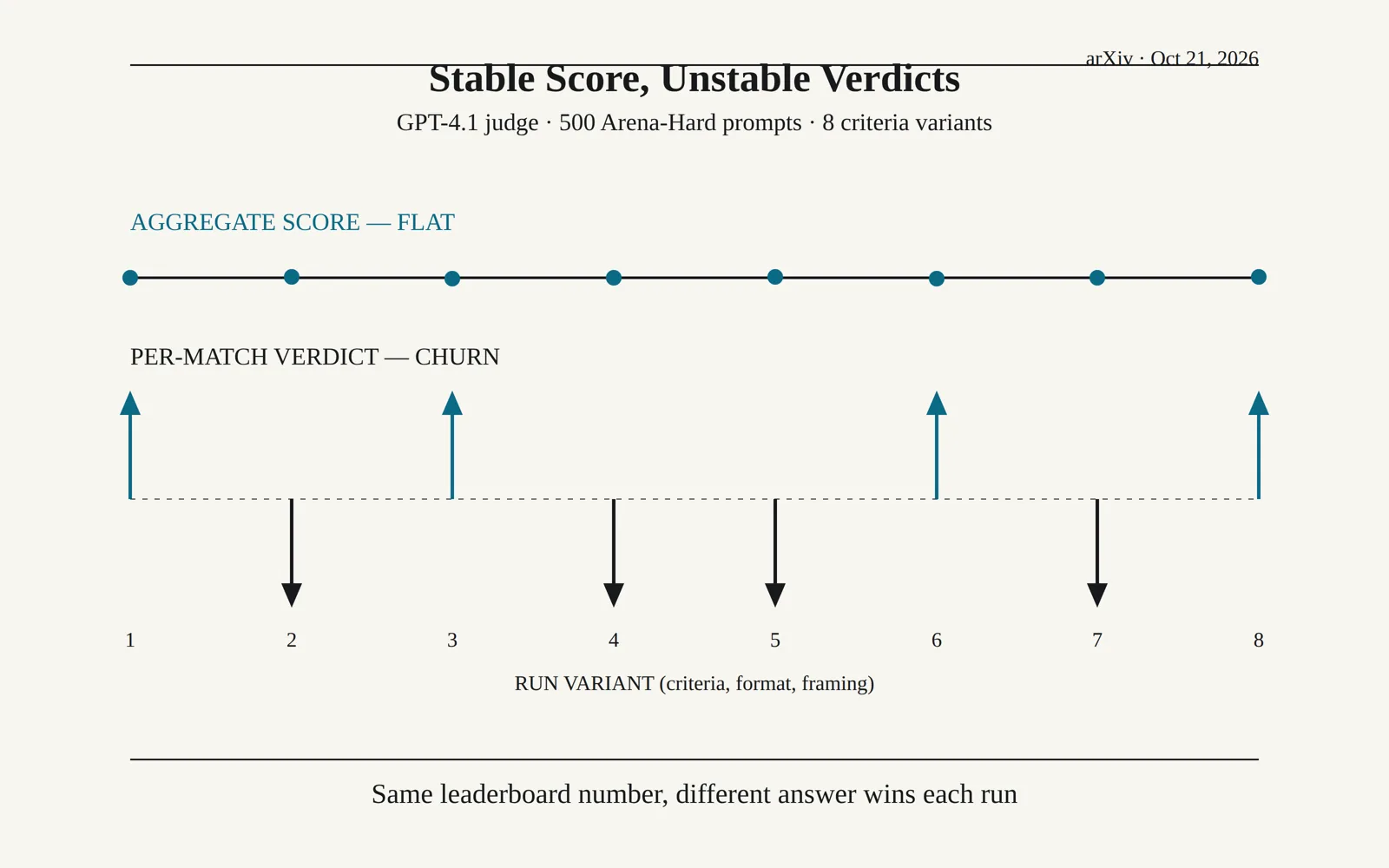
Diagram drawn for this item: Paper Finds Arena-Hard Judge Verdicts Shift Even When Scores Hold Steady. A paper posted to arXiv on October 21, 2026 tests how repeatable GPT-4.1 is as a judge on 500 Arena-Hard v2.0 prompts, rerunning the same setup unchanged and then varying the judge's criteria, output format and task framing across eight... For any team that benchmarks models with an LLM acting as judge, these figures mean a flat leaderboard score can hide wide churn in which answer actually wins each head to head match, so a workflow that only tracks the aggregate figure...
The numbers
Outcome flips on rerun
21.2%
Share of prompts where win/tie/loss changed on an identical rerun
Prompts tested
500
Arena-Hard v2.0 prompts used, with two models' answers held fixed
Extra flips, reasoning dropped
28.2 percentage points
More prompts changed outcome when the judge was told to skip reasoning
Score fall, same setup
4.09 points
Aggregate score drop when reasoning and other instructions were dropped
Read from arXiv preprint 2610.30512, submitted 21 October 2026
What it means for you
For any team that benchmarks models with an LLM acting as judge, these figures mean a flat leaderboard score can hide wide churn in which answer actually wins each head to head match, so a workflow that only tracks the aggregate figure risks publishing a ranking that would look different on a second run with no visible warning. A reader comparing two models on a single Arena-Hard score should ask whether that score was checked against a rerun before treating the gap between them as real.
In more detail
The paper, by Louise Yorke and accepted at the JUDGe workshop at NeurIPS 2026, asks a narrow but uncomfortable question about a benchmarking practice that has become routine: when an LLM is asked to pick the better of two answers, does the same judge give the same verdict twice, and does that verdict depend on how the instructions are worded. Both questions sit underneath every leaderboard that reports an LLM-judged win rate as if it were a stable measurement.
The study holds the two models being compared fixed and runs GPT-4.1 as the judge over 500 prompts from Arena-Hard v2.0, a pinned model version at temperature zero. It first reruns the exact same setup unchanged, then builds eight combinations of judging criteria, output format and task framing to see how much the instructions themselves move the result. Repeating the unchanged setup still moved the aggregate score by about one point, a gap small enough to look like noise, yet the underlying win, tie or loss call changed on a sizeable share of individual prompts. Changing the instructions pushed that further: one variant that asked for a verdict with no reasoning and trimmed several other instructions produced far more outcome changes than the unchanged reruns did on average, alongside a real fall in the aggregate score. A separate variant that told the judge to weight accuracy moved almost as many individual outcomes while leaving the aggregate score close to flat, which is the paper’s central warning: a steady headline number does not mean the verdicts behind it are steady.
The paper’s own recommendation is blunt. Anyone who relies on individual LLM-judge verdicts, whether as preference labels for training or as a way to score one response, should rerun each setup they use and report prompt level agreement alongside the aggregate score, rather than treating one run of one prompt set as settled.
The numbers
- 21.2% of prompts changed win, tie or loss outcome when the identical default setup was rerun unchanged.
- 500 Arena-Hard v2.0 prompts were judged, with the two compared models’ answers held fixed across every setup.
- 28.2 percentage points more prompts changed outcome in the setup that dropped reasoning and other instructions, compared with the unchanged reruns.
- 4.09 points was the aggregate score fall in that same reasoning-dropped setup.
The practical lesson for anyone citing an Arena-Hard style score is to treat the published number as one sample from a noisy process, not a fixed property of the model being judged, and to ask whether the people who produced it ever checked a rerun.
Sources
Sources read
arXiv preprint 2610.30512, submitted 21 October 2026 (arxiv.org)
Paper read
Cite this
AI Journey, "Paper Finds Arena-Hard Judge Verdicts Shift Even When Scores Hold Steady", 24 Oct 2026, https://aijourney.space/updates/2026-10-24-behind-aggregate-scores-what-systematically-varying-arena-hard-s-llm-jud/ (source: arXiv, verified 24 Oct 2026)
Next in the stream
Preprint Maps When Muon's Orthogonal Update Beats Plain Gradient Descent
A new arXiv preprint studies PolarGD, the orthogonalized update inside the Muon optimizer, and finds exactly when that extra step pays for itself.
Previous
Paper Describes Data-Centric Continual Pretraining Method For Arabic LLMs
A new paper describes AQL-Lite, a quality-first data pipeline and partial-parameter training recipe that adapts multilingual language models to Modern Standard Arabic at lower cost.
Next
More in Research
Study Finds Precedent Labels Sway Claude Haiku Approval Calls
A new paper tests Claude Haiku 5.5 alongside other models on refund and claim decisions, showing that past case labels shift approvals sharply.
Paper Tests Claude Opus 4.8 Agents on Conflicting Code Edits
A new paper benchmarks Claude Code running Claude Opus 4.8 against other coding agents on tasks where two agents edit the same shared codebase at once.
Perplexity AI Researchers Detail LoRA Recipe For Converting Four Language Models To Diffusion
A paper associated with Perplexity AI describes BYOD, a LoRA-only method that converts standard autoregressive language models into diffusion language models without full retraining.