Event Published ResearchResearch
Preprint Maps When Muon's Orthogonal Update Beats Plain Gradient Descent
A new arXiv preprint studies PolarGD, the orthogonalized update inside the Muon optimizer, and finds exactly when that extra step pays for itself.
What happened
Published here
On October 21, 2026, researchers Egor Shulgin, Sam Laing, Antonio Orvieto and Peter Richtarik posted a 47 page preprint to arXiv analyzing PolarGD, the orthogonalized update at the core of the Muon optimizer used to train some large language models faster than AdamW. The paper studies PolarGD on matrix quadratics, where optimizer behavior can be solved in closed form, and compares update directions under line search so the result is not an artifact of learning rate tuning. (arXiv preprint 2610.30280, A Quadratic Lens on Muon's Polar Update, posted October 21, 2026)
Open the photograph at full size
Photograph: Diagram: AI Journey
Read the full description of this diagram
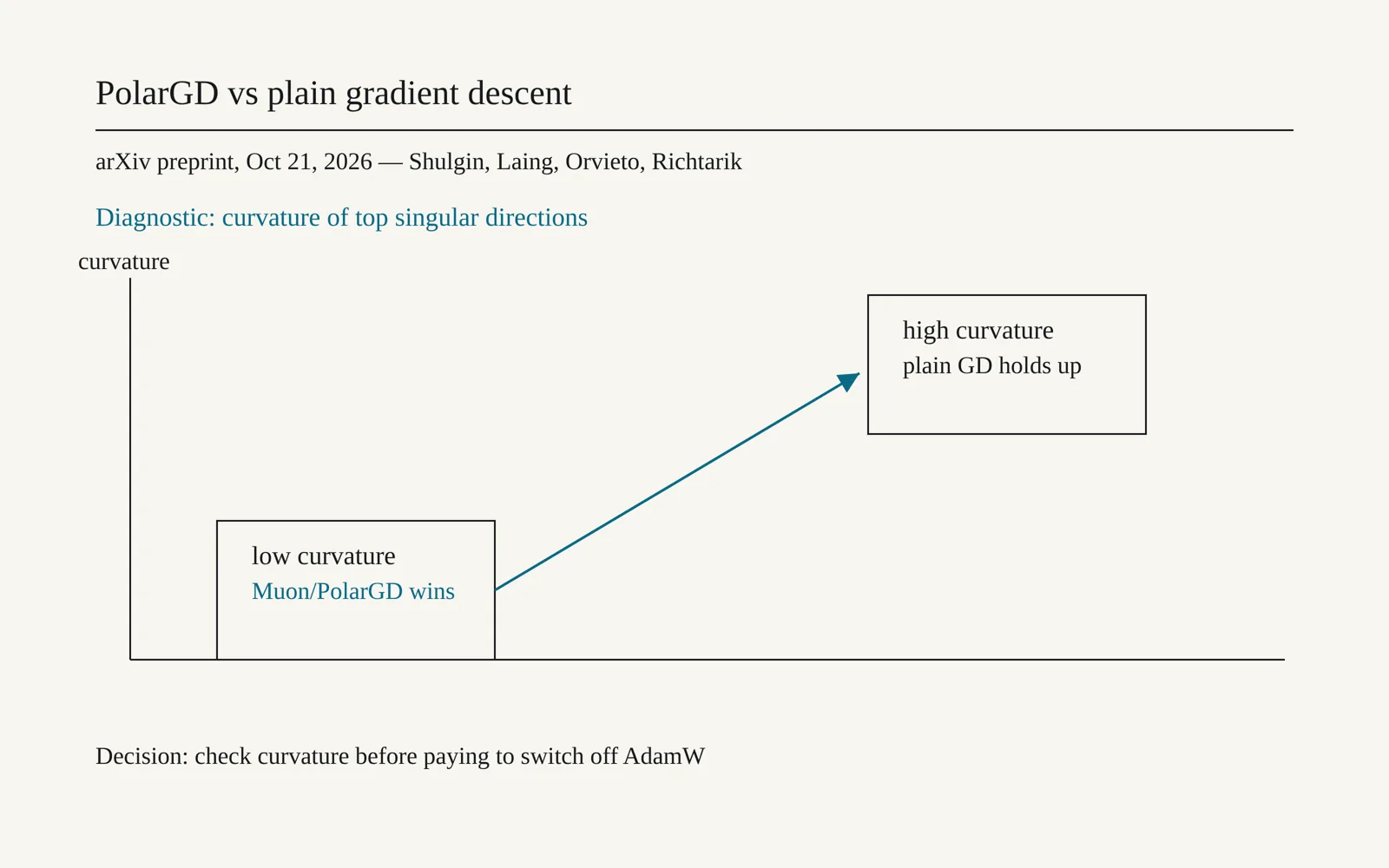
Diagram drawn for this item: Preprint Maps When Muon's Orthogonal Update Beats Plain Gradient Descent. On October 21, 2026, researchers Egor Shulgin, Sam Laing, Antonio Orvieto and Peter Richtarik posted a 47 page preprint to arXiv analyzing PolarGD, the orthogonalized update at the core of the Muon optimizer used to train some large... For a team deciding whether a training run is worth switching off AdamW, this gives a cheap diagnostic to run before paying for the swap: check the curvature of a gradient's top singular directions, and if it is low, the heavier update...
What it means for you
For a team deciding whether a training run is worth switching off AdamW, this gives a cheap diagnostic to run before paying for the swap: check the curvature of a gradient's top singular directions, and if it is low, the heavier update buys nothing. It also sets a budget on expectations, since real runs lean on only a handful of Newton-Schulz passes rather than an exact solve, and roughly one quarter of the attention weights the authors checked sat in a range where that shortcut quietly reduces to ordinary gradient descent, capping any speed gain a team might plan around.
In more detail
The paper’s core move is to strip away learning rate tuning by comparing update directions under line search, then study PolarGD, the orthogonalized step that sits inside the Muon optimizer, on matrix quadratic problems where the whole trajectory can be written out in closed form. That setting lets the authors say precisely when orthogonalizing a gradient update helps and when it does not, rather than relying on the usual anecdotal reports that Muon trains some large language models faster than AdamW.
Their central result is a one step convergence guarantee: PolarGD reaches the minimizer in a single step whenever the rows of the error are orthogonal and have equal norms, regardless of what the Hessian looks like. Plain gradient descent only gets that same one step guarantee when every eigenvalue of the Hessian is equal, a far narrower condition. The authors also show PolarGD, unlike sign descent, is unaffected by rotating the problem, which rules out an entire class of coordinate tricks as an explanation for why the method works.
Over many steps the picture changes. The paper shows PolarGD behaves like gradient descent preconditioned by the current iterate, so its speed depends on how well conditioned that iterate is rather than on the Hessian’s conditioning. That framing explains both the fast regimes practitioners report and a slow regime the authors identify, caused by tiny singular values in the iterate, where PolarGD can run much slower than plain gradient descent.
The numbers
The preprint runs 47 pages and carries 13 figures, and traces the slow regime back to the Newton-Schulz iteration Muon actually uses in practice. Because Muon runs only a few Newton-Schulz steps rather than exact orthogonalization, it treats small singular values the same way gradient descent does, so fewer iterations can sometimes converge faster than full orthogonalization would. Checking a transformer trained with Muon, the authors find about a quarter of the singular values in its attention matrices fall into this regime, which is the figure likely to draw the most attention from teams running Muon at scale.
A shorter version of the work was presented at the ICML 2026 Workshop on High-dimensional Learning Dynamics, and the full preprint was submitted to arXiv on October 21, 2026 by Sam Laing on behalf of the coauthors.
Sources
Sources read
Cite this
AI Journey, "Preprint Maps When Muon's Orthogonal Update Beats Plain Gradient Descent", 23 Oct 2026, https://aijourney.space/updates/2026-10-23-a-quadratic-lens-on-muon-s-polar-update-benefits-pitfalls-and-the-role-o/ (source: arXiv, verified 23 Oct 2026)
Next in the stream
Paper Tests ChatGPT and Claude on Medical Triage Chat Safety
Researchers built a simulation framework called SIM-UT and used it to test ChatGPT, Claude and a fine-tuned open model on WhatsApp triage chatbots.
Previous
Paper Finds Arena-Hard Judge Verdicts Shift Even When Scores Hold Steady
A new paper finds that Arena-Hard's GPT-4.1 judge flips its verdict on one in five reruns, even though the aggregate score barely moves.
Next
More in Research
Study Finds Precedent Labels Sway Claude Haiku Approval Calls
A new paper tests Claude Haiku 5.5 alongside other models on refund and claim decisions, showing that past case labels shift approvals sharply.
Paper Tests Claude Opus 4.8 Agents on Conflicting Code Edits
A new paper benchmarks Claude Code running Claude Opus 4.8 against other coding agents on tasks where two agents edit the same shared codebase at once.
Perplexity AI Researchers Detail LoRA Recipe For Converting Four Language Models To Diffusion
A paper associated with Perplexity AI describes BYOD, a LoRA-only method that converts standard autoregressive language models into diffusion language models without full retraining.