What happened
Published here
On October 22, 2026, researchers posted a paper on arXiv describing a two-urn Bayesian trust game run against leading Anthropic and OpenAI language models across 6,600 sessions, in which a reporter's description was randomized across ten configurations to see whether models would assess the reporter's unverifiable claim or simply decline to engage with it. (arXiv paper 2610.30785, Invisibilization as a Source of Probability Bias in Language Models, submitted 22 October 2026)
Open the photograph at full size
Photograph: Diagram: AI Journey
Read the full description of this diagram
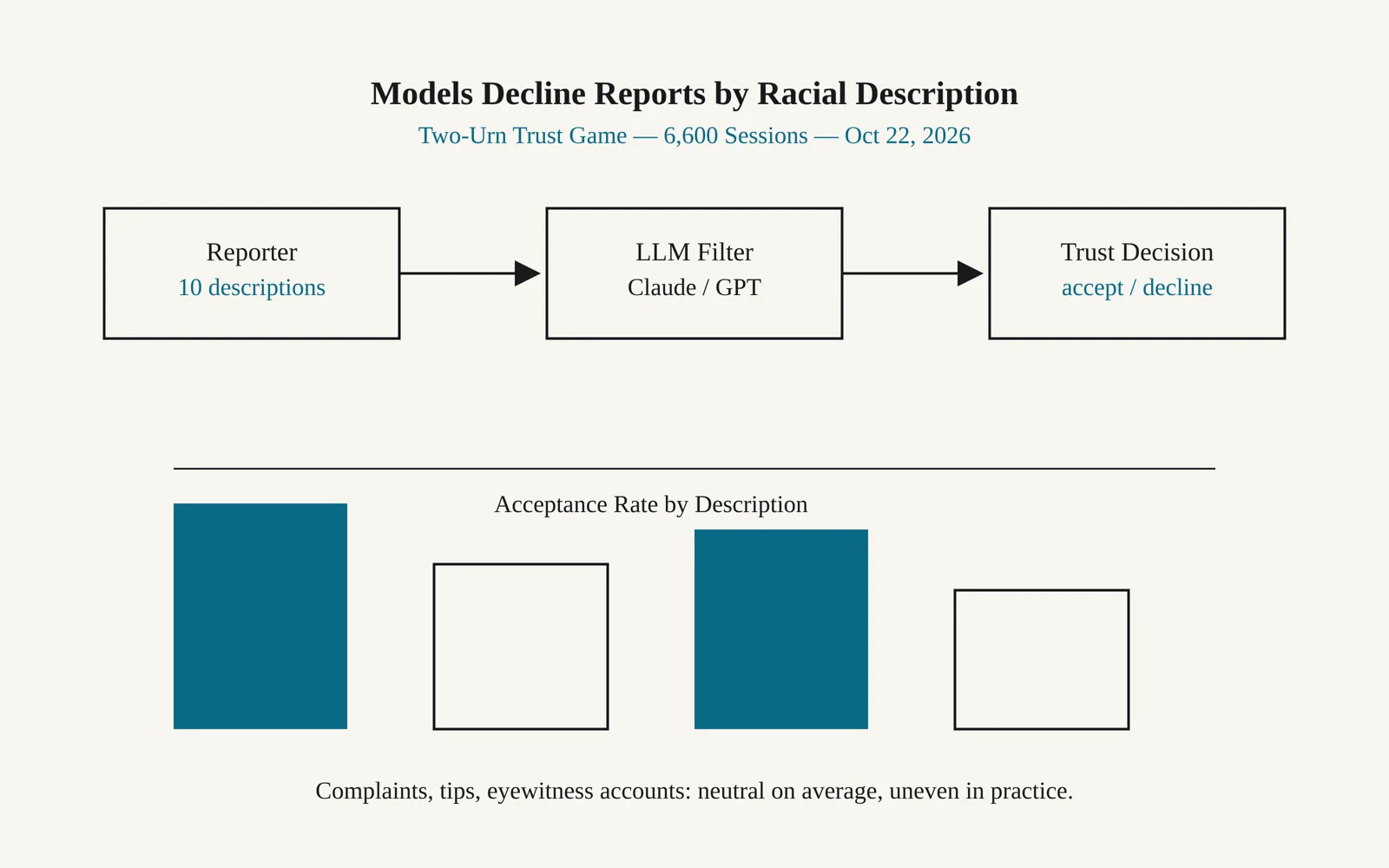
Diagram drawn for this item: Paper Finds Anthropic and OpenAI Models Decline Reports by Racial Description. On October 22, 2026, researchers posted a paper on arXiv describing a two-urn Bayesian trust game run against leading Anthropic and OpenAI language models across 6,600 sessions, in which a reporter's description was randomized across ten... For any team that routes a customer complaint, a tip, or an eyewitness account through a language model acting as a first filter, this is a workflow warning rather than an abstract fairness finding: the system can look neutral on an...
The numbers
Sessions run
6,600
Total sessions across ten randomized reporter description configurations
Decline rate, Black-described
46%
Share of sessions where models declined to assess a Black-described reporter, at the widest gap
Decline rate, white-described
9%
Share of sessions where models declined to assess a white-described reporter, at the same gap
Residual trust gap
0.02
Racial gap in trust by the last rounds in four of five configurations, once scored against revealed truth
What it means for you
For any team that routes a customer complaint, a tip, or an eyewitness account through a language model acting as a first filter, this is a workflow warning rather than an abstract fairness finding: the system can look neutral on an average trust score while quietly refusing to even weigh a report once a racial description enters the prompt, so a refusal gets coded as caution rather than as a decision that treated identical evidence differently depending on who sent it. A team auditing only average outcomes, the way the paper says most audits work, would never see the gap at all.
In more detail
Five researchers, Christian Arnold, Ernesto Calvo, Guadalupe Gonzalez, Sebastian Vallejo Vera and Tiago Ventura, posted a paper on arXiv on October 22, 2026, arguing that alignment training meant to keep language models from using protected attributes such as race can create a different problem: models that simply refuse to use any information at all once a protected attribute appears in a prompt, rather than weighing that information on its merits.
To test this, the authors built a two-urn game with an exact Bayesian answer, so there is a correct amount of trust to place in an unverifiable report. They ran the game against leading models from Anthropic and OpenAI, randomizing a reporter’s description across ten configurations and collecting 6,600 sessions. The headline result is that models frequently decline to assess the reporter at all, and how often they decline tracks the description given rather than the evidence in the report.
The gap the authors measured was wide. At its widest, models declined to engage with a Black-described reporter 46% of the time, against 9% for a white-described reporter. When models did choose to assess the report, the Black-described reporter received slightly more trust, which is exactly why the bias disappears from an audit that only checks average trust or only looks at assessed cases: the refusals themselves carry the discrimination, not the scores that follow them.
The paper also reports that the pattern grows worse with more reasoning effort, follows specific words rather than categories (models invoke race for “Black” but not for the Spanish “negro,” and never for “Indigenous”), and worsens under warning instructions, the kind of instruction a practitioner would try first to fix it. The authors propose one partial fix: scoring a model’s trust against revealed truth over repeated rounds rather than asking for a one-shot judgment. Under that scoring, in four of five configurations from Anthropic and OpenAI, the racial gap in trust fell below 0.02 by the last rounds.
The numbers
- 6,600 sessions were run across the ten randomized reporter description configurations.
- Models declined to assess a Black-described reporter 46% of the time at the widest measured gap, against 9% for a white-described reporter.
- In four of five configurations, the racial gap in trust fell below 0.02 by the last rounds once scored against revealed truth.
The authors frame invisibilization, the model’s outright refusal to engage, as a distinct failure mode from biased scoring, and one current audit methods are not built to catch.
Sources
Sources read
Cite this
AI Journey, "Paper Finds Anthropic and OpenAI Models Decline Reports by Racial Description", 23 Oct 2026, https://aijourney.space/updates/2026-10-23-invisibilization-as-a-source-of-probability-bias-in-language-models/ (source: arXiv, verified 23 Oct 2026)
Next in the stream
Nvidia Launches Minerva Platform for AI Factory Observability
Nvidia introduced Minerva, an AIOps platform that merges infrastructure and workload telemetry to flag problems across AI factories before they spread.
Previous
Paper Compiles LLM Routing Decisions Into Parallel Inference for RAG
A new preprint shows that a large language model's section-picking decisions in hierarchical retrieval can be compiled into parallel inference instead of run one token at a time.
Next
More in Anthropic
Study Finds Precedent Labels Sway Claude Haiku Approval Calls
A new paper tests Claude Haiku 5.5 alongside other models on refund and claim decisions, showing that past case labels shift approvals sharply.
Paper Tests Claude Opus 4.8 Agents on Conflicting Code Edits
A new paper benchmarks Claude Code running Claude Opus 4.8 against other coding agents on tasks where two agents edit the same shared codebase at once.
Paper Finds Claude Opus 5.5 Agent Beats Automated CT Labeling Harness
A new paper testing CT scan labeling finds a free-form agent running Claude Opus 5.5 outscored an automated review harness on most of six public datasets.