Event Published ResearchResearch
Paper Compiles LLM Routing Decisions Into Parallel Inference for RAG
A new preprint shows that a large language model's section-picking decisions in hierarchical retrieval can be compiled into parallel inference instead of run one token at a time.
What happened
Published here
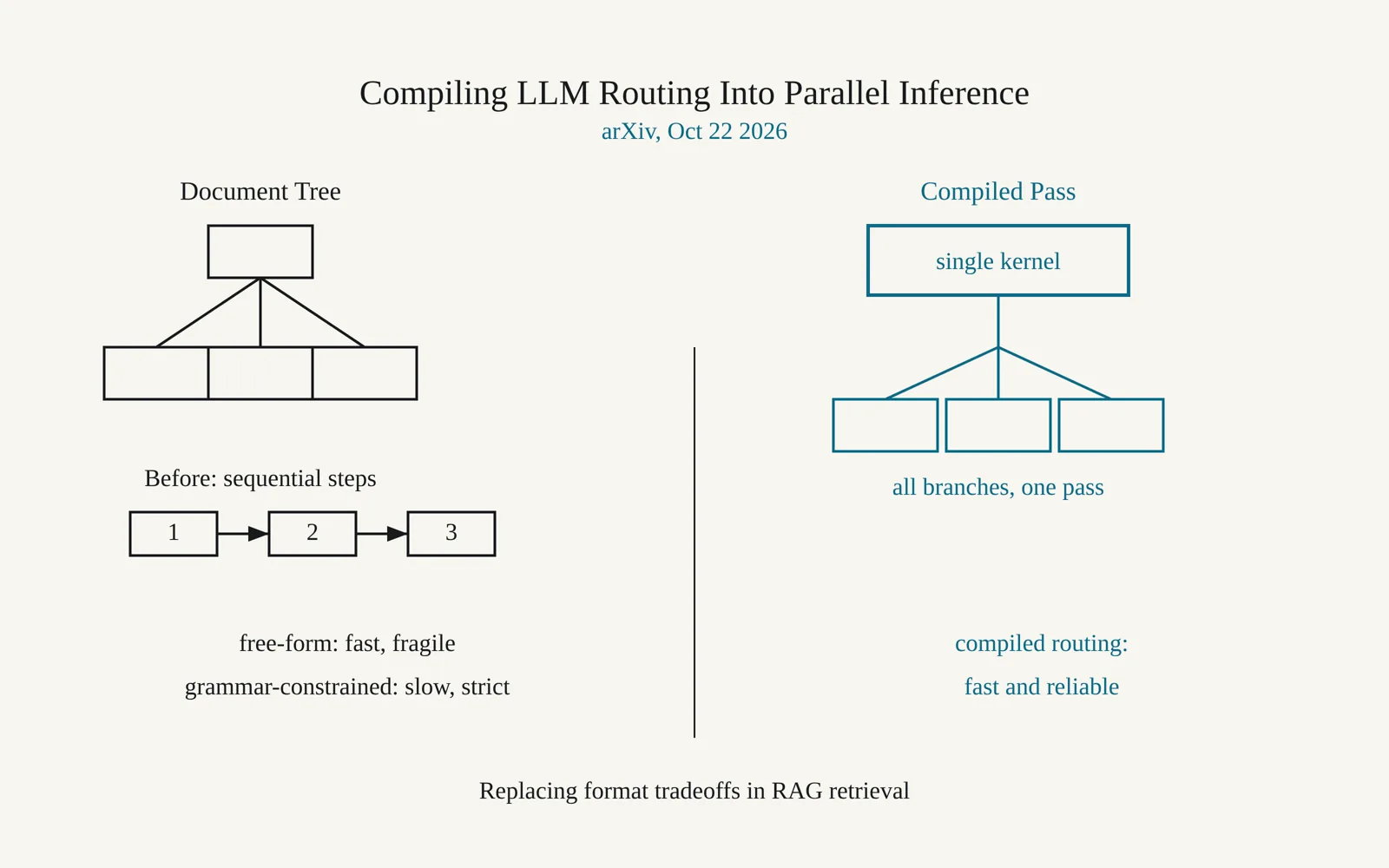
On October 22, 2026, researchers posted a paper to arXiv describing a method for compiling the branching choices a large language model makes while navigating a hierarchical document tree into a single parallel inference pass, replacing the token by token decoding that this kind of retrieval control has relied on. (arXiv preprint 2610.30664, posted October 22, 2026)
Open the photograph at full size
Photograph: Diagram: AI Journey
Read the full description of this diagram
Diagram drawn for this item: Paper Compiles LLM Routing Decisions Into Parallel Inference for RAG. On October 22, 2026, researchers posted a paper to arXiv describing a method for compiling the branching choices a large language model makes while navigating a hierarchical document tree into a single parallel inference pass, replacing... For teams building retrieval systems that ask a model to pick sections from a document tree at each step, the choice has been between a fast free-form format that sometimes breaks and a strict grammar-constrained format that forces one...
What it means for you
For teams building retrieval systems that ask a model to pick sections from a document tree at each step, the choice has been between a fast free-form format that sometimes breaks and a strict grammar-constrained format that forces one decision to wait for the last, so a method that collapses that wait into two forward passes changes what counts as an acceptable latency budget for a multi-step lookup rather than forcing a tradeoff between speed and reliability.
In more detail
A model that acts as a controller inside a structured pipeline still has to speak its decisions out loud, one token after another, even when the decision itself is simple: which of several document sections to open next. In hierarchical retrieval augmented generation, that pattern repeats at every level of a document tree, and the paper argues the serial decoding used to enforce it is not actually required.
The authors frame the problem around two existing options. A model can emit free-form JSON describing which sections it wants, which is quick but fails often enough to need repair. Or it can be forced through grammar-constrained generation, which is reliable but strictly serial, so each branch of the decision waits for the one before it to finish. The paper’s claim is that for this kind of bounded-horizon control, the set of reachable next actions forms a shallow tree that can be worked out in one prefill and one further probe pass, rather than walked one step at a time. A lemma in the paper is used to argue that the compiled version produces the identical policy, in exact arithmetic, to the slower serial method it replaces.
The method was tested across four document-disjoint data splits and at two model scales, run primarily on a MetaX device with a repeat run on an H800 chip to check that the ordering of results held across hardware.
The numbers
The paper reports that compiled control matched the serial, token by token policy on between 84 and 89 percent of questions across the tested splits, and states that every case where the two methods diverged was a floating point near-tie rather than a genuine disagreement. Compared with the slower token-wise serial decoding baseline, the compiled approach is reported to cut control latency by 35 to 47 percent. Against an idealized chunked decoding engine, a stronger baseline that already batches some of the work, the reported saving narrows to 6 to 7 percent. The submission itself runs 5 pages with 2 figures and 1 table, according to its listing.
The gap between the 35 to 47 percent figure and the 6 to 7 percent figure is the detail worth sitting with: most of the available speed-up comes from avoiding naive serial decoding at all, and only a smaller slice comes from this specific compilation trick once a team has already built a reasonably efficient batched pipeline. That matters for anyone deciding whether to adopt a new inference technique or simply fix an unoptimized baseline first.
Sources
Sources read
arXiv preprint 2610.30664, posted October 22, 2026 (arxiv.org)
Paper read
Cite this
AI Journey, "Paper Compiles LLM Routing Decisions Into Parallel Inference for RAG", 25 Oct 2026, https://aijourney.space/updates/2026-10-25-compiling-autoregressive-llm-control-into-policy-exact-parallel-inferenc/ (source: arXiv, verified 25 Oct 2026)
Next in the stream
Paper Finds Anthropic and OpenAI Models Decline Reports by Racial Description
A new paper tests whether Anthropic's Claude and OpenAI models refuse to weigh an informant's report based on racial description alone, not evidence.
Previous
Paper Tests Whether Claude and Five Other Models Can Tell a Teenager's Writing From an Adult's
A new case study finds that Claude Fable 5 and five other frontier models often mismatch handwritten exam answers to the wrong age, while voicing high confidence in the wrong guess.
Next
More in Research
Study Finds Precedent Labels Sway Claude Haiku Approval Calls
A new paper tests Claude Haiku 5.5 alongside other models on refund and claim decisions, showing that past case labels shift approvals sharply.
Paper Tests Claude Opus 4.8 Agents on Conflicting Code Edits
A new paper benchmarks Claude Code running Claude Opus 4.8 against other coding agents on tasks where two agents edit the same shared codebase at once.
Perplexity AI Researchers Detail LoRA Recipe For Converting Four Language Models To Diffusion
A paper associated with Perplexity AI describes BYOD, a LoRA-only method that converts standard autoregressive language models into diffusion language models without full retraining.