Event Published ResearchAnthropic
Paper Tests Whether Claude and Five Other Models Can Tell a Teenager's Writing From an Adult's
A new case study finds that Claude Fable 5 and five other frontier models often mismatch handwritten exam answers to the wrong age, while voicing high confidence in the wrong guess.
What happened
Published here
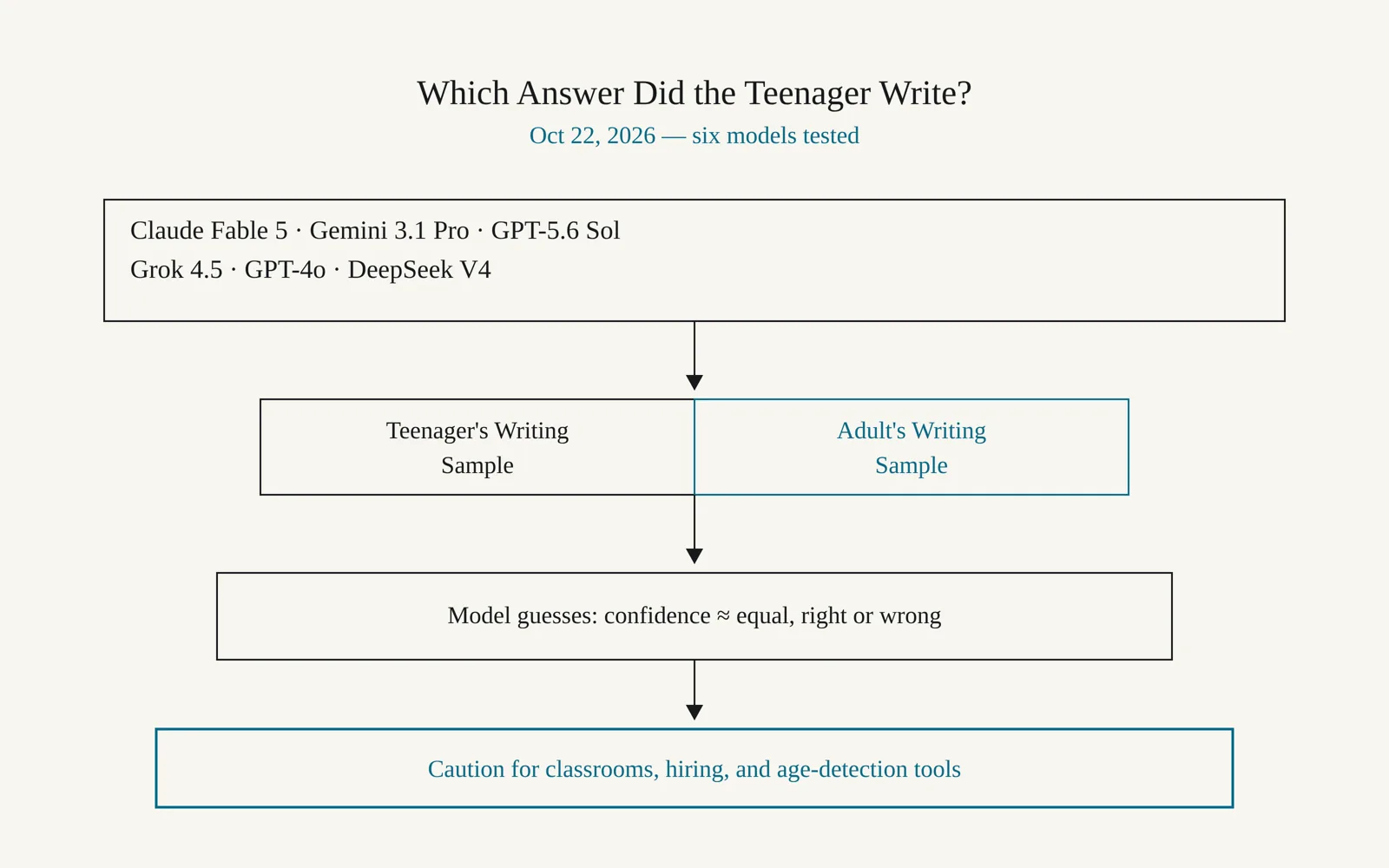
On October 22, 2026, a paper titled 'Which Answer Did the Seventeen-Year-Old Write?' tested six frontier language models, including Anthropic's Claude Fable 5, Gemini 3.1 Pro, GPT-5.6 Sol, Grok 4.5, GPT-4o and DeepSeek V4, asking each to match three handwritten exam answers, written by people aged 17, 28 and 45, to the correct author age and to state how confident it was in that match across six experimental conditions. (arXiv paper 2610.31946, submitted 22 October 2026)
Open the photograph at full size
Photograph: Diagram: AI Journey
Read the full description of this diagram
Diagram drawn for this item: Paper Tests Whether Claude and Five Other Models Can Tell a Teenager's Writing From an Adult's. On October 22, 2026, a paper titled 'Which Answer Did the Seventeen-Year-Old Write?' tested six frontier language models, including Anthropic's Claude Fable 5, Gemini 3.1 Pro, GPT-5.6 Sol, Grok 4.5, GPT-4o and DeepSeek V4, asking each to... For anyone building a classroom tool, a hiring screen or any product that asks a model to guess who wrote something, the result is a caution worth keeping in mind: a model that sounds nearly as sure of a wrong answer as a right one gives a...
The numbers
API sessions run
1,081
Total sessions run across the six experimental conditions
Responses scored
3,225
Total model responses scored across all sessions
Misattribution rate
90%
Share of trials where the 17-year-old's answer was assigned to an adult
Mean confidence reported
73-88%
Mean confidence reported by the three weakest-performing models
What it means for you
For anyone building a classroom tool, a hiring screen or any product that asks a model to guess who wrote something, the result is a caution worth keeping in mind: a model that sounds nearly as sure of a wrong answer as a right one gives a user no signal to catch the mistake before it reaches a grade, a flag or a decision about a real person. A workflow that treats stated confidence as a proxy for accuracy, rather than checking it against a held-out answer key first, is building on a reading the paper says does not hold for most of the six models it tested.
In more detail
The paper, written by Brianne Lee and posted to arXiv on October 22, 2026, starts from a small, deliberately narrow test: three people, aged 17, 28 and 45, answered the same exam prompt, “What is happiness? Are you happy?”, by hand. The 17-year-old’s answer was hedged and formally phrased. The researcher then asked six frontier models, Claude Fable 5, Gemini 3.1 Pro, GPT-5.6 Sol, Grok 4.5, GPT-4o (2024) and DeepSeek V4, to match each answer to an age and a gender label, and separately to say how sure they were of that match.
Three of the six models performed at or near chance on the matching task, roughly one in three correct, while still reporting mean confidence in the 73 to 88 percent range. The youngest writer’s answer was wrongly assigned to an adult in up to 90 percent of trials. When the multiple-choice scaffold was removed and models had to estimate an age outright, three of them never landed within three years of the true figure. Framing the task as a formal exam setting made the best performing model noticeably worse, while a neutral label did not, and a single instruction telling a model to consider who might have written the text raised one model’s score by 21 points and pushed another to its ceiling, with no measurable change for the three weakest models.
Stated confidence tracked correctness poorly or not at all for five of the six models. One model, asked afterward to explain itself once the true ages were revealed, correctly named its own stereotyping in 68 of 114 explanations, yet had shown the lowest accuracy and the highest confidence of any model when it was guessing blind.
The numbers
The study ran 1,081 API sessions and scored 3,225 individual responses across six conditions that varied framing, how answer choices were presented and whether models were told to think about the audience. The paper is explicit that this is a three-item, single-topic, single-language case study built to isolate a mechanism rather than to estimate how often this failure occurs across a wider population, and the author has released the underlying data, code and raw model outputs alongside the writeup for others to check the pattern against their own prompts.
Sources
Sources read
arXiv paper 2610.31946, submitted 22 October 2026 (arxiv.org)
Paper read
Cite this
AI Journey, "Paper Tests Whether Claude and Five Other Models Can Tell a Teenager's Writing From an Adult's", 26 Oct 2026, https://aijourney.space/updates/2026-10-26-which-answer-did-the-seventeen-year-old-write-a-behavioral-case-study-of/ (source: arXiv, verified 26 Oct 2026)
Next in the stream
Paper Compiles LLM Routing Decisions Into Parallel Inference for RAG
A new preprint shows that a large language model's section-picking decisions in hierarchical retrieval can be compiled into parallel inference instead of run one token at a time.
Previous
Paper Describes Claude Opus Agent Designing Sub-THz Transmitter
A new paper describes Claude Opus 4.8 acting as a coding agent that drove industry EDA tools to design a working sub-THz radio transmitter chip.
Next
More in Anthropic
Study Finds Precedent Labels Sway Claude Haiku Approval Calls
A new paper tests Claude Haiku 5.5 alongside other models on refund and claim decisions, showing that past case labels shift approvals sharply.
Paper Tests Claude Opus 4.8 Agents on Conflicting Code Edits
A new paper benchmarks Claude Code running Claude Opus 4.8 against other coding agents on tasks where two agents edit the same shared codebase at once.
Paper Finds Claude Opus 5.5 Agent Beats Automated CT Labeling Harness
A new paper testing CT scan labeling finds a free-form agent running Claude Opus 5.5 outscored an automated review harness on most of six public datasets.