What happened
Published here
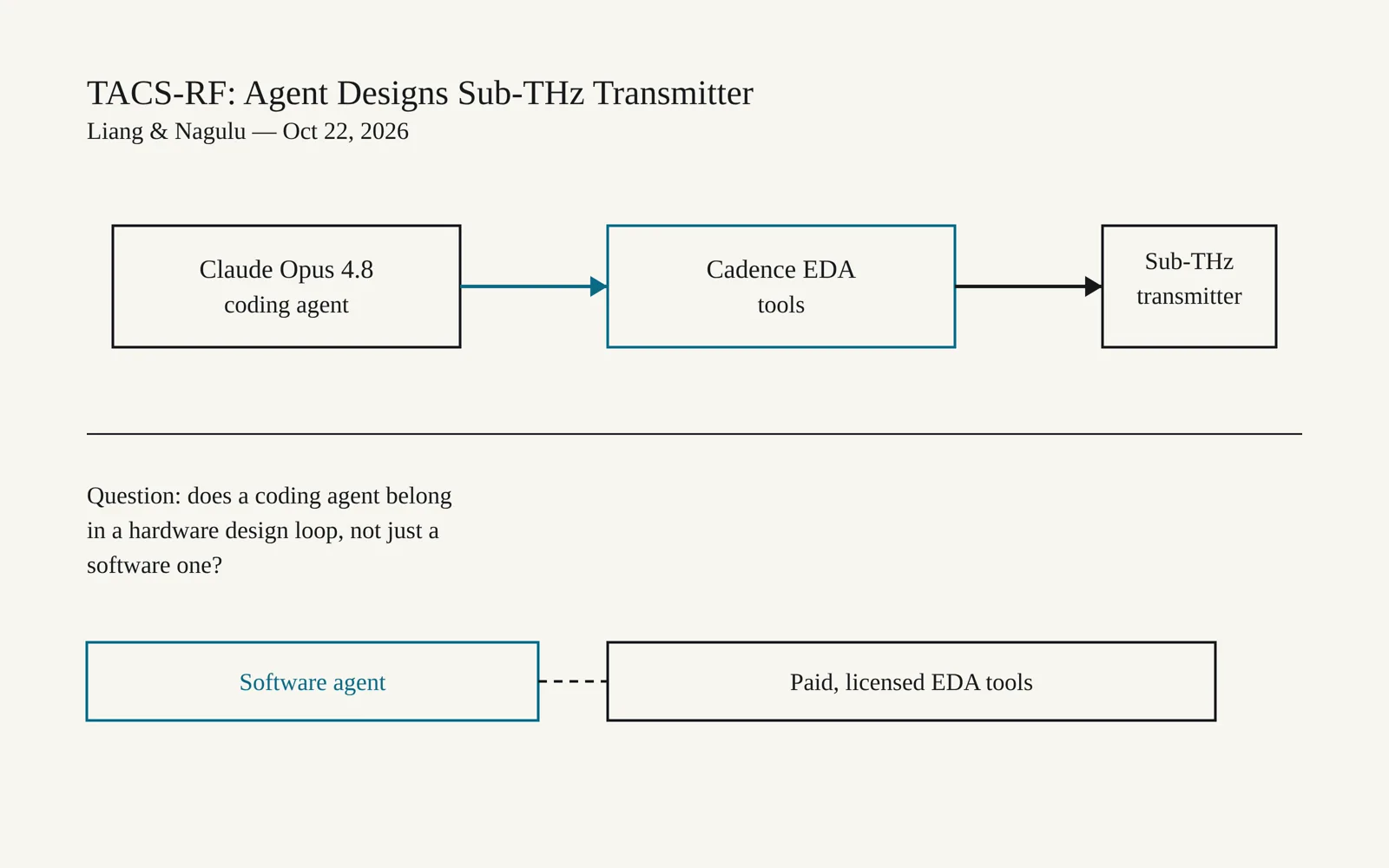
On October 22, 2026, researchers Tristan Liang and Aravind Nagulu posted a paper describing TACS-RF, a framework in which a Claude Opus 4.8 coding agent directly drives electronic-design-automation tools, including Cadence Virtuoso/Spectre, Calibre, Cadence EMX and Ansys HFSS, to design radio-frequency and millimeter-wave circuit modules. The team validated the approach by having the agent semi-autonomously design a 240-251 GHz sub-THz transmitter in a 90 nm SiGe BiCMOS process, covering sub-blocks such as a push-push Colpitts voltage-controlled oscillator, cascode power drivers, a frequency doubler, an antenna and the matching networks between stages. (arXiv paper, TACS-RF: Tool-driven Agentic Circuit Synthesis of RF and mmWave Modules, posted October 22, 2026)
Open the photograph at full size
Photograph: Diagram: AI Journey
Read the full description of this diagram
Diagram drawn for this item: Paper Describes Claude Opus Agent Designing Sub-THz Transmitter. On October 22, 2026, researchers Tristan Liang and Aravind Nagulu posted a paper describing TACS-RF, a framework in which a Claude Opus 4.8 coding agent directly drives electronic-design-automation tools, including Cadence... For anyone weighing whether a coding agent belongs in a hardware design loop rather than just a software one, this paper is a data point that the same chat-style agent people use for writing code can also be set loose on paid, licensed EDA...
The numbers
Transmitter frequency range
240-251
GHz band the sub-THz transmitter was designed to cover
Output power
+5.1 to +6.3
dBm delivered across the tuning range
DC power draw
361
mW consumed by the transmitter chain
Tuning range
11
GHz varactor-only tuning range achieved
What it means for you
For anyone weighing whether a coding agent belongs in a hardware design loop rather than just a software one, this paper is a data point that the same chat-style agent people use for writing code can also be set loose on paid, licensed EDA tools and still produce a chip block that meets its spec, which changes the calculus on what counts as billable engineer time versus billable compute time on a project like this.
In more detail
A paper posted to arXiv on October 22, 2026 describes an experiment in handing a large language model agent control of the software engineers already use to design radio chips, rather than building a new tool around the model. The authors, Tristan Liang and Aravind Nagulu, call the framework TACS-RF, for Tool-driven Agentic Circuit Synthesis of RF and mmWave modules. The agent in the loop is Claude Opus 4.8, run as a coding agent that issues commands to Cadence Virtuoso and Spectre for schematic capture and simulation, Calibre for physical verification, Cadence EMX for electromagnetic extraction of passives, and Ansys HFSS for full-wave electromagnetic analysis. These are the standard, expensive, license-gated tools that analog and RF chip designers already use, which is the detail that separates this from a demo built around a toy simulator.
To test the framework the authors had the agent design a sub-THz transmitter intended to operate between 240 and 251 GHz, built in a 90 nanometer silicon-germanium BiCMOS process. The agent worked semi-autonomously through the sub-blocks: a 60 GHz push-push Colpitts voltage-controlled oscillator with second-harmonic extraction, multistage differential cascode power drivers, a push-push frequency doubler, a differential bowtie antenna, and the interstage matching networks that connect them. The finished chain, with devices extracted for parasitics and passives verified against electromagnetic simulation, delivered output power from +5.1 to +6.3 dBm across an 11 GHz varactor-only tuning range, with phase noise of -80 to -88 dBc/Hz at a 1 MHz offset, while drawing 361 mW of DC power.
The paper frames this as a step toward what the authors call a “text-to-ASIC” future, and spends part of its discussion on the division of labor that emerged between the human designers and the agent rather than claiming the agent worked unsupervised. The work has been accepted for presentation at the 2027 IEEE Radio and Wireless Week, in its Silicon Monolithic Integrated Circuits in RF Systems track, which puts it in front of the specific community of RF chip designers who would judge whether the output is genuinely usable silicon or a carefully chosen demonstration case.
The numbers
Figures above are drawn directly from the abstract: the transmitter’s operating band, its output power range, its tuning range and its DC power draw, each one a property of the finished chip rather than a claim about the agent’s process.
Sources
Sources read
Cite this
AI Journey, "Paper Describes Claude Opus Agent Designing Sub-THz Transmitter", 26 Oct 2026, https://aijourney.space/updates/2026-10-26-tacs-rf-tool-driven-agentic-circuit-synthesis-of-rf-and-mmwave-modules/ (source: arXiv, verified 26 Oct 2026)
Next in the stream
Paper Tests Whether Claude and Five Other Models Can Tell a Teenager's Writing From an Adult's
A new case study finds that Claude Fable 5 and five other frontier models often mismatch handwritten exam answers to the wrong age, while voicing high confidence in the wrong guess.
Previous
Paper Finds Claude Opus 5.5 Stays Coherent on Hidden-Variable Probability Tests
A new paper tests seven models, including Claude Opus 5.5 and Claude Haiku 5.5, on whether their probability judgments obey a basic law of probability.
Next
More in Anthropic
Study Finds Precedent Labels Sway Claude Haiku Approval Calls
A new paper tests Claude Haiku 5.5 alongside other models on refund and claim decisions, showing that past case labels shift approvals sharply.
Paper Tests Claude Opus 4.8 Agents on Conflicting Code Edits
A new paper benchmarks Claude Code running Claude Opus 4.8 against other coding agents on tasks where two agents edit the same shared codebase at once.
Paper Finds Claude Opus 5.5 Agent Beats Automated CT Labeling Harness
A new paper testing CT scan labeling finds a free-form agent running Claude Opus 5.5 outscored an automated review harness on most of six public datasets.