Event Published Models and productsNvidia
Nvidia Expands Agent Toolkit With Data Grounding Tools
Nvidia expanded its open source Agent Toolkit on October 21, 2026, adding an Agent Knowledge Foundation that grounds enterprise agents in company data without moving it.
What happened
Published here
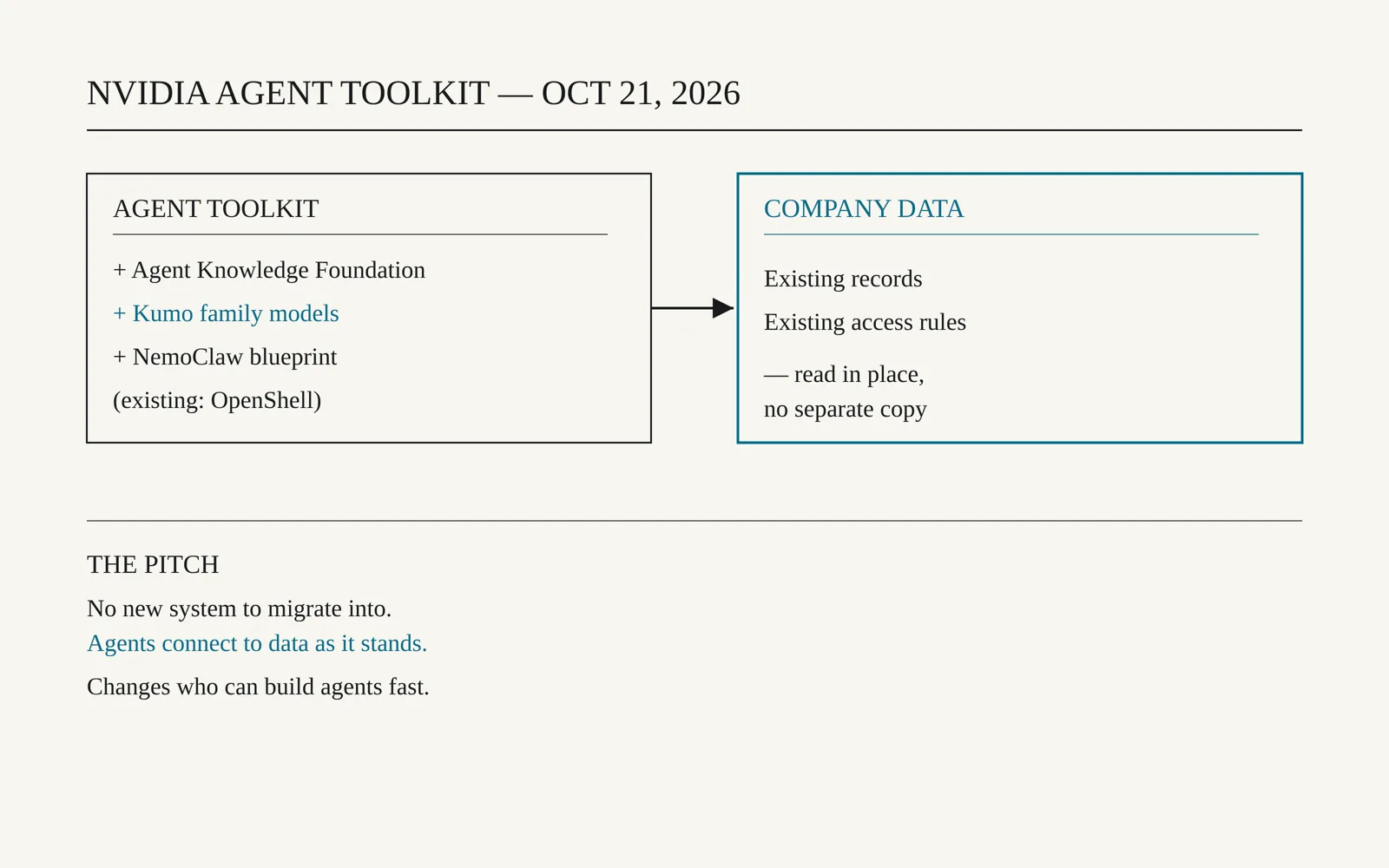
On October 21, 2026, Nvidia announced an expansion of its open source Agent Toolkit, adding the Agent Knowledge Foundation, new Kumo family models and an updated NemoClaw blueprint for agent optimization, alongside the existing OpenShell runtime, Nemotron Retriever models and tools such as NeMo Relay and NeMo Compass. (Nvidia newsroom post on the expanded Agent Toolkit, published October 21, 2026)
Open the photograph at full size
Photograph: Diagram: AI Journey
Read the full description of this diagram
Diagram drawn for this item: Nvidia Expands Agent Toolkit With Data Grounding Tools. On October 21, 2026, Nvidia announced an expansion of its open source Agent Toolkit, adding the Agent Knowledge Foundation, new Kumo family models and an updated NemoClaw blueprint for agent optimization, alongside the existing OpenShell... For a company weighing whether to build agents on its own data, the pitch is that Nvidia's stack reads existing records and access rules in place rather than forcing a separate copy of the business into a new system, which changes the...
What it means for you
For a company weighing whether to build agents on its own data, the pitch is that Nvidia's stack reads existing records and access rules in place rather than forcing a separate copy of the business into a new system, which changes the usual calculus between speed of deployment and the cost of rebuilding governance from scratch, and it shifts the competitive question from which model answers best to whose retrieval and runtime layer a company already trusts with its data.
In more detail
Nvidia used its GTC Berlin event on October 21, 2026 to announce an expansion of the Agent Toolkit, the open source stack it has been assembling for enterprises that want to build agents rather than buy a single chatbot. The headline addition is the Agent Knowledge Foundation, a layer meant to turn a company’s existing records into something an agent can query directly, using Nvidia’s CUDA-X libraries and a new Auto-Ontology library that maps raw data into concepts like customers, products and orders. Nvidia says enterprises can adopt the foundation without moving their data, rebuilding workflows or changing governance controls already in place.
The toolkit also gains new Kumo family models, Kumo Tabular, Kumo Relational, Kumo Time Series and Kumo Forecast, which sit alongside the existing Nemotron Retriever models for search and retrieval. The runtime side is unchanged in name but still central: OpenShell remains the secure boundary that controls what an agent can access and do, and NemoClaw supplies reference blueprints for building agents inside that boundary, including a newest blueprint aimed specifically at improving agent performance over time.
Nvidia named a wide set of partners already working with the Agent Knowledge Foundation, including Palantir, Databricks, Snowflake, Amazon Web Services, SAP, ServiceNow and Zoom, each wiring Nvidia’s retrieval or anomaly detection models into their own platforms. The breadth of that list is the real signal here: Nvidia is positioning itself not as a model vendor competing on one leaderboard, but as the layer that sits underneath several companies’ separate agent products at once.
The numbers
Nvidia’s own examples give a sense of what the retrieval layer is meant to buy a customer. Amazon OpenSearch Service reported improved relevance with fewer search steps and little added latency after adopting the Nemotron Retriever embedding model. SAP said its fine-tuned reranker ran nearly 3x faster using the same family of models, and ServiceNow reported better reranking quality while cutting latency by close to a quarter. None of these figures are independently audited, and Nvidia did not publish the underlying benchmarks or baseline conditions, so they describe vendor-reported gains rather than a controlled comparison across the stack.
For a reader deciding whether to adopt an agent framework built on a single vendor’s retrieval and runtime layer, the open source licensing matters as much as the feature list, since it is the difference between a reversible choice and a locked-in one.
Sources
Sources read
Nvidia newsroom post on the expanded Agent Toolkit, published October 21, 2026 (blogs.nvidia.com)
Newsroom read
Cite this
AI Journey, "Nvidia Expands Agent Toolkit With Data Grounding Tools", 21 Oct 2026, https://aijourney.space/updates/2026-10-21-nvidia-agent-toolkit-expands-grounding-enterprise-agents-in-company-data/ (source: Nvidia, verified 21 Oct 2026)
Next in the stream
Gemini Gains Personal Intelligence For Cars Worldwide
Google is rolling out Personal Intelligence for Gemini in cars, letting the assistant draw on a driver's Gmail, Photos and Calendar for hands-free help.
Previous
ChatGPT Ads Expands To 26 New Countries
OpenAI expanded ChatGPT Ads to 26 new countries, saying more than 100,000 advertisers have now used the ad platform inside ChatGPT.
Next
More in Nvidia
Nvidia RTX Spark Laptops Add Transcription Model and New Game Support
Nvidia detailed new RTX Spark laptop updates, including a transcription model from its Nemotron line and support for Liquid AI's LFM3 models.
Nvidia Launches Minerva Platform for AI Factory Observability
Nvidia introduced Minerva, an AIOps platform that merges infrastructure and workload telemetry to flag problems across AI factories before they spread.
Nvidia RTX Spark Laptops Go On Sale From $2,399
Nvidia marked the retail arrival of its RTX Spark laptops with launch events worldwide, as partner Windows PCs built around the new chip reached buyers.