Event Published ResearchResearch
New Paper Introduces Psi-0.6, a Unified Vision-Language World Model
A new paper introduces Psi-0.6, a unified vision-language world model that threads perception, language, geometry and simulation into one shared reasoning process.
What happened
Published here
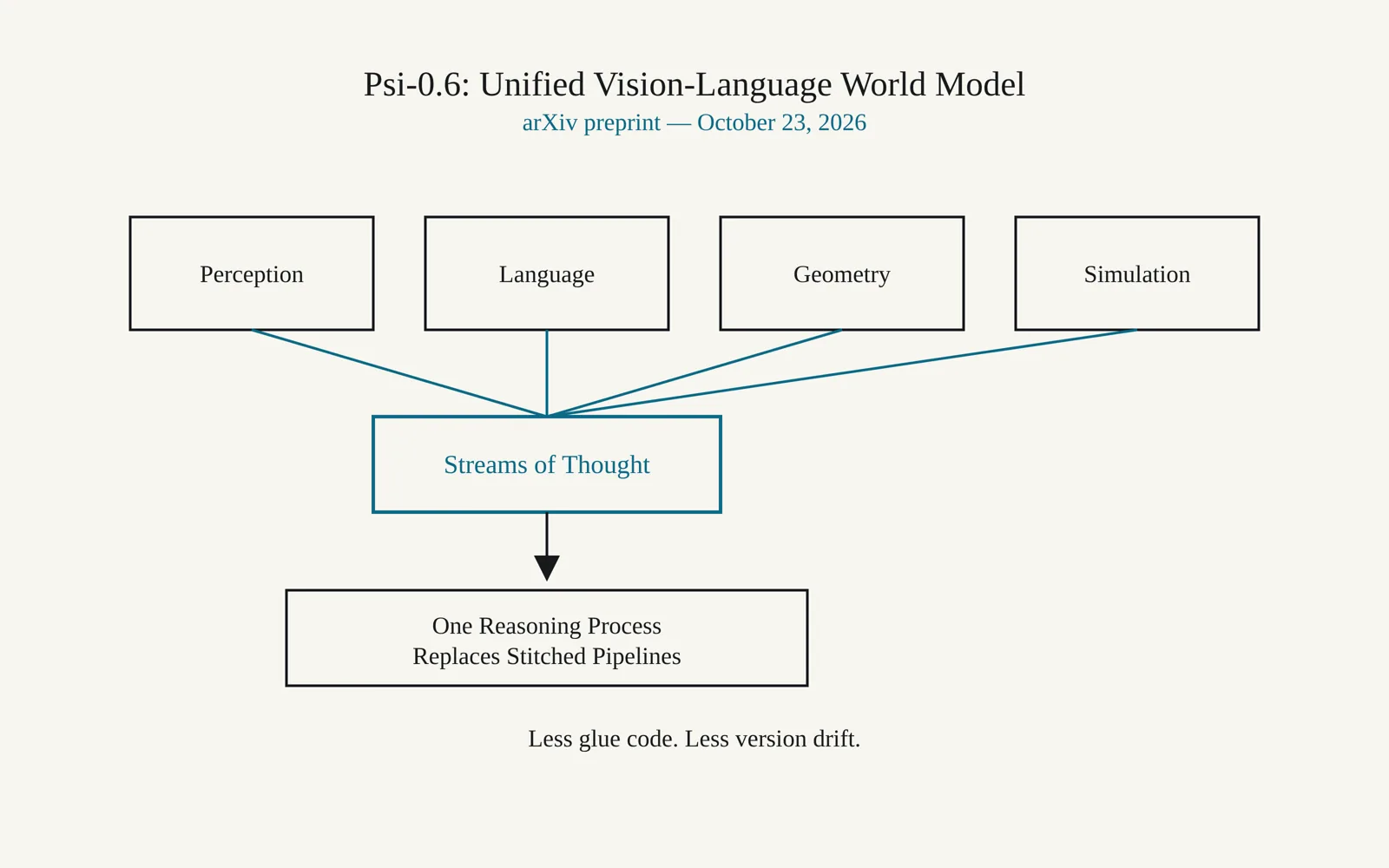
On October 23, 2026, researchers posted a preprint on arXiv describing Psi-0.6, a unified vision-language world model that combines perception, language, geometry and simulation in a single reasoning process the authors call streams of thought, rather than keeping those capabilities in separate specialized models. (arXiv preprint, Psi-0.6: Adaptive Streams of Thought in a Unified Vision-Language World Model, submitted October 23, 2026)
Open the photograph at full size
Photograph: Diagram: AI Journey
Read the full description of this diagram
Diagram drawn for this item: New Paper Introduces Psi-0.6, a Unified Vision-Language World Model. On October 23, 2026, researchers posted a preprint on arXiv describing Psi-0.6, a unified vision-language world model that combines perception, language, geometry and simulation in a single reasoning process the authors call streams of... For teams built on separate vision and language pipelines, Psi-0.6 points toward one model that threads perception and geometry together instead of stitching outputs from specialized tools, which could cut the glue code and version drift...
What it means for you
For teams built on separate vision and language pipelines, Psi-0.6 points toward one model that threads perception and geometry together instead of stitching outputs from specialized tools, which could cut the glue code and version drift that comes with running several models in sequence for any system that has to reason about physical space.
In more detail
Researchers including Khai Loong Aw, Klemen Kotar and Daniel Yamins posted a preprint describing Psi-0.6, a unified vision-language world model built to reason about physical scenes the way people do, by switching between forms of inference as a problem unfolds. The paper argues that today’s systems keep perception, language, geometry and simulation in separate specialized models, which limits how those capabilities can be combined or adapted together for a single task.
Psi-0.6 is organized around what the authors call streams of thought: a shared reasoning process that interleaves images, text and explicit representations of geometry and motion. The model generates and interprets all of these through one shared token interface, rather than passing outputs between separate tools built for each modality. The authors report that Psi-0.6 beats leading open-weight models in zero-shot tests of multi-view spatial reasoning, the task of working out how a scene looks from an angle it has not been shown, and that reasoning through geometric intermediates produces further gains on top of that.
The paper also describes a counterfactual simulation capability: Psi-0.6 can generate and interpret imagined scenes to work out, for instance, whether moving an object would block a path. Training pairs this with reinforcement learning driven by task feedback, which the authors use to jointly shape how the model selects, generates and uses its intermediate representations. That training approach, they report, raises visual question answering accuracy with gains that carry over to benchmarks the model was not trained on.
The numbers
The preprint, submitted on October 23, 2026, is a 13,260 KB PDF with eight listed authors working across perception, geometry and simulation research. The authors describe Psi-0.6 as surpassing leading open-weight models zero-shot on multi-view spatial reasoning, though the abstract does not publish a specific accuracy figure or benchmark score, leaving the exact margin for readers who pull the full document.
The approach matters beyond this one model because it is a bet against the current default of stitching together separate vision, language and simulation tools with custom glue code. If a shared token interface can hold geometry, images and text together and still beat specialized systems at spatial reasoning, that changes a concrete choice facing anyone building a system that has to reason about physical space: whether to keep composing separate models, or adopt one model trained to move between representations on its own.
Sources
Sources read
Cite this
AI Journey, "New Paper Introduces Psi-0.6, a Unified Vision-Language World Model", 28 Oct 2026, https://aijourney.space/updates/2026-10-28-psi-0-6-adaptive-streams-of-thought-in-a-unified-vision-language-world-m/ (source: arXiv, verified 28 Oct 2026)
Next in the stream
Paper Proposes Message-Passing Method For Compressing LLM Weights
A new arXiv paper proposes a message-passing method for compressing large language model weights, the kind of efficiency work that underlies answer engines like Perplexity AI.
Previous
OpenAI Publishes ChatGPT Signals Data On Work Activities
OpenAI released ChatGPT Signals data tracking 165 work activities across nearly 100 countries, showing how work use of the assistant changes over time.
Next
More in Research
Perplexity AI Researchers Detail LoRA Recipe For Converting Four Language Models To Diffusion
A paper associated with Perplexity AI describes BYOD, a LoRA-only method that converts standard autoregressive language models into diffusion language models without full retraining.
Gemini Negotiation Paper Finds Persona Effects Shift By Language
A new paper testing Google's Gemini model in buyer-seller negotiations found that the same persona instruction produced different deal outcomes in English and Korean.
Paper Finds Gemini Monitor Beats Small Models At Spotting Reward Hacking
A new paper tests whether Google's Gemini 3.1 Flash-Lite can tell real reward hacking apart from honest failure better than small local monitors.