What happened
Published here
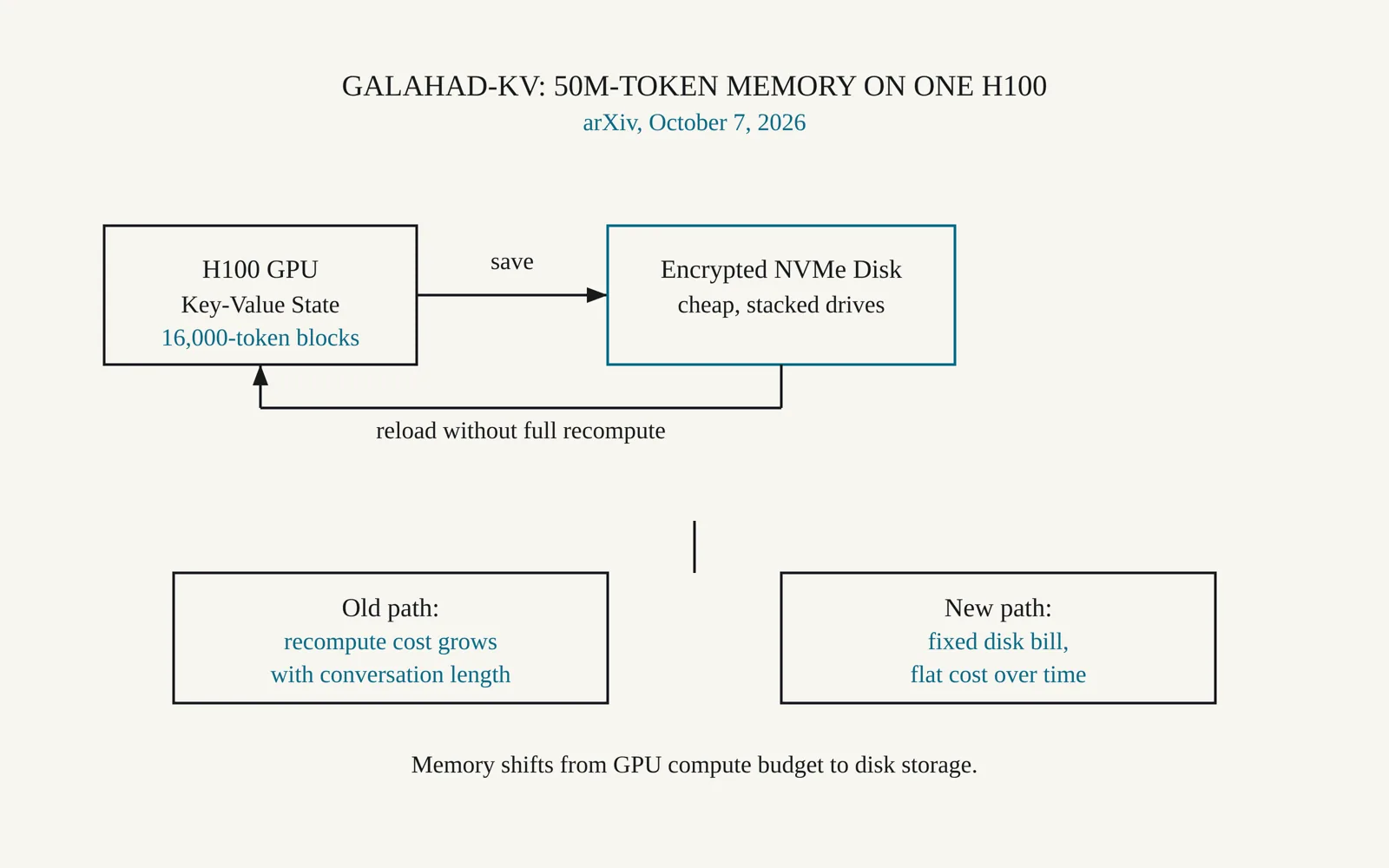
On October 7, 2026, a paper posted to arXiv described tests of galahad-kv, a memory layer that saves each roughly 16,000-token block of a large language model's key-value state to encrypted local NVMe disk and reloads it later without recomputing it, run on 50,000,000 tokens of real public text served through vLLM on one Nvidia H100 with Gemma 4 12B and Gemma 4 31B. (arXiv paper, galahad-kv memory layer tests, submitted October 7, 2026)
Open the photograph at full size
Photograph: Diagram: AI Journey
Read the full description of this diagram
Diagram drawn for this item: Paper Tests 50 Million Token Memory Layer on One Nvidia H100. On October 7, 2026, a paper posted to arXiv described tests of galahad-kv, a memory layer that saves each roughly 16,000-token block of a large language model's key-value state to encrypted local NVMe disk and reloads it later without... For a team running a long-context assistant, this shifts the cost of remembering a conversation from the GPU's compute budget onto a stack of cheap NVMe drives, trading a fixed disk bill for a recompute bill that would otherwise grow every...
The numbers
Tokens streamed
50,000,000
Real public text served through vLLM on one Nvidia H100
Fastest reload
2.8x
Low end of the speedup over recomputing a block
Lowest energy use
8.8x
Low end of the GPU energy saving over recompute
31B recall
98
Correct answers out of 100 for facts planted far earlier
Read from arXiv paper, galahad-kv memory layer tests, submitted October 7, 2026
What it means for you
For a team running a long-context assistant, this shifts the cost of remembering a conversation from the GPU's compute budget onto a stack of cheap NVMe drives, trading a fixed disk bill for a recompute bill that would otherwise grow every time an old prompt gets sent again. A cheaper way to hold state for longer also changes which workloads are worth running on a single Nvidia card rather than a cluster, since the paper reports GPU memory stayed flat across the whole stream.
In more detail
A paper submitted to arXiv on October 7, 2026, tests whether a model needs to hold everything in its context window to use it, or whether saved state can stand in for recomputation. The author, Sietse Schelpe, built galahad-kv, a package that writes each block of a model’s key-value cache, about 16,000 tokens at a time, to encrypted local NVMe disk and reads it back byte exact later instead of running the block through the model again.
The test ran 50,000,000 tokens of real public text through vLLM on a single Nvidia H100, with Gemma 4 12B and Gemma 4 31B taking turns. Every block the authors checked came back from disk with no recomputation at all, at depths running from the start of the stream to the full 50 million tokens, on both model sizes. Loading a saved block beat recomputing it on both speed and energy, and GPU memory held steady for the entire run rather than climbing as the stream grew, which is the behavior that normally forces a long session to be cut short or moved to a bigger card.
The paper is careful about what this is not. It is reuse of stored state rather than a genuinely wider attention window: one block loads at a time, and how well a question gets answered still depends on the model answering it. Gemma 4 31B recovered facts planted deep in the stream far more reliably than the 12B model, and the paper reports that neither model invented an answer when probed. Writing the memory in the first place carries a one-time cost, and the resulting store runs to terabytes of local disk, which is not a free trade so much as a different one.
The numbers
The 50,000,000-token run was served from one Nvidia H100. Reloading a saved block ran 2.8x to 4.3x faster than recomputing it, and used 8.8x to 12.3x less GPU energy, across both model sizes tested. Asked about facts buried millions of tokens earlier, Gemma 4 31B answered correctly 98 times out of 100, against 82 times out of 100 for the 12B model.
The author has released the test protocol and a single-GPU reproduction built on public software, along with a free license for the package, so the claims can be checked on hardware a smaller lab or team can actually get hold of.
Sources
Sources read
arXiv paper, galahad-kv memory layer tests, submitted October 7, 2026 (arxiv.org)
Paper read
Cite this
AI Journey, "Paper Tests 50 Million Token Memory Layer on One Nvidia H100", 10 Oct 2026, https://aijourney.space/updates/2026-10-10-real-long-term-memory-for-ai-a-50-million-token-window-that-is-faster-an/ (source: arXiv, verified 10 Oct 2026)
Next in the stream
StoreBench Paper Tests Seven Frontier Models Against a Scripted Store Manager
A new paper tests seven frontier language models, including one run through the Claude Code harness, on a year of simulated retail decisions.
Previous
Paper Tests Wildfire Tasks Across Six Core Language Models
A new paper, AI4Fire, tests six core large language models on wildfire tasks and finds grounding helps most where the added data already carries the answer.
Next
More in Nvidia
Nvidia RTX Spark Laptops Add Transcription Model and New Game Support
Nvidia detailed new RTX Spark laptop updates, including a transcription model from its Nemotron line and support for Liquid AI's LFM3 models.
Nvidia Launches Minerva Platform for AI Factory Observability
Nvidia introduced Minerva, an AIOps platform that merges infrastructure and workload telemetry to flag problems across AI factories before they spread.
Nvidia Expands Agent Toolkit With Data Grounding Tools
Nvidia expanded its open source Agent Toolkit on October 21, 2026, adding an Agent Knowledge Foundation that grounds enterprise agents in company data without moving it.