Event Published ResearchResearch
Paper Tests Wildfire Tasks Across Six Core Language Models
A new paper, AI4Fire, tests six core large language models on wildfire tasks and finds grounding helps most where the added data already carries the answer.
What happened
Published here
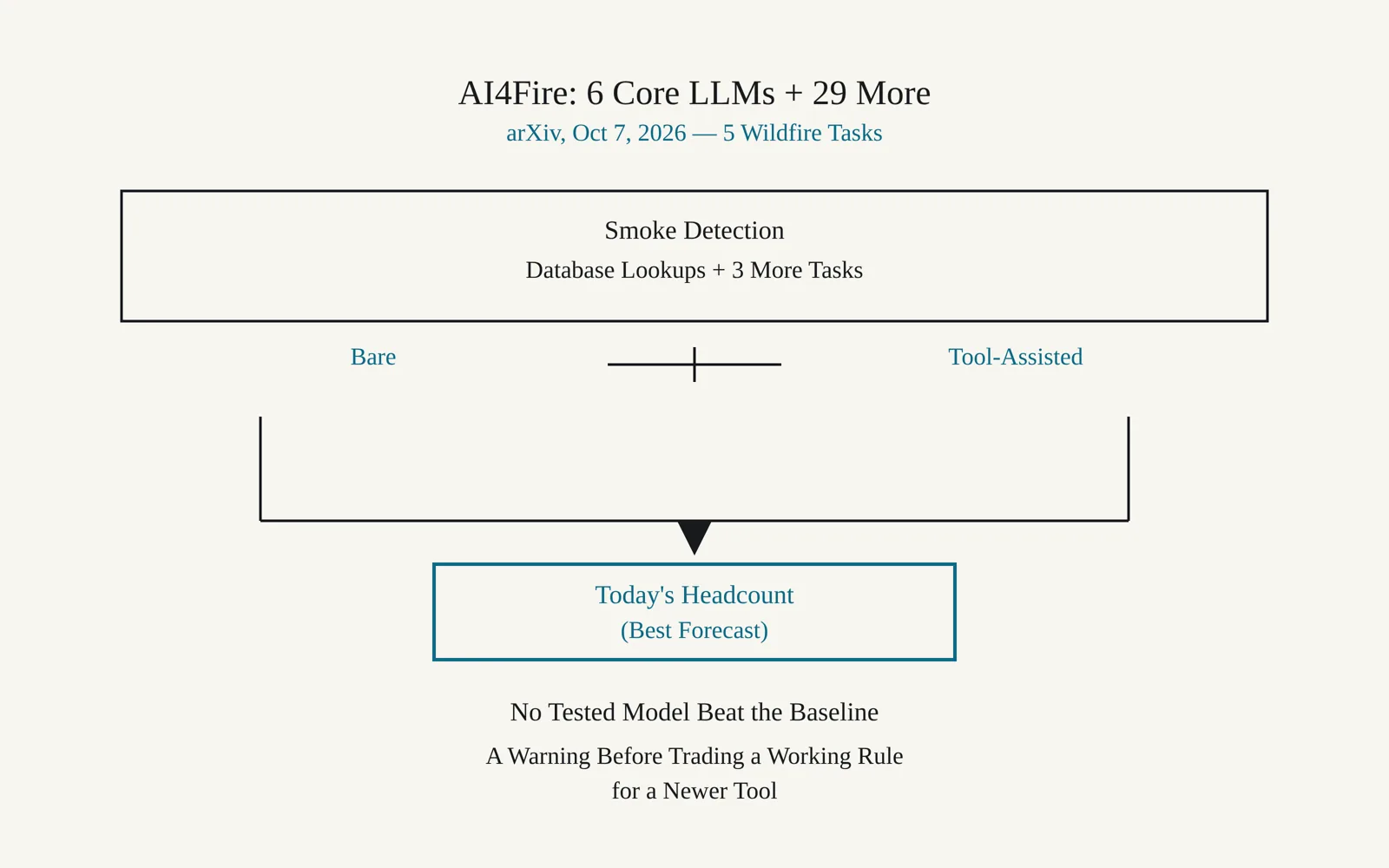
On October 7, 2026, researchers posted the AI4Fire paper to arXiv, testing six core large language models, plus a wider sweep of 29 more, on five wildfire tasks, including smoke detection and database lookups, each run both bare and with one task-specific addition such as a smoke-free reference frame for a camera. (AI4Fire paper abstract on arXiv, submitted October 7, 2026)
Open the photograph at full size
Photograph: Diagram: AI Journey
Read the full description of this diagram
Diagram drawn for this item: Paper Tests Wildfire Tasks Across Six Core Language Models. On October 7, 2026, researchers posted the AI4Fire paper to arXiv, testing six core large language models, plus a wider sweep of 29 more, on five wildfire tasks, including smoke detection and database lookups, each run both bare and with... For a fire agency deciding whether to hand a staffing decision to a language model, the finding that no tested system beat the current day's headcount as its own forecast is a warning against trading a working rule for a newer tool.
The numbers
Literature works reviewed
138
Fire-task papers surveyed, none combining this roster and task coverage
Sweep models added
29
Additional models run beyond the six core models
Aerial frames flagged
67
Aerial fire frames with labels read from a clipped thermal maximum
Grounded database accuracy
88 percent
Lower bound reached by every core model once a read-only SQL tool was added
Read from AI4Fire paper abstract on arXiv, submitted October 7, 2026
What it means for you
For a fire agency deciding whether to hand a staffing decision to a language model, the finding that no tested system beat the current day's headcount as its own forecast is a warning against trading a working rule for a newer tool. The accuracy jump only appearing once a lookup tool was attached suggests the gain sits in that added data, not in better judgment from the model itself, which matters for anyone drafting a procurement checklist around this kind of system.
In more detail
Large language models are being tested for wildfire work, and a new paper called AI4Fire tries to measure how well they actually do. Posted to arXiv on October 7, 2026, the paper runs six core models on five wildfire tasks, zero-shot, each one tested twice: once bare, with only the task input, and once grounded, with one task-specific addition, such as a smoke-free reference frame from the same camera for smoke detection. A wider sweep adds 29 more models on top of the six core ones. The authors say their own search of fire-related work turned up 138 prior papers, and none paired this roster of models with this task coverage and matched bare-versus-grounded runs.
The paper reports three findings. First, grounding mattered most where the extra information effectively contained the answer: giving a read-only SQL tool to query a database lifted every core model’s database accuracy from as low as 16 percent up to at least 88 percent. That is less a reasoning improvement than a demonstration that the model could read a result once it was handed one.
Second, simple rules were hard to beat elsewhere. No core model did better than a naive forecast built on the current staffing figure, and two open-weight models mostly just copied the median of similar past fire-days instead, which the authors call a worse forecast than the simple rule.
Third, the paper flags hazards in public wildfire datasets themselves: a fire-danger column in one release separates the holdout set perfectly, which can make a model look far more capable than it is, and 67 aerial fire frames carry smoldering or fire-free labels that were read off a clipped thermal maximum rather than checked directly.
The numbers
The authors reviewed 138 existing works on fire-related tasks before building their own benchmark, then tested six core models before expanding to a sweep of 29 further models. Database accuracy, bare, ran as low as 16 percent and reached at least 88 percent once a read-only SQL tool was attached. Separately, 67 aerial fire frames were found to carry labels derived from a clipped thermal maximum rather than ground truth, a detail the authors flag as a hazard for anyone training or evaluating on that public data.
The authors say they are releasing prompts, responses, scores, code and the survey record alongside the paper, which lets other researchers rerun the same bare-versus-grounded comparison on new models as they appear.
Sources
Sources read
AI4Fire paper abstract on arXiv, submitted October 7, 2026 (arxiv.org)
Paper read
Cite this
AI Journey, "Paper Tests Wildfire Tasks Across Six Core Language Models", 10 Oct 2026, https://aijourney.space/updates/2026-10-10-ai4fire-evaluating-large-language-models-on-wildfire-tasks/ (source: arXiv, verified 10 Oct 2026)
Next in the stream
Paper Tests 50 Million Token Memory Layer on One Nvidia H100
A new paper tested on one Nvidia H100 shows a key-value memory layer holding 50 million tokens of text without ever recomputing them.
Previous
Paper Proposes Distillation Methods To Expose Or Isolate Misaligned AI Models
A new preprint describes two distillation methods meant to either expose a misaligned AI model's hidden behavior or strip its capabilities clean of that behavior.
Next
More in Research
Study Finds Precedent Labels Sway Claude Haiku Approval Calls
A new paper tests Claude Haiku 5.5 alongside other models on refund and claim decisions, showing that past case labels shift approvals sharply.
Paper Tests Claude Opus 4.8 Agents on Conflicting Code Edits
A new paper benchmarks Claude Code running Claude Opus 4.8 against other coding agents on tasks where two agents edit the same shared codebase at once.
Perplexity AI Researchers Detail LoRA Recipe For Converting Four Language Models To Diffusion
A paper associated with Perplexity AI describes BYOD, a LoRA-only method that converts standard autoregressive language models into diffusion language models without full retraining.