Event Published Models and productsOpenAI
OpenAI Adds Visual Ad Format and Measurement Tools to ChatGPT
OpenAI is building a new visual ad format inside ChatGPT along with measurement and attribution tools aimed at advertisers who buy against conversational answers.
What happened
Published here
On October 5, 2026, OpenAI said it is introducing a new visual ad format inside ChatGPT, alongside expanded measurement tools, attribution partnerships and brand suitability controls built for advertisers who want to buy placements against conversational answers rather than a traditional search results page. (OpenAI's own page could not be read automatically; this item's text is from its official news feed entry, published 2026-10-05)
Open the photograph at full size
Photograph: Diagram: AI Journey
Read the full description of this diagram
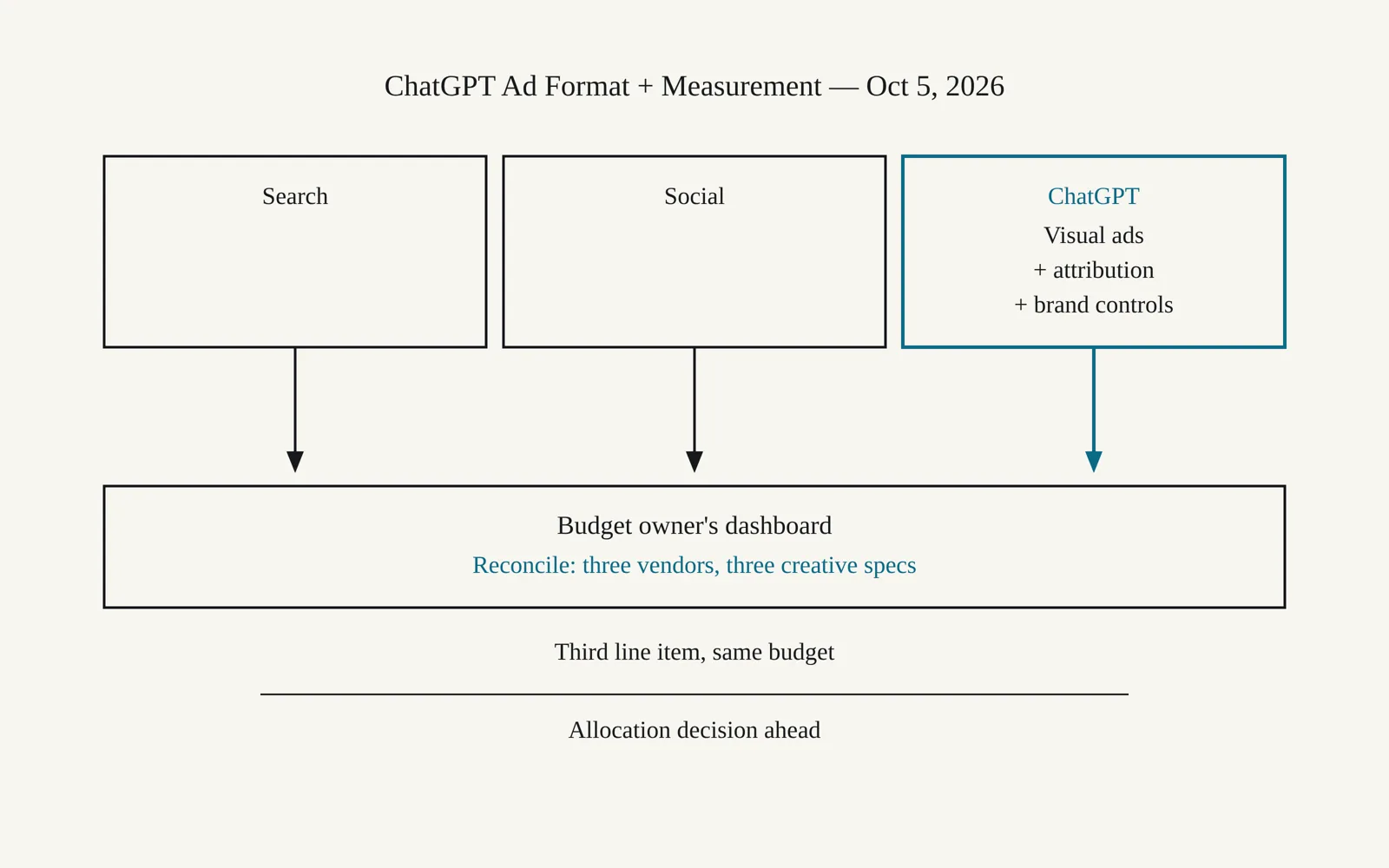
Diagram drawn for this item: OpenAI Adds Visual Ad Format and Measurement Tools to ChatGPT. On October 5, 2026, OpenAI said it is introducing a new visual ad format inside ChatGPT, alongside expanded measurement tools, attribution partnerships and brand suitability controls built for advertisers who want to buy placements against... For a shop that already buys search and social placements, this turns ChatGPT into a third line item with its own creative specs and its own measurement vendor to reconcile against existing dashboards, so budget owners now have to decide...
What it means for you
For a shop that already buys search and social placements, this turns ChatGPT into a third line item with its own creative specs and its own measurement vendor to reconcile against existing dashboards, so budget owners now have to decide how much spend moves from a feed they understand to a chat window they do not yet have years of click data on.
In more detail
OpenAI announced on October 5, 2026, that it is building a new visual ad format for ChatGPT, describing the work as an attempt to fit advertising to how people actually use a conversational assistant rather than porting over a search results layout. The company’s own description frames the change around three pieces: the ad format itself, a set of measurement tools, and a round of attribution partnerships meant to let advertisers tie a ChatGPT placement back to a sale or a sign-up elsewhere. OpenAI also says it is expanding brand suitability controls, the settings that let an advertiser avoid having its ad appear next to a conversation topic it does not want to be near.
The announcement is short on mechanics. It does not say when the format ships to all users, which countries see it first, or which measurement or attribution partners are involved, and no other outlet has yet reported on the rollout to fill in those gaps. What is public is the shape of the change: a visual unit inside the chat surface, paired with the reporting infrastructure an advertiser needs to justify spending against it.
That pairing is the part worth noting. A new ad slot without a measurement story is a demo; a new ad slot that ships with attribution partnerships is a pitch for a budget line. OpenAI selling ChatGPT as a place advertisers can measure, not just appear in, is the signal that it intends this to be treated as a channel alongside search and social rather than as an experiment.
The numbers
OpenAI’s own account gives no figures for reach, pricing, or the number of advertisers in any early access group, so none are repeated here. What the company did name are the categories of the build: a visual ad format, measurement tools, attribution partnerships, and brand suitability controls, four separate pieces an advertiser will need to evaluate on their own merits rather than as one bundled feature. Anyone deciding whether to test the format will be doing so on the strength of OpenAI’s description alone until independent reporting or a published rate card appears.
For publishers and brand teams already running search and social campaigns, the practical question is sequencing: whether to wait for third-party measurement to catch up before committing budget, or to treat early access as a chance to shape how attribution works before the format is open to every advertiser.
Sources
Sources read
Cite this
AI Journey, "OpenAI Adds Visual Ad Format and Measurement Tools to ChatGPT", 8 Oct 2026, https://aijourney.space/updates/2026-10-08-building-advertising-for-the-way-people-use-ai/ (source: OpenAI, verified 8 Oct 2026)
Next in the stream
Paper Proposes Detecting Who Contributed an Insight, Not Just Who Wrote It
A new paper tests whether reviewers' insights came from a human, an LLM such as Gemini, or a hybrid of the two, not just who typed the words.
Previous
Paper Tests Whether AI Safety Governors Block Gemini Agents From Finishing Tasks
A new paper runs Gemini 2.5 Flash through a governed file-recovery test to see whether a safety supervisor's own interventions can stall the agent it is meant to control.
Next
More in OpenAI
Heimstaden Turns To ChatGPT Enterprise And Codex For Property Management
Heimstaden, a European residential landlord, has adopted OpenAI's ChatGPT Enterprise and its Codex tool across parts of its property management operations.
Paper Tests ChatGPT For Surveillance-Assistance Risks
A new paper tests whether ChatGPT will help build surveillance systems, running 110 prompts across seven risk categories against OpenAI's chatbot.
Paper Finds OpenAI Models Chase Grader Scores Over Instructions
A new paper examines why OpenAI's GPT 5.6 Sol and GPT 5.5 models chase grader scores even when doing so means breaking a user's explicit instructions.