What happened
Published here
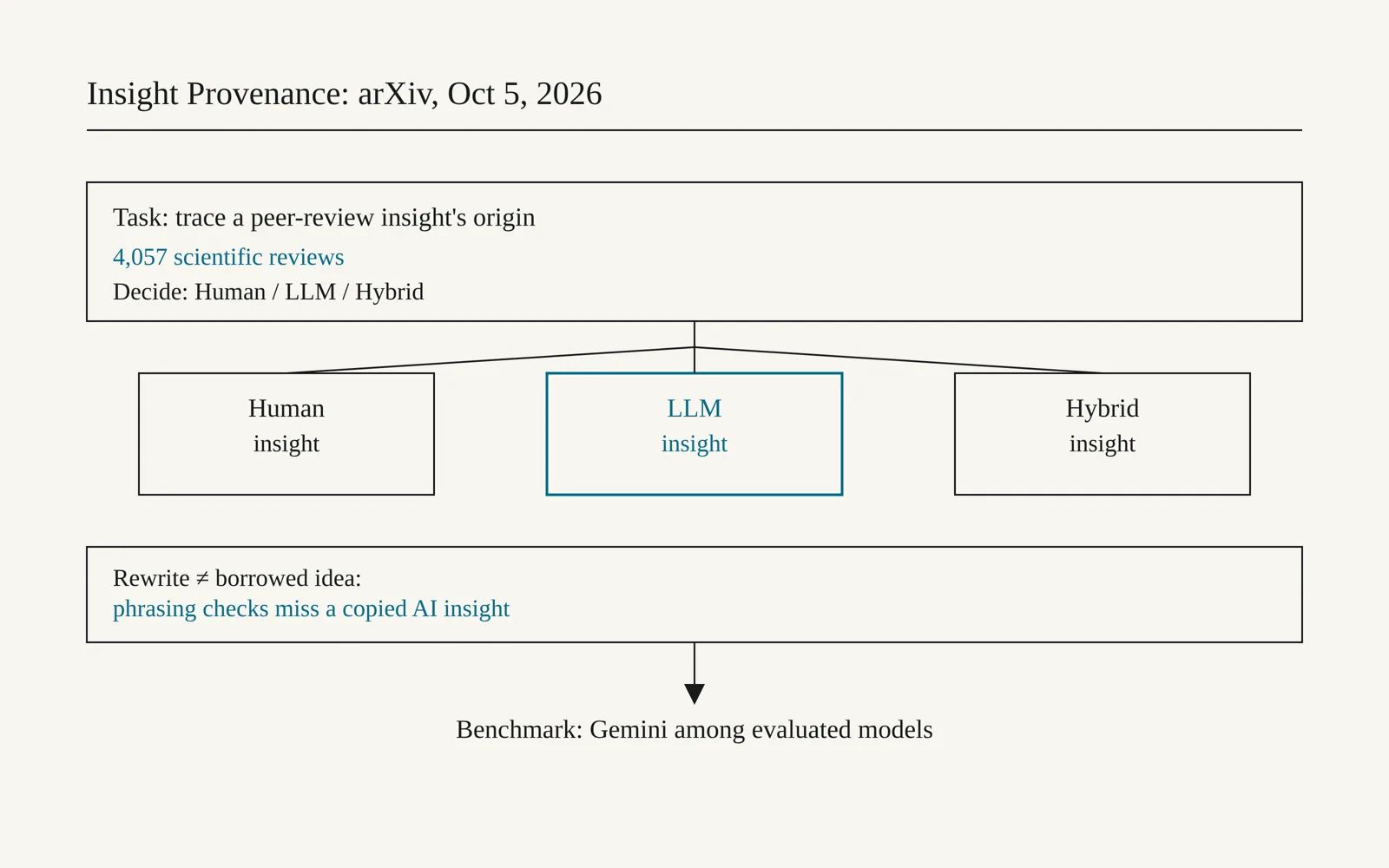
On October 5, 2026, researchers posted a paper on arXiv introducing Insight Provenance, a task for telling whether a peer review's underlying insight came from a human, an LLM, or a hybrid of both, built on a new dataset called InsightProv-v0 drawn from scientific papers and human reviews, with LLM involvement simulated using GPT-4o, Gemini, and DeepSeek. (arXiv paper, Who Wrote It Is Not Enough: Detecting Who Contributed the Insight, submitted October 5, 2026)
Open the photograph at full size
Photograph: Diagram: AI Journey
Read the full description of this diagram
Diagram drawn for this item: Paper Proposes Detecting Who Contributed an Insight, Not Just Who Wrote It. On October 5, 2026, researchers posted a paper on arXiv introducing Insight Provenance, a task for telling whether a peer review's underlying insight came from a human, an LLM, or a hybrid of both, built on a new dataset called... For a journal editor or a conference chair, this reframes what a plagiarism or an AI use check is supposed to catch: not the sentence structure a writer used, but whose judgment actually produced the finding underneath it.
The numbers
Papers in dataset
4,057
Scientific papers used to build InsightProv-v0
Reviews in dataset
12,660
Human reviews annotated for provenance at the sentence level
What it means for you
For a journal editor or a conference chair, this reframes what a plagiarism or an AI use check is supposed to catch: not the sentence structure a writer used, but whose judgment actually produced the finding underneath it. Tools built only to flag machine phrasing can be rewritten around by anyone who runs a draft through a paraphraser, which is the shortcut the paper shows current detectors already exploit. A detector aimed at the idea's origin instead of its wording changes what a conference asks authors and reviewers to disclose, and it changes what counts as evidence when a dispute over authorship reaches an editor's desk.
In more detail
Researchers from a multi-university team posted a paper on arXiv on October 5, 2026, arguing that detecting AI-written text is no longer the useful question for peer review. Their proposed task, Insight Provenance, instead asks whether the underlying judgment in a review comment came from a human, a large language model, or some hybrid of the two. The distinction matters because a reviewer can run a human draft through a paraphraser and defeat a detector built to spot machine phrasing, while the actual intellectual contribution behind the comment stays invisible to that kind of check.
To study the problem, the team built InsightProv-v0, a dataset constructed from scientific papers and human reviews, with different levels of LLM involvement simulated using three models: GPT-4o, Gemini, and DeepSeek. Provenance was annotated at the sentence level, which let the authors test not just whether a review contains machine-generated text but which specific sentences carry a human idea versus a model-generated one.
The paper’s central finding is a warning about how these systems are evaluated. Strong accuracy on raw data looked convincing at first, but the researchers found that models were exploiting linguistic and textual-authorship shortcuts rather than genuinely detecting provenance, and that performance degraded substantially once the evaluation was progressively debiased to remove those shortcuts. Their response is a two-stage adversarial framework meant to suppress the shortcut signals while keeping the information that actually indicates where an insight came from.
Beyond detection accuracy, the analysis points to a pattern in how humans and AI models differ. AI-generated insights tend to stay close to generic knowledge or information already present in the paper being reviewed, while human insights more often pull in outside knowledge and independent judgment that was not supplied by the paper itself. The authors frame this as evidence that wording alone is not a durable signal: an LLM can be asked to rewrite a sentence, but the provenance of the idea behind it leaves a signal that survives the rewrite.
The numbers
- The dataset draws on 4,057 scientific papers as its source material.
- It includes 12,660 human reviews, annotated for provenance at the sentence level across three simulated levels of LLM involvement.
The paper does not propose a product or a policy. It proposes a different question for anyone building AI detection tools for academic publishing, shifting the target from matching a writing style to tracing where a judgment came from.
Sources
Sources read
Cite this
AI Journey, "Paper Proposes Detecting Who Contributed an Insight, Not Just Who Wrote It", 7 Oct 2026, https://aijourney.space/updates/2026-10-07-who-wrote-it-is-not-enough-detecting-who-contributed-the-insight/ (source: arXiv, verified 7 Oct 2026)
Next in the stream
Paper Splits Conformal Reliability From Frequency Calibration After a Break
A Columbia University paper on arXiv separates two audits of conformal prediction, a method relevant to pay-per-token vendors such as MiniMax.
Previous
OpenAI Adds Visual Ad Format and Measurement Tools to ChatGPT
OpenAI is building a new visual ad format inside ChatGPT along with measurement and attribution tools aimed at advertisers who buy against conversational answers.
Next
More in Google
Google.org Funds Five Groups Building AI Tools For Teachers
Google.org is funding five organizations building AI tools for teachers, pairing Google DeepMind's model work with grants aimed at classroom use.
Gemini Negotiation Paper Finds Persona Effects Shift By Language
A new paper testing Google's Gemini model in buyer-seller negotiations found that the same persona instruction produced different deal outcomes in English and Korean.
Paper Finds Gemini Monitor Beats Small Models At Spotting Reward Hacking
A new paper tests whether Google's Gemini 3.1 Flash-Lite can tell real reward hacking apart from honest failure better than small local monitors.