What happened
Published here
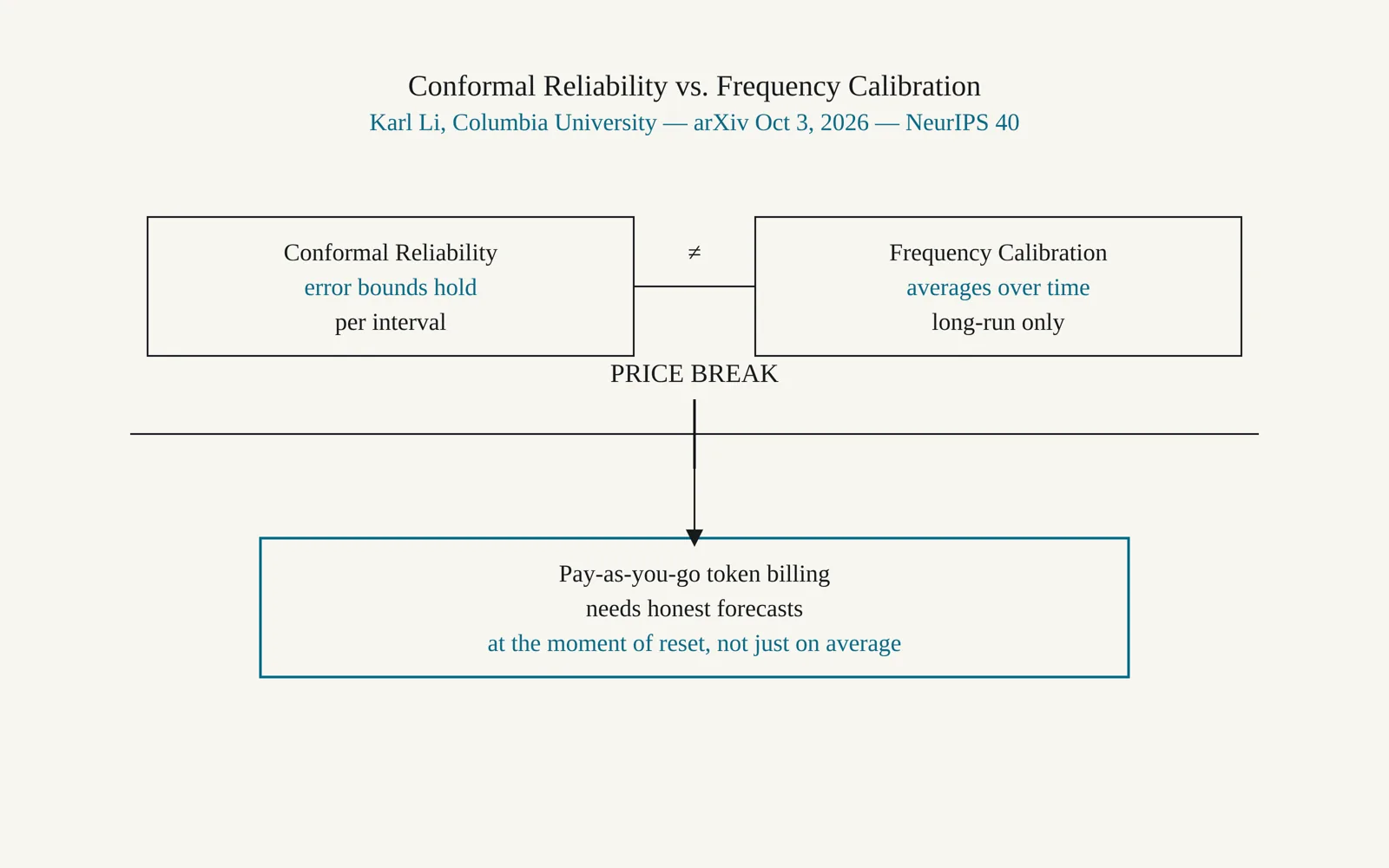
On October 3, 2026, researcher Karl Li of Columbia University posted a paper to arXiv, later accepted at the 40th Conference on Neural Information Processing Systems, arguing that conformal reliability and frequency calibration are separate audits once a forecasting system hits an announced boundary, a partition visible before the first affected outcome arrives. (arXiv preprint 2610.23917, Announced Breaks Separate Conformal Reliability from Frequency Calibration)
Open the photograph at full size
Photograph: Diagram: AI Journey
Read the full description of this diagram
Diagram drawn for this item: Paper Splits Conformal Reliability From Frequency Calibration After a Break. On October 3, 2026, researcher Karl Li of Columbia University posted a paper to arXiv, later accepted at the 40th Conference on Neural Information Processing Systems, arguing that conformal reliability and frequency calibration are... A vendor that bills by the token, the way MiniMax's published pay as you go price list does, depends on forecasts of demand and error rates staying honest across a pricing change, not just on average; a reset rule that keeps a usage...
The numbers
Nominal miscoverage
0.1
Target miscoverage level the per-time reliability audit is measured against
Unseen test scores
68
Scores drawn from an electricity market reform used to test the reset rule
Forecast checkpoint
50th
Point after a synthetic break where the reset rule is compared against five adaptive methods
Announced boundaries
9
Total announced boundaries the study evaluates
What it means for you
A vendor that bills by the token, the way MiniMax's published pay as you go price list does, depends on forecasts of demand and error rates staying honest across a pricing change, not just on average; a reset rule that keeps a usage model's coverage close to nominal right after a known shift could let an operator avoid both overbuilt capacity and surprise shortfalls the week a new price tier lands.
In more detail
A paper posted to arXiv by Columbia University researcher Karl Li proposes that conformal prediction, the technique that wraps a forecast in a band meant to contain the true outcome a set share of the time, needs two separate report cards once a system passes a known, announced boundary. One report card, the per-time audit, tracks how close the band’s coverage sits to a target miscoverage of 0.1 at each step. The other, the frequency audit, checks whether a closed window’s actual error rate matched that target over its whole span. The paper argues a single reset rule, built from the empirical quantile of scores observed after the boundary, can satisfy the first audit at close to the best possible rate for independent scores, and can keep the second audit’s error small and shrinking as more data arrives, provided a bounded floor is added to the recursion.
The author tests the reset rule against adaptive conformal methods run from the original authors’ published code, on a large synthetic break and on two real economic series: an electricity market reform and a set of monetary policy decisions. At the 50th forecast after the synthetic break, the reset rule’s gap against the nominal target beat every comparison method. On unseen scores following the market reform, its performance band sat below some comparison methods, tied others including adaptive conformal inference, and matched one exactly at zero.
The numbers
The paper reports announced boundaries tested in total, with one clearing the smallest coverage difference its own detection window could register. Around monetary policy decisions, the reset rule’s band sat above zero against every rival method on 10 of the first 34 days studied, a sign that real policy announcements are harder to reset around cleanly than the synthetic break or the electricity reform.
For an operator pricing a service by predicted load, the difference between a method that looks calibrated on average and a method that stays calibrated the moment a new boundary is announced is the difference between a smooth billing cycle and a week of refunds or throttling after every price change.
Sources
Sources read
Cite this
AI Journey, "Paper Splits Conformal Reliability From Frequency Calibration After a Break", 21 Oct 2026, https://aijourney.space/updates/2026-10-21-announced-breaks-separate-conformal-reliability-from-frequency-calibrati/ (source: arXiv, verified 21 Oct 2026)
Next in the stream
IdeaScientist Paper Benchmarks Ideation Agents Against Claude-4.8-Opus
A new paper benchmarks the IdeaScientist agent system against Claude Code SDK running Claude-4.8-Opus for generating research ideas.
Previous
Paper Proposes Detecting Who Contributed an Insight, Not Just Who Wrote It
A new paper tests whether reviewers' insights came from a human, an LLM such as Gemini, or a hybrid of the two, not just who typed the words.
Next
More in MiniMax
Paper Proposes Sparse Priors To Cut Sample Needs In Distribution Learning
A new arXiv paper argues that sparse priors can sharply lower the number of samples needed to learn a distribution, a bound relevant to model vendors such as MiniMax.
Researchers Publish Bias-Variance Theory For Guided Reasoning Training
A paper relevant to reasoning methods used across the field, including by vendors such as MiniMax, sets out a bias-variance theory for guidance-augmented reinforcement learning.