What happened
Published here
On September 16, 2026, researchers Saumya Goyal and Barnabas Poczos posted a paper on arXiv titled Sparse Priors for Efficient Distribution Learning, introducing a class of sparse priors and a measure called the Sparse Dimension, and showing that under a k sparse prior a distribution can be learned with a Bayesian risk bound of order the square root of k over n, rather than a rate that worsens sharply with the number of dimensions. (arXiv preprint, Sparse Priors for Efficient Distribution Learning, submitted 16 September 2026)
Open the photograph at full size
Photograph: Diagram: AI Journey
Read the full description of this diagram
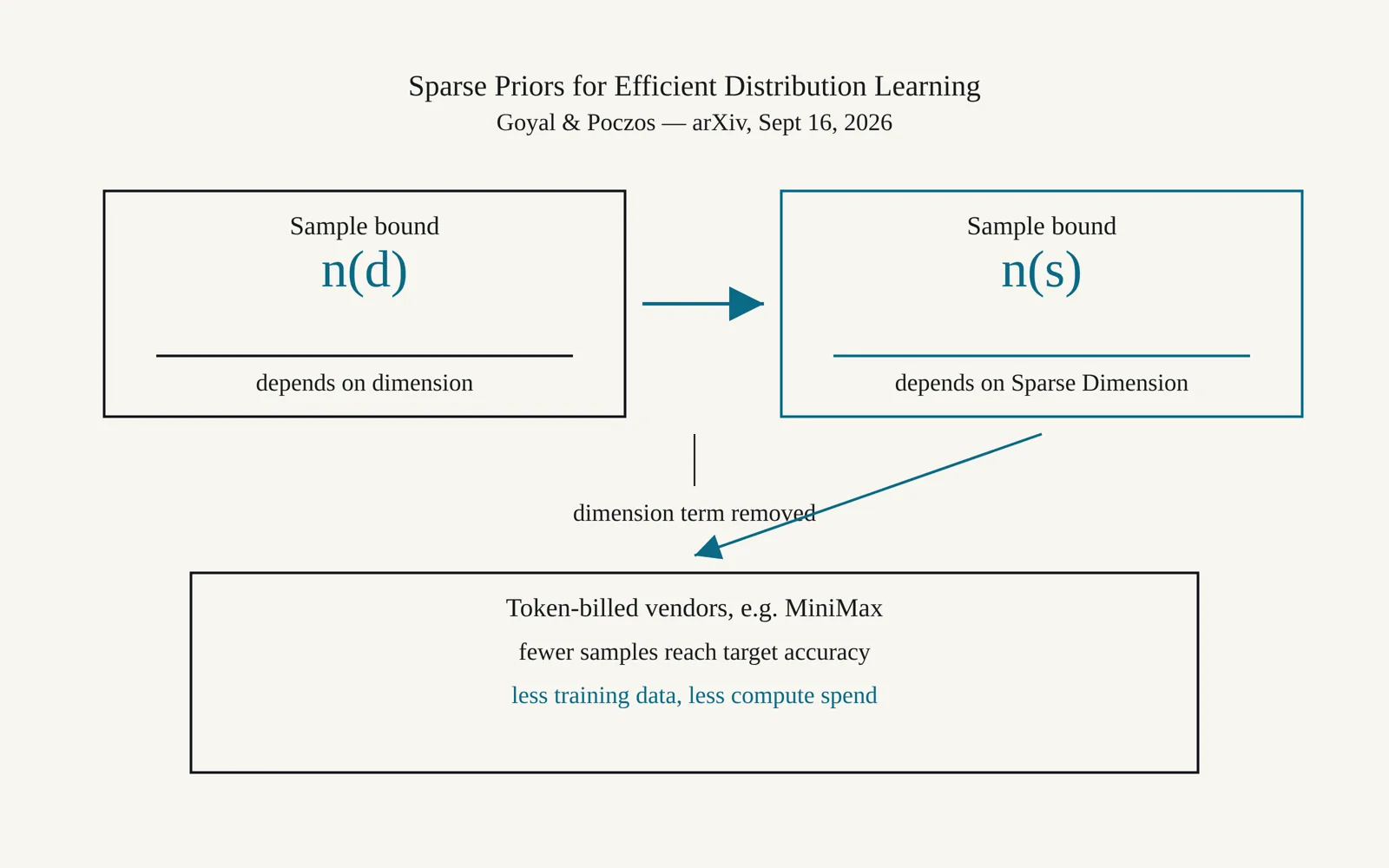
Diagram drawn for this item: Paper Proposes Sparse Priors To Cut Sample Needs In Distribution Learning. On September 16, 2026, researchers Saumya Goyal and Barnabas Poczos posted a paper on arXiv titled Sparse Priors for Efficient Distribution Learning, introducing a class of sparse priors and a measure called the Sparse Dimension, and... For vendors such as MiniMax that sell generation by the token, a bound that removes the usual dependence on dimension matters because it suggests fewer training samples could reach a target accuracy, which affects how much data and compute...
What it means for you
For vendors such as MiniMax that sell generation by the token, a bound that removes the usual dependence on dimension matters because it suggests fewer training samples could reach a target accuracy, which affects how much data and compute a model needs before its outputs are reliable enough to price and ship at scale.
In more detail
Standard theory on learning a probability distribution from samples has long carried a discouraging rate: as the number of dimensions d grows, the error shrinks only as n raised to the power of minus one over roughly d, a rate the authors describe as minimax optimal under the usual smoothness assumptions. That rate is the reason distribution learning in high dimensions is treated as fundamentally hard, and it sits behind the intuition that generative models need exponentially more data as their output space grows richer.
Goyal and Poczos argue the pessimism comes from the assumption itself rather than from the problem. Real distributions used in practice, they write, often carry more structure than a smoothness bound can see. To capture that structure they define a class of sparse priors and a quantity called the Sparse Dimension, a measure of how sparse a prior is across the space of possible distributions. Under a k sparse prior, they show a Bayesian risk lower bound of order the square root of k over n under common distance metrics, and a matching upper bound for total variation distance up to logarithmic terms, under mild extra conditions. Because k can be far smaller than d, the bound removes the exponential dependence on dimension that the classical result carries.
The paper also shows that learning a distribution and learning to sample from it are statistically equivalent in this Bayesian setting, so the same result covers models built to generate samples rather than to estimate density directly, which is the mode most deployed generative systems actually use.
The numbers
- The classical minimax rate for distribution learning in d dimensions degrades as n to the power of minus one over a quantity that grows with d, the pessimistic baseline the paper argues against.
- Under a k sparse prior, the paper’s Bayesian risk bound is of order the square root of k over n, a rate that does not grow worse with dimension the way the classical bound does.
- The upper bound for total variation distance matches the lower bound up to logarithmic factors in n and k, under the paper’s stated mild assumptions.
The result is theoretical, with no benchmark or released model attached, but it speaks directly to a question every vendor training generative systems faces: how much data is enough. If real world distributions are closer to sparse than to merely smooth, as the authors hypothesize, then sample requirements could scale with a hidden sparse dimension rather than with the raw dimensionality of the output space, a distinction that matters for anyone deciding how much training data a given accuracy target actually needs.
Sources
Sources read
Cite this
AI Journey, "Paper Proposes Sparse Priors To Cut Sample Needs In Distribution Learning", 21 Sep 2026, https://aijourney.space/updates/2026-09-21-sparse-priors-for-efficient-distribution-learning/ (source: arXiv, verified 21 Sep 2026)
Next in the stream
Nvidia's Vera Rubin NVL72 Posts First MLPerf Inference Benchmark Results
Nvidia's first Vera Rubin NVL72 submission to MLPerf Inference v6.1 posted higher throughput than the current GB300 NVL72 rack.
Previous
arXiv Paper Finds Grok Amplifies Aggression in Synthetic Cyberbullying Data
A new arXiv paper compared cyberbullying dialogues generated by Grok, GPT and LLaMA against real conversations, finding xAI's model stands out for amplifying aggressive behavior.
Next
More in MiniMax
Paper Splits Conformal Reliability From Frequency Calibration After a Break
A Columbia University paper on arXiv separates two audits of conformal prediction, a method relevant to pay-per-token vendors such as MiniMax.
Researchers Publish Bias-Variance Theory For Guided Reasoning Training
A paper relevant to reasoning methods used across the field, including by vendors such as MiniMax, sets out a bias-variance theory for guidance-augmented reinforcement learning.