What happened
Published here
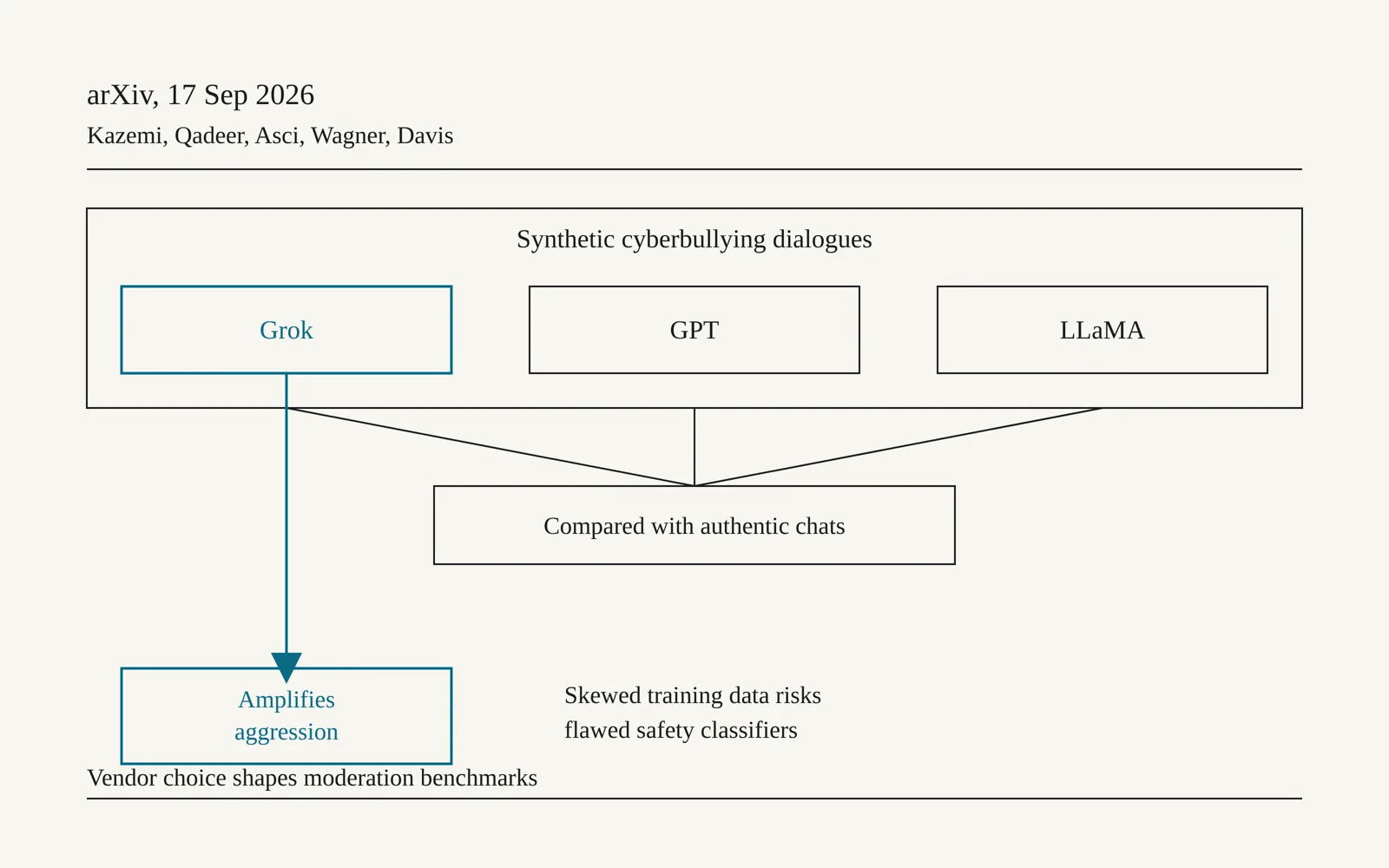
On 17 September 2026, researchers Arefeh Kazemi, Hamza Qadeer, Sinan Asci, Joachim Wagner and Brian Davis posted a paper to arXiv comparing synthetic cyberbullying dialogues generated by Grok, GPT and LLaMA against authentic conversations. The study measured turn-taking, power dynamics, repair behavior, pronoun usage, humor, profanity, toxicity and escalation patterns, then added human evaluation of realism and role plausibility. (arXiv paper, Do Social Patterns Hold in Synthetic Data?, submitted 15 July 2026, posted to cs.CL 17 September 2026)
Open the photograph at full size
Photograph: Diagram: AI Journey
Read the full description of this diagram
Diagram drawn for this item: arXiv Paper Finds Grok Amplifies Aggression in Synthetic Cyberbullying Data. On 17 September 2026, researchers Arefeh Kazemi, Hamza Qadeer, Sinan Asci, Joachim Wagner and Brian Davis posted a paper to arXiv comparing synthetic cyberbullying dialogues generated by Grok, GPT and LLaMA against authentic conversations. Teams building safety classifiers or moderation benchmarks with LLM-generated training data need to know which vendor's outputs skew the resulting dataset.
What it means for you
Teams building safety classifiers or moderation benchmarks with LLM-generated training data need to know which vendor's outputs skew the resulting dataset. If Grok systematically writes harsher synthetic aggression than GPT or LLaMA, a benchmark built only from Grok transcripts will overstate how severe real cyberbullying looks, and a detector trained on it may miscalibrate against authentic conversations. That is a concrete caution for anyone choosing which model to use for data augmentation in trust and safety pipelines, not just an abstract finding about realism.
In more detail
The paper builds a framework to test whether synthetic conversations generated for cyberbullying research actually behave like real ones, rather than just being useful for training a downstream classifier. The authors generated dialogues with three model families and scored them against authentic conversations across interactional structure, linguistic style, affective markers and escalation over time.
The numbers
At a high level, all three model families preserved broad interactional structure: role participation patterns, the direction of power imbalance between aggressor and target, and the general spread of behavioral markers looked similar to authentic dialogues. Where the models diverged was in the finer grain. The paper reports that synthetic data from every model distorted behavioral magnitude, how roles were allocated, categorical distributions of cyberbullying types, and the timing of escalation, even while the coarse patterns held up.
The model-specific differences are the most actionable part of the paper. GPT suppressed harmful content, producing gentler dialogues than authentic examples. LLaMA landed closest to a balanced approximation, though it smoothed over distinctions between the aggressor and target roles. Grok stood apart by amplifying aggressive behavior, generating synthetic exchanges that were more hostile than the real conversations they were meant to approximate.
For xAI, the finding is not a product complaint since Grok was not tuned for this task, but it is a data point about the model’s tendency in an unconstrained generation setting. A model that defaults toward harsher output when asked to role-play conflict is a different tool from one that defaults toward suppression, and the choice matters for anyone assembling training or evaluation sets for content moderation systems. A dataset skewed toward either extreme, whether too soft from GPT or too aggressive from Grok, teaches a downstream classifier the wrong baseline for what ordinary hostility looks like.
The authors’ broader conclusion is a caution rather than a rejection of synthetic data. Global structure transfers well enough to be useful for augmentation and benchmarking, but researchers relying on any single model’s output for behavioral realism, magnitude, or role-specific detail should treat that data as an imperfect substitute for authentic transcripts, especially when the downstream task depends on exactly the fine-grained patterns the paper shows getting distorted.
Sources
Sources read
Cite this
AI Journey, "arXiv Paper Finds Grok Amplifies Aggression in Synthetic Cyberbullying Data", 18 Sep 2026, https://aijourney.space/updates/2026-09-18-do-social-patterns-hold-in-synthetic-data-analyzing-cyberbullying-dynami/ (source: arXiv, verified 18 Sep 2026)
Next in the stream
Paper Proposes Sparse Priors To Cut Sample Needs In Distribution Learning
A new arXiv paper argues that sparse priors can sharply lower the number of samples needed to learn a distribution, a bound relevant to model vendors such as MiniMax.
Previous
Paper Proposes Quality-Gated Swap of Attention Layers in Small Language Models
A new paper indexed alongside Perplexity AI's research tracking replaces some attention layers in small language models only when accuracy checks pass.
Next
More in xAI
xAI Changes Grok Pricing Page at grok.com
xAI's public site at grok.com now shows a pricing page that differs from the version this site last recorded, though the vendor has not detailed the change.
Paper Benchmarks Grok's Voice Agent Across Five Languages
A new paper testing voice agents across five languages found Grok leads on task completion but trails rivals on the quality of its generated speech.