Event Published ResearchPerplexity AI
Paper Proposes Quality-Gated Swap of Attention Layers in Small Language Models
A new paper indexed alongside Perplexity AI's research tracking replaces some attention layers in small language models only when accuracy checks pass.
What happened
Published here
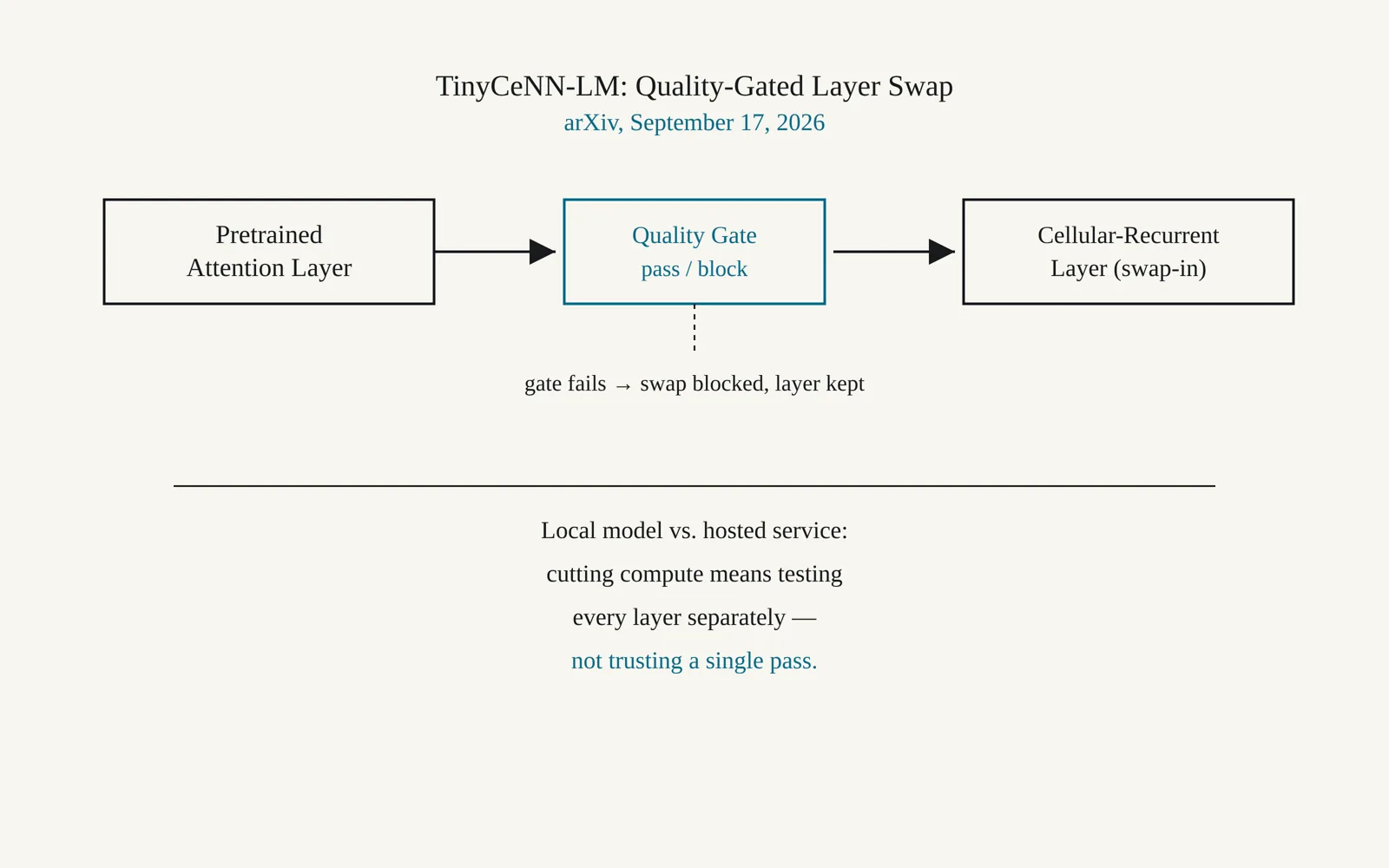
On September 17, 2026, researchers posted a paper on arXiv describing TinyCeNN-LM, a method that replaces attention layers in a pretrained language model with cellular-recurrent layers, but only after a quality gate checks that the swap does not damage the model's internal representations or its next-word accuracy, rejecting any layer that fails the check and keeping the original attention in place instead. (arXiv paper 2609.21139, TinyCeNN-LM: Quality-Gated Conversion of Pretrained Attention with CeNN-Inspired Cellular-Recurrent Layers, submitted September 17, 2026)
Open the photograph at full size
Photograph: Diagram: AI Journey
Read the full description of this diagram
Diagram drawn for this item: Paper Proposes Quality-Gated Swap of Attention Layers in Small Language Models. On September 17, 2026, researchers posted a paper on arXiv describing TinyCeNN-LM, a method that replaces attention layers in a pretrained language model with cellular-recurrent layers, but only after a quality gate checks that the swap... For anyone deciding whether to run a smaller local model instead of paying for a hosted service, this work is a reminder that cutting compute inside a language model usually means testing every layer separately rather than trusting a...
The numbers
Layers 0-2 NLL change
+0.01209
Cumulative change in negative log likelihood after accepting layers 0 to 2 on SmolLM2-135M
Layers 3, 7, 11 NLL change
+0.02073
Final change in negative log likelihood after accepting three full-attention layers on Qwen3.5-0.8B
What it means for you
For anyone deciding whether to run a smaller local model instead of paying for a hosted service, this work is a reminder that cutting compute inside a language model usually means testing every layer separately rather than trusting a single global swap, so a team weighing a cheaper self-hosted setup against an API bill should budget time for that layer-by-layer validation work rather than assuming a published speedup number will hold on their own model.
In more detail
Three authors working outside any named AI vendor posted a paper on arXiv on September 17, 2026, describing TinyCeNN-LM, a framework for replacing attention layers inside an already trained language model without retraining the whole system from scratch. The idea sits in a narrow but practical problem: swapping out attention for something cheaper to run can quietly break the representations that later layers in the network expect to see, so a naive global replacement can look fine on paper and still perform worse in practice.
The paper’s answer is a “quality-gated” process. Each candidate layer is converted to a cellular-recurrent design inspired by cellular neural networks, bounded local processing and a small routing and fusion step, and then the converted layer is only kept if it passes fixed thresholds on both representation fidelity and next-word accuracy. If either check fails, the layer is rolled back to its original attention. The authors tested this on two small models, SmolLM2-135M and Qwen3.5-0.8B, and found the gate behaves unevenly: on SmolLM2-135M, the first three layers passed, but a fourth layer was rejected despite acceptable accuracy loss because its representations no longer matched what the rest of the network expected.
Three separate implementations were compared: Integrated Memory, MemoryFusion, and a combined design called PDelta3-GDN2-CLVR+Local32. Integrated Memory came out best on efficiency, cutting cache use while keeping perplexity close to the original model’s. A downstream sanity check across 200 test items on converted Qwen models still showed a fairly wide accuracy band, underlining that layer conversion is not yet a drop-in win.
The numbers
The reported figures describe two model families and one downstream test. On SmolLM2-135M, accepting the first three layers changed the model’s negative log likelihood only slightly. On Qwen3.5-0.8B, accepting three full-attention layers produced a comparably small change. The Integrated Memory design’s best result on cache size shaved off a modest share of memory use, and the 200-item downstream check on converted Qwen releases produced accuracy in the high twenties to low thirties percent range, a spread the authors present as evidence for cautious, per-layer validation rather than blanket attention replacement.
The paper does not name any deployed product, and its authors have no stated link to Perplexity AI. It is included here as a research signal for anyone tracking how small open models might be made cheaper to run, including teams weighing self-hosting against paying for an answer engine’s hosted service.
Sources
Sources read
Cite this
AI Journey, "Paper Proposes Quality-Gated Swap of Attention Layers in Small Language Models", 22 Sep 2026, https://aijourney.space/updates/2026-09-22-tinycenn-lm-quality-gated-conversion-of-pretrained-attention-with-cenn-i/ (source: arXiv, verified 22 Sep 2026)
Next in the stream
arXiv Paper Finds Grok Amplifies Aggression in Synthetic Cyberbullying Data
A new arXiv paper compared cyberbullying dialogues generated by Grok, GPT and LLaMA against real conversations, finding xAI's model stands out for amplifying aggressive behavior.
Previous
Anthropic Partners With Accenture on Embedded AI Evaluation
Anthropic said it will let evaluators from Accenture's Faculty unit work inside the company with access comparable to an employee's, testing safeguards on frontier models.
Next
More in Perplexity AI
Perplexity AI Researchers Detail LoRA Recipe For Converting Four Language Models To Diffusion
A paper associated with Perplexity AI describes BYOD, a LoRA-only method that converts standard autoregressive language models into diffusion language models without full retraining.
Paper Proposes Message-Passing Method For Compressing LLM Weights
A new arXiv paper proposes a message-passing method for compressing large language model weights, the kind of efficiency work that underlies answer engines like Perplexity AI.
Researchers Publish S-SALAAD Framework For Sparse Large Model Inference
A new paper on compressing large models for edge devices matters to Perplexity AI and any company whose answer engine has to run inference away from a data center.