What happened
Published here
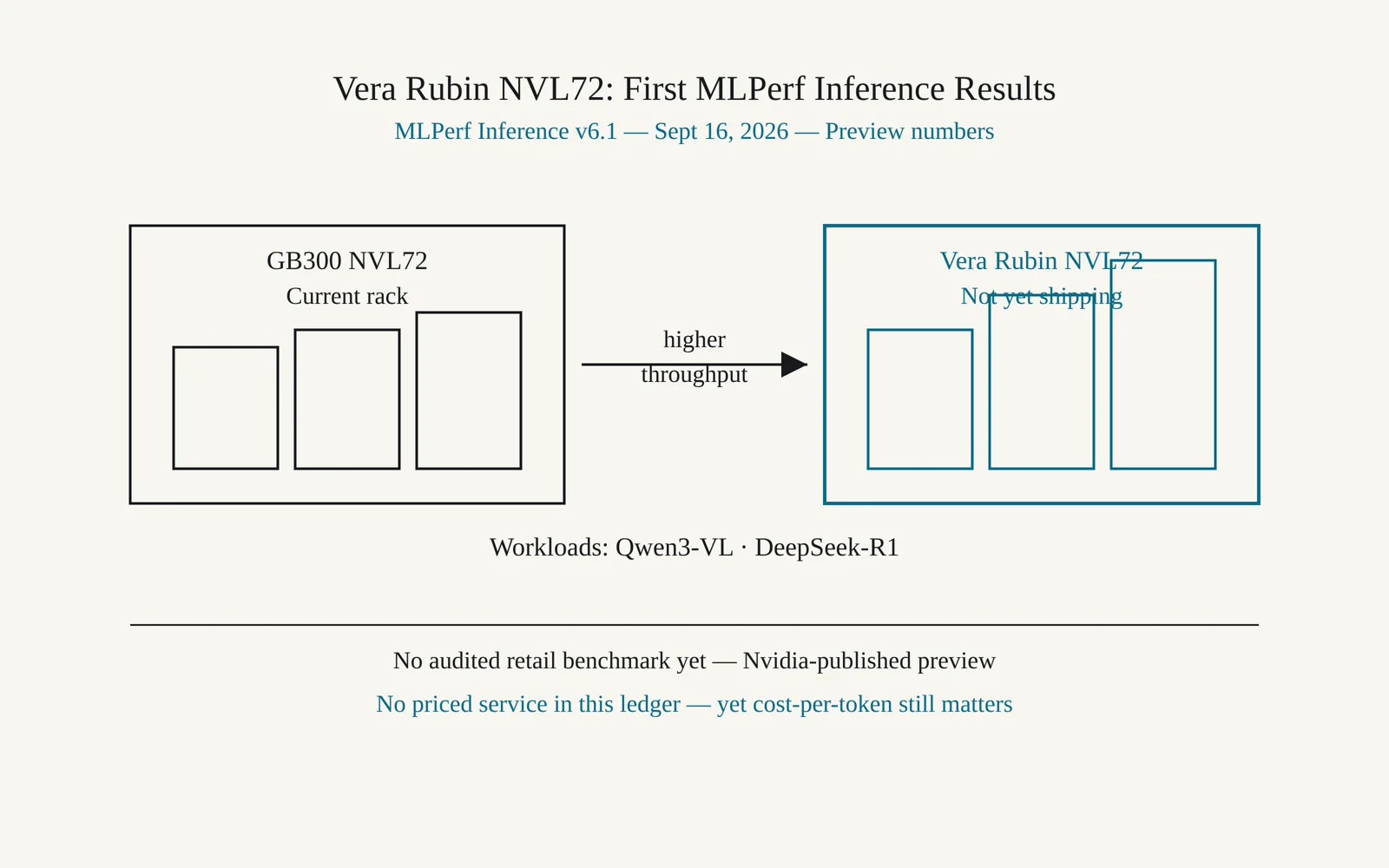
Nvidia published its first Vera Rubin NVL72 results for the MLPerf Inference v6.1 benchmark suite on September 16, 2026, reporting higher throughput than its current GB300 NVL72 rack on the Qwen3-VL and DeepSeek-R1 workloads, alongside a separate GB300 NVL72 submission that scaled from one rack to four with 99% efficiency. (Nvidia newsroom post on Vera Rubin NVL72 MLPerf Inference v6.1 results, 16 September 2026)
Open the photograph at full size
Photograph: Diagram: AI Journey
Read the full description of this diagram
Diagram drawn for this item: Nvidia's Vera Rubin NVL72 Posts First MLPerf Inference Benchmark Results. Nvidia published its first Vera Rubin NVL72 results for the MLPerf Inference v6.1 benchmark suite on September 16, 2026, reporting higher throughput than its current GB300 NVL72 rack on the Qwen3-VL and DeepSeek-R1 workloads, alongside a... Vera Rubin NVL72 is not shipping yet, so these are preview numbers Nvidia chose to publish rather than audited retail benchmarks; still, since Nvidia carries no priced service in this ledger, any drop in cost per token on its next rack...
The numbers
Qwen3-VL throughput gain
3.7x
Vera Rubin NVL72 vs GB300 NVL72
DeepSeek-R1 throughput gain
2.5x
Vera Rubin NVL72 vs GB300 NVL72
GB300 scaling efficiency
99%
single rack to four racks, DeepSeek-R1 offline scenario
Read from Nvidia newsroom post on Vera Rubin NVL72 MLPerf Inference v6.1 results, 16 September 2026
What it means for you
Vera Rubin NVL72 is not shipping yet, so these are preview numbers Nvidia chose to publish rather than audited retail benchmarks; still, since Nvidia carries no priced service in this ledger, any drop in cost per token on its next rack matters mainly as a floor under what every AI vendor built on that hardware can eventually charge.
In more detail
Nvidia’s Vera Rubin NVL72 rack made its first appearance in the MLPerf Inference benchmark suite on September 16, 2026, with a preview submission to round v6.1. The company measured throughput against its own current-generation GB300 NVL72 rack, the platform it sells to cloud partners today, rather than against a rival’s hardware. On the Qwen3-VL workload, run through vLLM with Nvidia’s Dynamo inference framework, Vera Rubin NVL72 delivered higher throughput than GB300 NVL72 across offline, server and interactive scenarios. On DeepSeek-R1, run through the TensorRT-LLM library, the new rack again beat the older one. Nvidia credits the gains to Vera Rubin’s Tensor Cores and Transformer Engine, plus NVFP4 precision that shrinks the memory footprint of model weights, attention data and the key-value cache used during generation.
The same submission round carried a second result about the hardware already on sale: a GB300 NVL72 configuration scaled from a single rack up to four racks on the DeepSeek-R1 offline test, with throughput growing almost in step with the added hardware. That scaling result matters more than the headline throughput number for anyone buying racks today, because a system that does not scale cleanly erases the value of adding more of it. Nvidia also reported that software changes alone lifted GB300 NVL72’s Qwen3-VL score over the previous MLPerf round, through lower key-value cache precision, added kernel fusion and disaggregated serving that splits the prefill and decode stages of a request.
The numbers
Vera Rubin NVL72 posted up to 3.7x the throughput of GB300 NVL72 on Qwen3-VL and up to 2.5x on DeepSeek-R1, both measured in the same MLPerf Inference v6.1 preview round. The GB300 NVL72 scaling submission held 99% efficiency moving from a single rack to four, meaning throughput rose almost exactly in proportion to the added hardware rather than tapering off. Nvidia dates the software-only Qwen3-VL gain on GB300 NVL72 at up to 1.6x over the prior MLPerf round, separate from any new silicon.
None of these figures come from an independent buyer’s deployment. They are Nvidia’s own submission to MLCommons, checked against the benchmark’s rules but chosen and run by the vendor whose hardware is being measured. Preview status also means Vera Rubin NVL72 is not yet a shipping product with a public price, so a reader cannot convert the throughput gap into a cost-per-token figure today. What the release does establish is a baseline: the next generation of Nvidia’s inference hardware, once it ships, will be measured against these same numbers rather than against a competitor’s.
Sources
Sources read
Nvidia newsroom post on Vera Rubin NVL72 MLPerf Inference v6.1 results, 16 September 2026 (blogs.nvidia.com)
Newsroom read
Cite this
AI Journey, "Nvidia's Vera Rubin NVL72 Posts First MLPerf Inference Benchmark Results", 18 Sep 2026, https://aijourney.space/updates/2026-09-18-nvidia-vera-rubin-nvl72-delivers-leading-performance-in-mlperf-inference/ (source: Nvidia, verified 18 Sep 2026)
Next in the stream
Google Publishes Teen AI Research With RXN
Google published research conducted with partner RXN describing how American teenagers use generative AI for study, creativity and fact-checking.
Previous
Paper Proposes Sparse Priors To Cut Sample Needs In Distribution Learning
A new arXiv paper argues that sparse priors can sharply lower the number of samples needed to learn a distribution, a bound relevant to model vendors such as MiniMax.
Next
More in Nvidia
Nvidia RTX Spark Laptops Add Transcription Model and New Game Support
Nvidia detailed new RTX Spark laptop updates, including a transcription model from its Nemotron line and support for Liquid AI's LFM3 models.
Nvidia Launches Minerva Platform for AI Factory Observability
Nvidia introduced Minerva, an AIOps platform that merges infrastructure and workload telemetry to flag problems across AI factories before they spread.
Nvidia Expands Agent Toolkit With Data Grounding Tools
Nvidia expanded its open source Agent Toolkit on October 21, 2026, adding an Agent Knowledge Foundation that grounds enterprise agents in company data without moving it.