What happened
Published here
On September 16, 2026, Google published the U.S. Future Report, research conducted with its partner RXN that surveyed American teenagers between the ages of thirteen and seventeen about how they use generative AI for schoolwork, creativity and fact-checking, drawing on quantitative surveys across several states and follow-up focus groups. (Google newsroom post on teen AI research findings, published September 16, 2026)
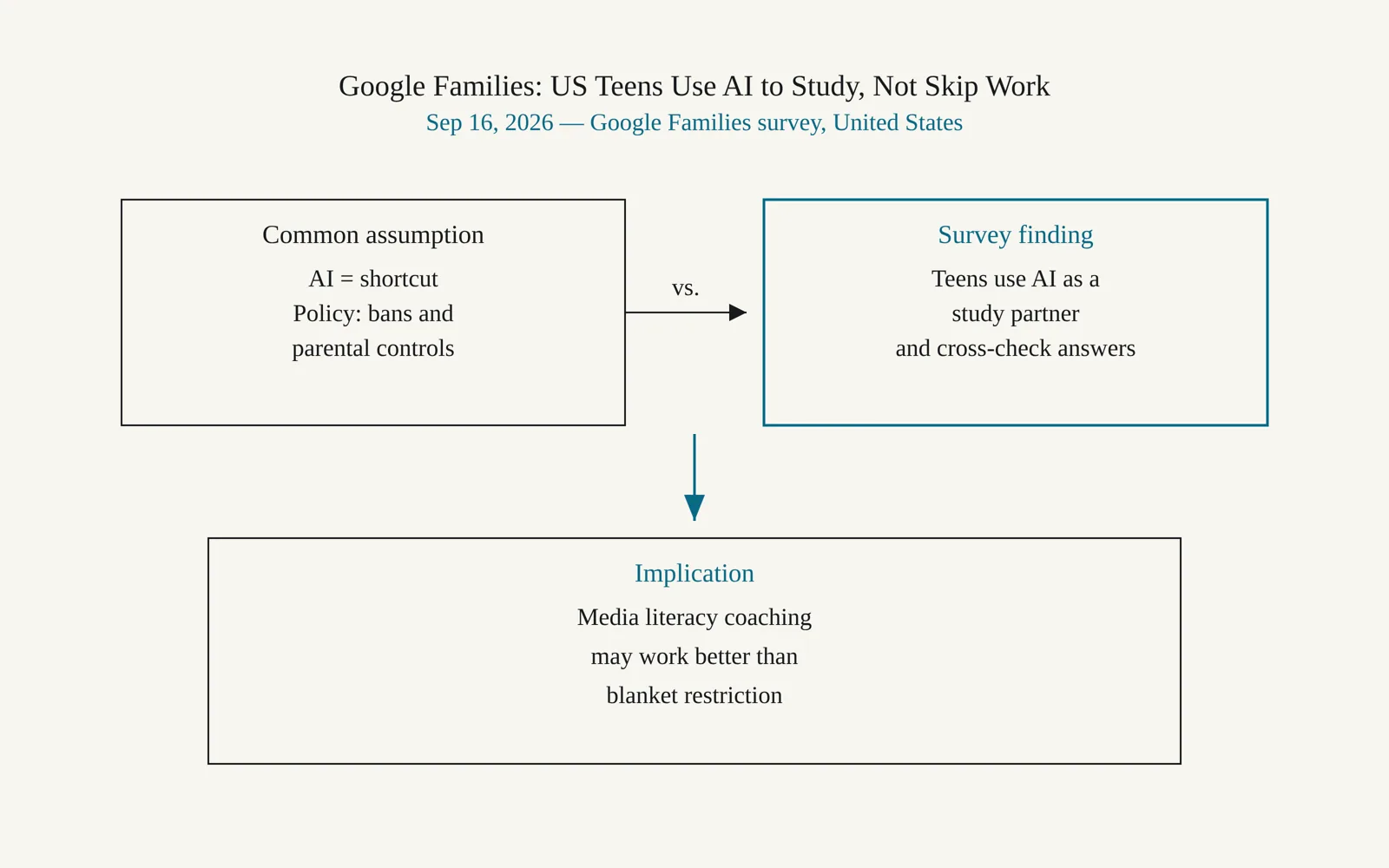
Open the photograph at full size
Photograph: Diagram: AI Journey
Read the full description of this diagram
Diagram drawn for this item: Google Publishes Teen AI Research With RXN. On September 16, 2026, Google published the U.S The findings matter because they complicate the assumption that schools and parents are the main source of guidance on AI, since teens told researchers they lean on family for safety questions but rely on their own judgment to check facts...
The numbers
Teens using AI
94%
Share of U.S. teens who used AI in the past year
Weekly AI users
74%
Share of teen AI users who use it weekly or more as a study partner
Fact cross-checking
55%
Share of teens who cross-check AI answers against other sources
Trust in family
67%
Share of teens who trust parents or family most for online safety guidance
Read from Google newsroom post on teen AI research findings, published September 16, 2026
What they are saying
Outlets read
Claude is getting a pair of new tools today: Docs and Slides.
read
"You're not supposed to know, as a parent, which emoji is popular right now," Aleksic says.
read
Our verdict
The Verge's report on Anthropic's new writing tools and the Guardian's look at how youth culture moves across platforms both treat young people and AI from angles Google's own study avoids, since neither outlet is examining vendor-funded survey data the way this newsroom post does. Read together, they show a gap between how teenagers describe their own AI habits and how outside reporters describe the platforms built around them.
What it means for you
The findings matter because they complicate the assumption that schools and parents are the main source of guidance on AI, since teens told researchers they lean on family for safety questions but rely on their own judgment to check facts, which puts pressure on schools to add digital literacy coursework rather than assume home guidance covers it.
In more detail
Google published a new study examining how American teenagers actually use generative AI tools, moving past the assumption that AI mainly helps students cut corners on schoolwork. The research, called the U.S. Future Report, was produced with market research partner RXN and combined large scale surveys with focus groups conducted in person with teenagers across the country. Google’s Kids and Family UX research lead, Jennifer Kotler, framed the findings as evidence that teenagers approach the technology with more caution and curiosity than adults often assume.
The headline finding is that most teenage AI users treat the tools as a study partner rather than a way to skip the work. Respondents described using AI to research homework questions, check spelling and grammar, and answer everyday questions, but the survey also found that teens use the tools to explore creative interests they would not otherwise have tried, from writing to visual art. A separate strand of the report focused on how teenagers verify what AI tells them, and found that most routinely cross-check answers against other sources such as news outlets, textbooks or a trusted adult before treating an AI response as reliable.
The report also surfaces a gap between what schools currently teach and what teenagers say they want. Most of the teens surveyed said digital literacy instruction should start by the fifth grade, but a smaller share reported that their own school currently offers a class covering digital literacy or technology skills. That gap leaves a portion of teenagers navigating AI tools, and the misinformation risks that come with them, without formal classroom guidance on how to do so safely.
The numbers
- The large majority of teens surveyed reported having used AI tools within the past year, and most of those users described weekly or more frequent use as a study aid rather than an occasional shortcut.
- A large share of teen AI users said the tools helped them discover a new creative interest or skill they had not pursued before.
- Roughly half of teen AI users said they routinely cross-check AI generated answers against another source, and a similar share said they ask a parent or teacher to confirm information.
- Family remains the dominant trusted source for online safety guidance among teens surveyed, well ahead of any other source named in the research.
Google frames the research as part of a broader push to build safer digital products for young people, and the company says it plans to use the findings to inform how it designs AI features aimed at younger users. For readers tracking how AI companies handle youth safety, the report is notable less for what it recommends and more for what it measures directly from teenagers themselves, rather than filtered through parent or educator surveys, which is where most prior industry research on this subject has focused.
Sources
Sources read
Google newsroom post on teen AI research findings, published September 16, 2026 (blog.google)
Newsroom read
Cite this
AI Journey, "Google Publishes Teen AI Research With RXN", 17 Sep 2026, https://aijourney.space/updates/2026-09-17-5-things-to-know-about-teens-views-on-ai-today/ (source: Google, verified 17 Sep 2026)
Next in the stream
Self-reported personality profiles diverge from behavior across 22 AI systems, study finds
A new paper asks Claude and rival systems to rate their own character, then checks those self-descriptions against Anthropic's published constitution and the systems' actual behavior.
Previous
Nvidia's Vera Rubin NVL72 Posts First MLPerf Inference Benchmark Results
Nvidia's first Vera Rubin NVL72 submission to MLPerf Inference v6.1 posted higher throughput than the current GB300 NVL72 rack.
Next
More in Google
Google.org Funds Five Groups Building AI Tools For Teachers
Google.org is funding five organizations building AI tools for teachers, pairing Google DeepMind's model work with grants aimed at classroom use.
Gemini Negotiation Paper Finds Persona Effects Shift By Language
A new paper testing Google's Gemini model in buyer-seller negotiations found that the same persona instruction produced different deal outcomes in English and Korean.
Paper Finds Gemini Monitor Beats Small Models At Spotting Reward Hacking
A new paper tests whether Google's Gemini 3.1 Flash-Lite can tell real reward hacking apart from honest failure better than small local monitors.