What happened
Published here
On July 8, 2026, researchers posted a paper to arXiv proposing Guidance-Augmented GRPO, a theoretical framework that treats external guidance used in reasoning training, such as expert traces or retrieved thought patterns, as a stochastic operator rewriting the question distribution, and derives convergence rates and an optimal weighting rule for that signal. (arXiv preprint 2610.06861, submitted July 8, 2026)
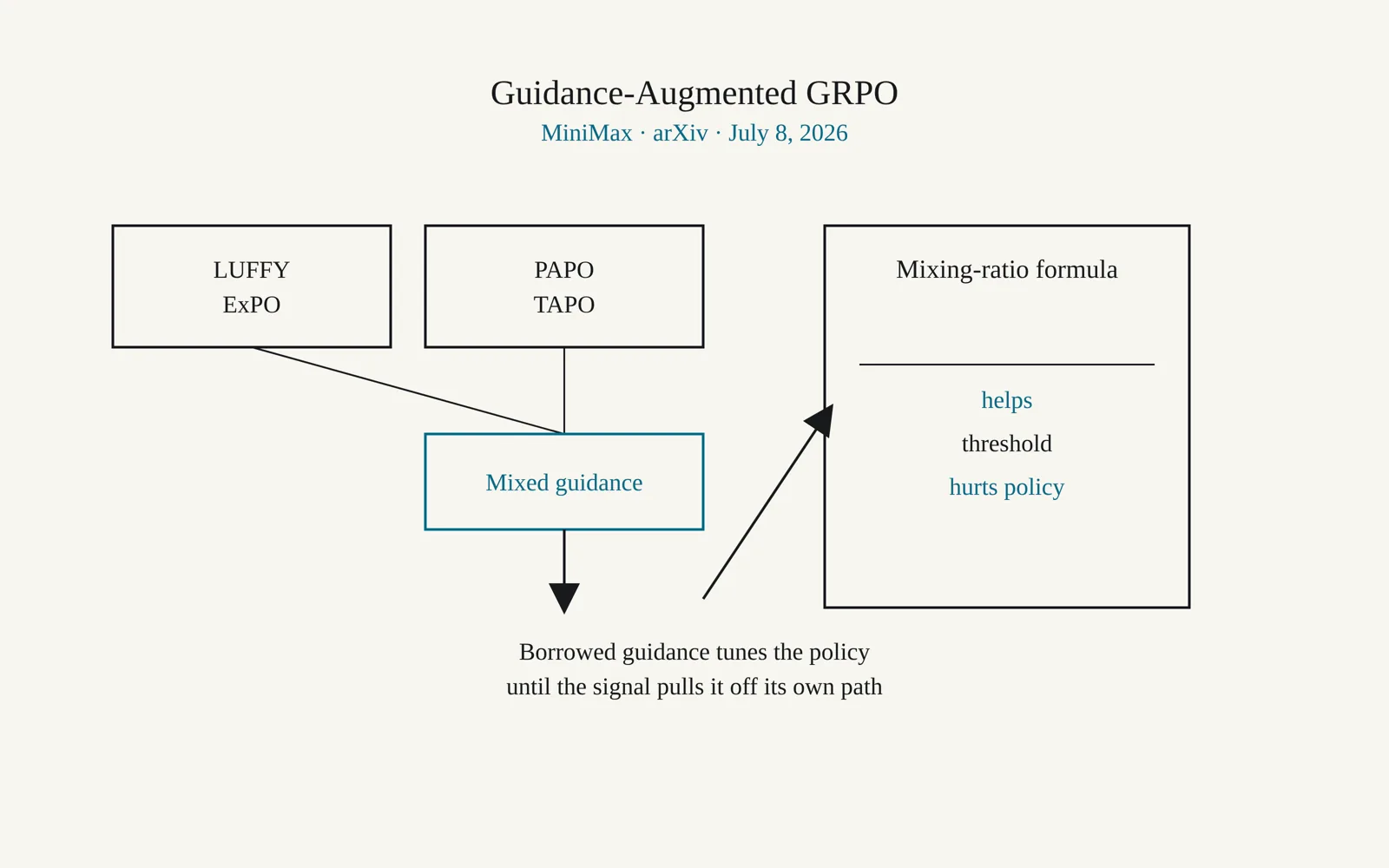
Open the photograph at full size
Photograph: Diagram: AI Journey
Read the full description of this diagram
Diagram drawn for this item: Researchers Publish Bias-Variance Theory For Guided Reasoning Training. On July 8, 2026, researchers posted a paper to arXiv proposing Guidance-Augmented GRPO, a theoretical framework that treats external guidance used in reasoning training, such as expert traces or retrieved thought patterns, as a stochastic... For a team deciding whether to add expert traces or retrieved patterns to a reasoning run, this work turns a choice that used to rest on trial and error into a weighting formula tied to a measurable divergence term, which changes how much...
What it means for you
For a team deciding whether to add expert traces or retrieved patterns to a reasoning run, this work turns a choice that used to rest on trial and error into a weighting formula tied to a measurable divergence term, which changes how much compute budget a lab like MiniMax needs to spend testing guidance strength before settling on a production recipe.
In more detail
Reinforcement learning with verifiable rewards has become the standard way to train large language models to reason step by step, and a cluster of recent methods, named in the paper as LUFFY, ExPO, PAPO and TAPO, add external guidance to that process in the form of expert traces, model-written self-explanations, or retrieved thought patterns. Each of those methods reports gains on benchmarks, but none of them, according to the paper, has offered a convergence rate, a bias bound, or a rule for how heavily to weight the guidance signal against the model’s own exploration.
The paper answers that gap with a framework called Guidance-Augmented GRPO. It models external guidance as a stochastic operator that rewrites the distribution of training questions, then treats the resulting policy-gradient estimator as biased, with the bias bounded by a measure of how far the guidance-augmented sampling distribution sits from the policy’s own distribution. Under stated smoothness and bounded-divergence assumptions, the authors derive a closed-form rule for the mathematically optimal guidance weight and a matching lower bound showing that a bias term tied to that divergence cannot be removed by any choice of weighting.
The authors tested the framework on the Qwen2.5-Math-7B-Base model across nine math and out-of-distribution benchmarks. They report that the optimal-weight version of GA-GRPO matched or beat TAPO, LUFFY, ExPO and vanilla GRPO, while cutting GPU-hours, and that eight further analysis experiments supported the theoretical predictions.
The numbers
The two figures carried over from the paper are a 31% cut in GPU-hours for the optimal-weight setup against the compared methods, and the 7B parameter size of the base model used throughout the benchmark suite. Both are the paper’s own figures, not a derived comparison, and neither appears anywhere else in public reporting yet.
The result matters beyond the lab that wrote it. Any team running RLVR style training, including vendors priced by the token such as MiniMax, currently tunes guidance strength by running several variants and comparing scores, which burns compute on every search. A closed-form weighting rule, if it holds up outside this one model and benchmark set, would let a training team set the guidance weight from a measured divergence number instead of a grid search, trading engineering time for a formula. Whether that generalises past a single 7B math model is the open question the paper itself does not settle.
Sources
Sources read
arXiv preprint 2610.06861, submitted July 8, 2026 (arxiv.org)
Paper read
Cite this
AI Journey, "Researchers Publish Bias-Variance Theory For Guided Reasoning Training", 7 Oct 2026, https://aijourney.space/updates/2026-10-07-when-does-external-guidance-help-llm-reasoning-a-bias-variance-theory-of/ (source: arXiv, verified 7 Oct 2026)
Next in the stream
Paper Proposes Reversible Tokenizer That Cuts Vocabulary Bloat
A new arXiv paper details a reversible subword tokenizer that could interest search tools like Perplexity, which parses messy web text into answers.
Previous
Small Nepali Legal Language Model NepLEGiT Trained From Scratch on Legal Corpus
Researchers built NepLEGiT, a compact Nepali legal language model, a project relevant to how Perplexity and other answer engines might one day serve underserved languages.
Next
More in MiniMax
Paper Splits Conformal Reliability From Frequency Calibration After a Break
A Columbia University paper on arXiv separates two audits of conformal prediction, a method relevant to pay-per-token vendors such as MiniMax.
Paper Proposes Sparse Priors To Cut Sample Needs In Distribution Learning
A new arXiv paper argues that sparse priors can sharply lower the number of samples needed to learn a distribution, a bound relevant to model vendors such as MiniMax.